 NL·0662
Herbarium of the Nature Library
- Name
- Lithobates sylvaticus
- Family
- Ranidae
- Native to
- Alaska and Canada to the Arctic treeline, south to the Appalachians and northeastern US
- Habitat
- Boreal forest, Temperate deciduous forest, Tundra edge, Vernal pools
Wood frog
Lithobates sylvaticus
Also calledGrenouille des bois (Québec French) · Rana de bosque (Spanish)
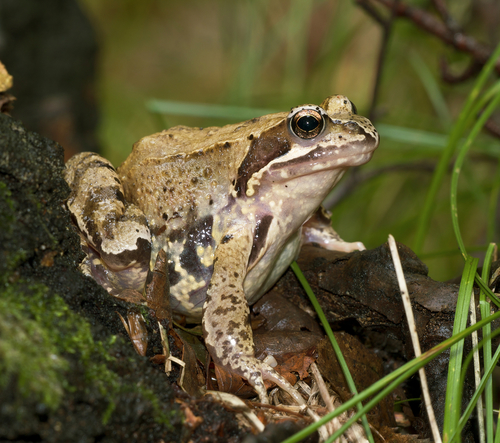
A brown, masked frog of northern forests that freezes solid in winter. Its heart stops and much of its body water turns to ice, and it thaws back to life in spring. It ranges farther north than any other North American amphibian, beyond the Arctic Circle.
Lithobates sylvaticus or Rana sylvatica, commonly known as the wood frog, is a frog species that has a broad distribution over North America, extending from the boreal forest of the north to the southern Appalachians, with several notable disjunct populations including lowland eastern North Carolina. The wood frog has garnered attention from biologists because of its freeze tolerance, relatively great degree of terrestrialism, interesting habitat associations, and relatively long-range movements. It is the only North American frog that occurs north of the Arctic Circle. Wikipedia
What it can do
- iSurvives being frozen, with up to about two-thirds of its body water turned to ice
- iiFloods its cells with glucose and urea, which act as antifreeze
- iiiAlaskan wood frogs survive temperatures as low as −16 °C
- ivBreeds in temporary pools free of fish
In the field
Field marks
- aBrown, tan or rust frog with a dark mask through the eye
- bWhite line along the upper lip
- cRidges (dorsolateral folds) running down the back
- dOften a pale stripe down the middle of the back
- Voice
- A chorus of short, rasping clucks, like quacking ducks
- Not to be confused with
- Leopard frogs (L. pipiens) are green or brown with large dark spots. Pickerel frogs have squarish spots. The spring peeper is tiny with an X on its back. The wood frog's dark mask is distinctive.
- Where to see it
- Vernal pools in New England, the Great Lakes region, Ontario, Quebec, Alaska; listen in early spring
- When
- Breeds March–May (as soon as ice melts); hibernates frozen in leaf litter in winter
Listen
Looking for field recordings…
Life & habits
- Diet
- Insects, spiders, slugs, snails and worms
- Habitat
- Moist woodland, breeding in vernal pools and ponds
- Size
- ~3.5–7.5 cm
- Lifespan
- ~3 years
In early spring, sometimes while ice still covers part of the pond, wood frogs gather for a breeding frenzy that lasts only a few days, laying large egg masses together.
Where it lives
Recorded sightings
—
geo-referenced records in GBIF, from museums, herbaria and field observers.
Native range
Alaska and Canada to the Arctic treeline, south to the Appalachians and northeastern US
Drag the globe to turn it. Dots are where records exist, not a range map; darker means more records.
In the stacks
Searching the stacks…
Every page naming Lithobates sylvaticus in the Biodiversity Heritage Library →
Marginalia
Curiosity
A frozen wood frog shows no heartbeat or breathing. Within hours of thawing its heart starts again.
Kinship




Photographs: iNaturalist contributors under the licences shown. Records: GBIF.org. Historical plates: Source Library (CC BY-SA 4.0; originals public domain). Summary text: Nature Library editors and Wikipedia (CC BY-SA). Medicinal and edibility notes are historical and educational, not advice. iNaturalist taxon 66012.