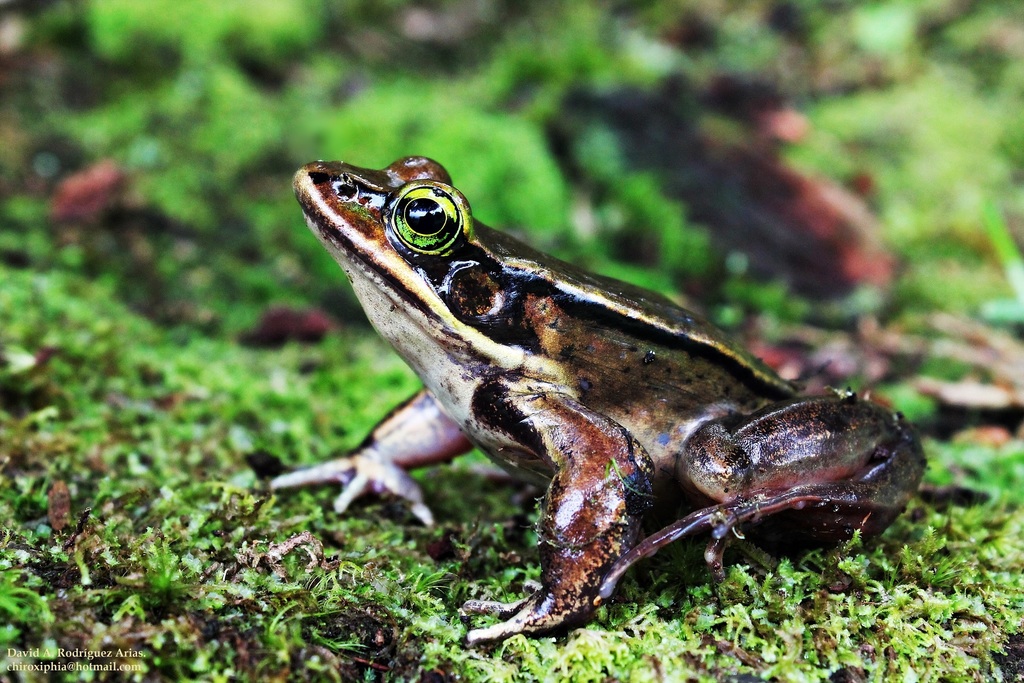
Green-eyed Frog
Lithobates vibicarius
Lithobates vibicarius, commonly known as either green-eyed frog (after its green eyes) or Rancho Redondo frog (after its type locality in Costa Rica), is a species of frog in the Ranidae family from highland rainforests in Costa Rica and western Panama.
From the article Lithobates vibicarius on Wikipedia (CC BY-SA), quoted section by section
Description
Lithobates vibicarius are relatively large frogs, 6–9 cm (2.4–3.5 in) in snout–vent length. Dorsal colouration is variable: golden, greenish, or dull brown; juveniles are usually green. There are at least some darker markings on the dorsum of most individuals. The dorsolateral folds typically have black linings on the outer edges. A black face mask is typical. The upper lip has white lining. The iris is green. Feet are extensively webbed.
Range & habitat
Lithobates vibicarius is a semi-aquatic frog found in lower montane and lower portions of montane rainforest. They prefer dense woods, but may also be found near water in clearings or pastures. Lithobates vibicarius was once very common in Costa Rica, but has almost disappeared; only three populations are known at present. Surveys in Panama have failed to find the species. This decline is believed to be mainly due to the disease chytridiomycosis, although habitat loss and agricultural chemicals may also have played a role. The IUCN now lists it as endangered.
== References ==
Wikipedia: “Habitat and conservation”
What it does
Breeding may occur throughout the year but is concentrated to the early parts of the rainy season. Calling and mating take place at night. Males generally call from vegetation in water. The call is a low, harsh trill. Eggs are laid in large, round gelatinous masses in shallow bodies of water, attached to the vegetation.
Wikipedia: “Reproduction”
Listen
Looking for field recordings…
Where it lives
Recorded sightings
—
geo-referenced records in GBIF, from museums, herbaria and field observers.
Drag the globe to turn it. Dots are where records exist, not a range map; darker means more records.
In the stacks
Searching the stacks…
Every page naming Lithobates vibicarius in the Biodiversity Heritage Library →
This page is assembled live from iNaturalist, GBIF, Wikipedia, the Source Library and the Internet Archive. It is not yet part of the hand-edited codex. iNaturalist taxon 66017.