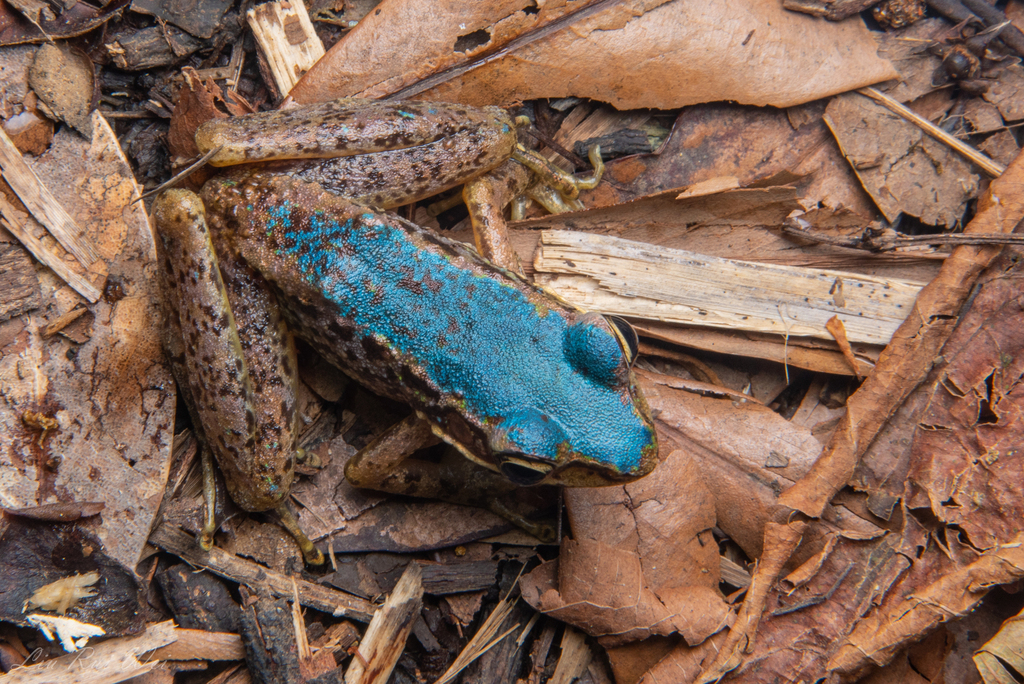
Swinhoe's frog
Odorrana swinhoana
Odorrana swinhoana is a species of frog in the family Ranidae. It is endemic to Taiwan and widely distributed in hilly areas below 2,000 m (6,600 ft). It is named for Robert Swinhoe, a British naturalist and diplomat. Its common names include Swinhoe's brown frog, Bangkimtsing frog, brown-backed odorous frog, Taiwan odorous frog, and Taiwan sucker frog.
From the article Odorrana swinhoana on Wikipedia (CC BY-SA), quoted section by section
Description
Odorrana swinhoana are medium to large-sized frogs, reaching a maximum snout-vent length of 12 cm (4.7 in). They can live up to 11 years. Sizes vary by location; males from a low-lying location measured on average 58 and 73 mm (2.3 and 2.9 in) in snout–vent length, respectively, and from a highland location 73 and 85 mm (2.9 and 3.3 in), respectively. The dorsum is bright green and the flanks are brown or green, broken up by white or dark mottling. The dorsal skin is finely pebbled. The venter is white. The finger tips bear well developed discs. The toes have well-developed webbing. The tadpoles are adapted to running water and have a ventral sucking disc. The back is green.
Range & habitat
Odorrana swinhoana occur in hill streams in broadleaf forests. They forage on both terrestrial and aquatic prey, primarily on insects and arachnids, but also gastropods, crustaceans, and chilopods. Breeding takes place in small mountainous, shady, rocky creeks. Males call day and night, usually hidden in crevices among the rocks. The eggs are attached to rocks under the water. It is a common species that is not facing serious threats, although agriculture and infrastructure development represent some threats. It is present in a number of protected areas.
== References ==
Wikipedia: “Habitat and conservation”
Listen
Looking for field recordings…
Where it lives
Recorded sightings
—
geo-referenced records in GBIF, from museums, herbaria and field observers.
Drag the globe to turn it. Dots are where records exist, not a range map; darker means more records.
In the stacks
Searching the stacks…
Every page naming Odorrana swinhoana in the Biodiversity Heritage Library →
This page is assembled live from iNaturalist, GBIF, Wikipedia, the Source Library and the Internet Archive. It is not yet part of the hand-edited codex. iNaturalist taxon 66264.