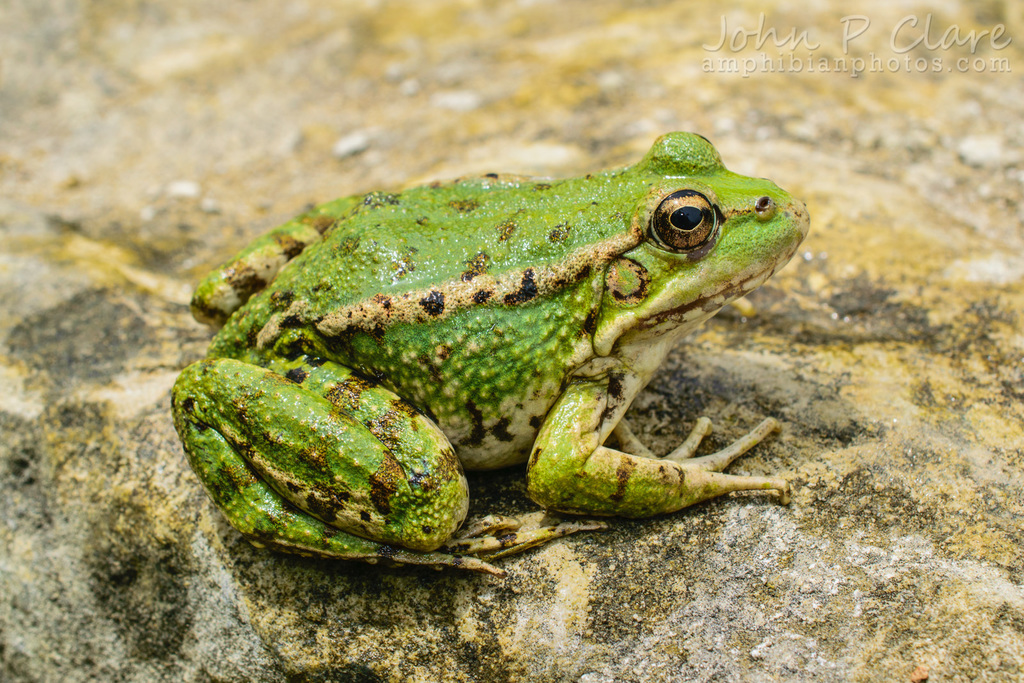
Cretan Frog
Pelophylax cretensis
The Cretan frog (Pelophylax cretensis) is an endangered species of frog in the family Ranidae. It is endemic to the Greek island of Crete.
From the article Cretan frog on Wikipedia (CC BY-SA), quoted section by section
Description
It is a medium-sized frog reaching up to 8 cm in length and with a weight of 40 g. The Cretan frog is generally light grey to brown and mottled with brown or olive-grey spots on its back, while the throat and underside of the body are whitish-grey. Occasionally, the upperparts of the Cretan frog may be grass-green with distinct brown spots. The insides of the hind legs are yellow, and the sides of the body may also have yellowish colouration. This species has a prominent dark brown fold of skin down the back. Its skin is smooth and slightly glossy. Males may feature prominent vocal sacs on their throats, especially during breeding season. Its long, muscular hind legs, common to frogs, are a key aspect of their agile swimming and jumping abilities.
Range & habitat
It is endemic to the Greek island of Crete, where it is patchily distributed over a wide area. It inhabits altitudes of up to 920 meters (with one unconfirmed record at 1,330 meters above sea level). All of its distribution range lies within the Crete Mediterranean forests ecoregion.
Its natural habitats are Mediterranean-type shrubby vegetation, rivers, intermittent rivers, swamps, freshwater lakes, intermittent freshwater lakes, freshwater marshes, intermittent freshwater marshes, and plantations.
Wikipedia: “Habitat and distribution”
What it does
It is a generally diurnal, shy frog that usually basks out of water and will jump into the water when it feels threatened. Nocturnal behaviors have also been reported, with individuals in some areas being predominantly active after sunset. It is typically solitary in nature and communicates via a sequence of distinct calls. Its lifespan is six to eight years in the wild.
Reproduction. It mates in spring and females lay their eggs in the water in clusters of a few hundred. Every female frog can lay up to 5000 eggs and they hatch after about a week, depending on water temperature. During breeding season, males develop prominent vocal sacs on their throats and they aggressively defend their territories, employing a variety of strategical calling and physical confrontation.
Diet. Cretan frogs predominantly consume invertebrates, with a food preference leaning towards aquatic insects, snails, and small crustaceans. They are opportunistic feeders, eying for readily available prey.
Wikipedia: “Behavior”
Listen
Looking for field recordings…
Where it lives
Recorded sightings
—
geo-referenced records in GBIF, from museums, herbaria and field observers.
Drag the globe to turn it. Dots are where records exist, not a range map; darker means more records.
In the stacks
Searching the stacks…
Every page naming Pelophylax cretensis in the Biodiversity Heritage Library →
This page is assembled live from iNaturalist, GBIF, Wikipedia, the Source Library and the Internet Archive. It is not yet part of the hand-edited codex. iNaturalist taxon 66319.