On eBird ↗
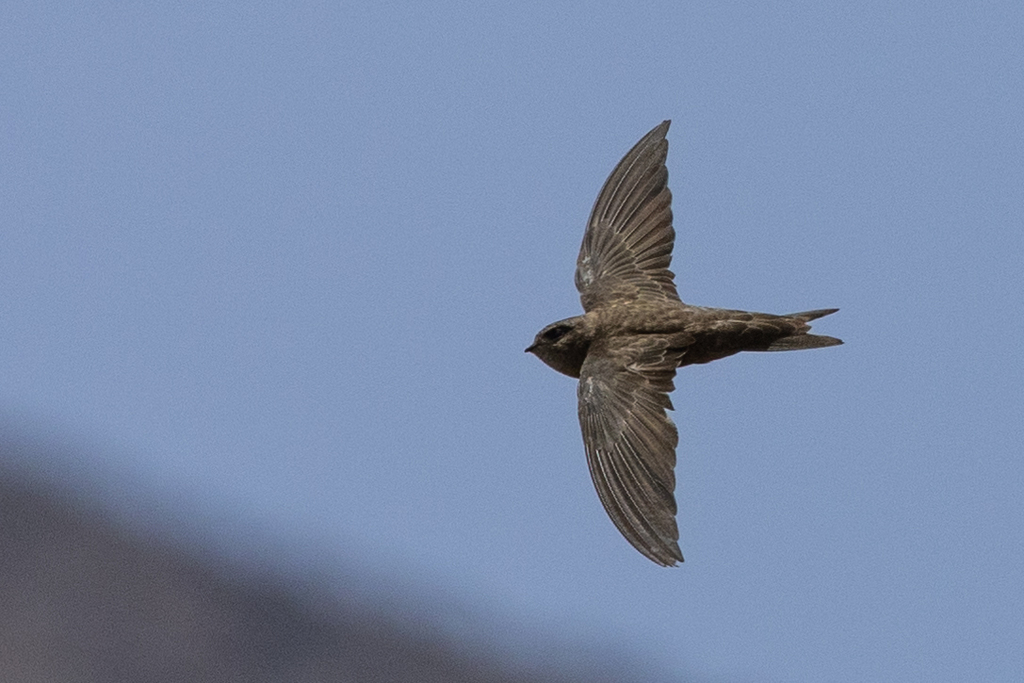
Cape Verde Swift
Live sightings near you, the range map, bar charts of when it is seen, and Macaulay Library photos and recordings.
Cape Verde swift
Apus alexandri
The Cape Verde swift or Alexander's swift (Apus alexandri) is a small bird of the swift family found only in the Cape Verde Islands. It has been recorded from all the islands except Santa Luzia although it probably breeds only on Santiago, Fogo, Brava, Santo Antão and São Nicolau. It is generally common with a stable population and is not considered to be threatened. The name Alexander's swift commemorates Boyd Alexander, an English ornithologist who led two expeditions to the islands in 1897.
From the article Cape Verde swift on Wikipedia (CC BY-SA), quoted section by section
Description
It is 13 cm long with a wingspan of 34 to 35 cm. The plumage is dark grey-brown with a large pale throat patch. Compared to other swifts recorded from the islands it is smaller with shorter wings and a shallower fork to the tail. Its flight action is weaker and more fluttering. It has a high-pitched, screaming call with a buzzing quality.
What it does
The Cape Verde swift feeds on insects that it catches while flying. It can be seen flying over all habitats and hunts in flight for insects, foraging in flocks over gullies and along cliffs and shorelines. The nest is built in a crevice in a cliff, in a cave, or on the roof of a building. It is saucer-shaped and made of grass and feathers. The eggs are white and a clutch size of two has been reported. The bird is thought to be resident rather than migratory.
Wikipedia: “Ecology”
Listen
Looking for field recordings…
Where it lives
Recorded sightings
—
geo-referenced records in GBIF, from museums, herbaria and field observers.
Drag the globe to turn it. Dots are where records exist, not a range map; darker means more records.
In the stacks
Searching the stacks…
Every page naming Apus alexandri in the Biodiversity Heritage Library →
This page is assembled live from iNaturalist, GBIF, Wikipedia, the Source Library and the Internet Archive. It is not yet part of the hand-edited codex. iNaturalist taxon 6641.