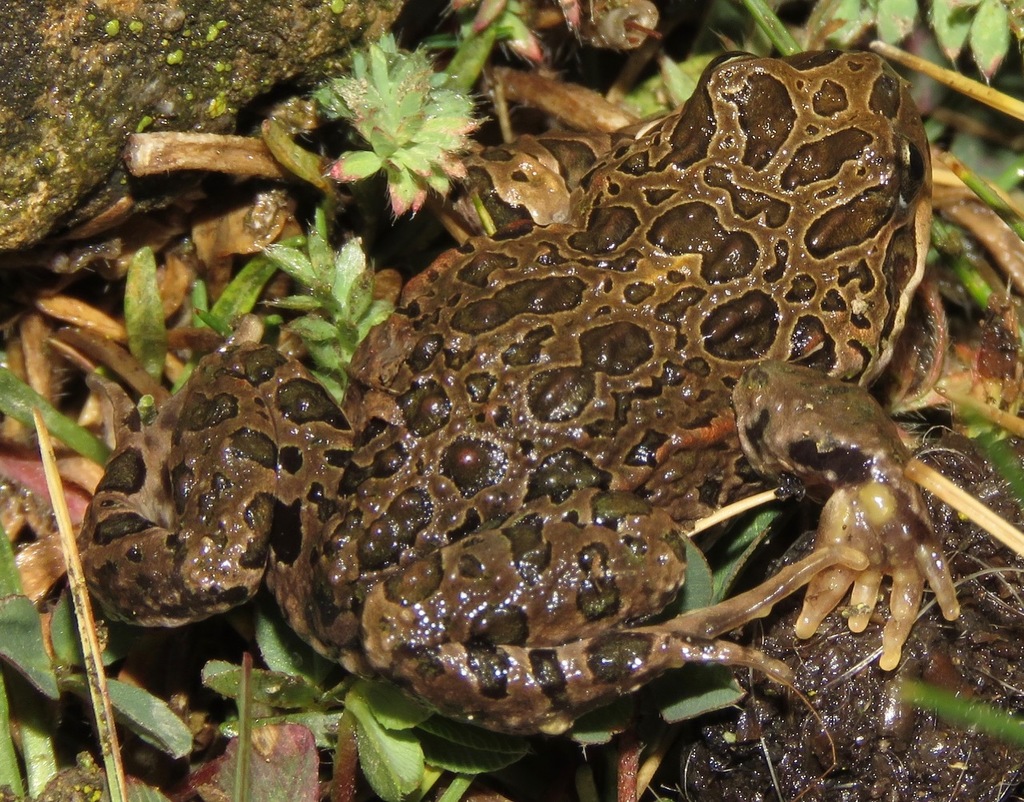
Marbled Four-eyed Frog
Pleurodema marmoratum
Pleurodema marmoratum is a species of frog in the family Leptodactylidae. It is found in Argentina, Bolivia, Chile, and Peru. Its natural habitats are subtropical or tropical high-altitude shrubland, subtropical or tropical high-altitude grassland, rivers, swamps, freshwater marshes, intermittent freshwater marshes, arable land, pastureland, and irrigated land.
From the article Pleurodema marmoratum on Wikipedia (CC BY-SA), quoted section by section
Range & habitat
This frog is terrestrial. The natural habitats of Pleurodema marmoratum are subtropical or tropical high-altitude shrubland, subtropical or tropical high-altitude grassland, rivers, swamps, freshwater marshes, intermittent freshwater marshes, arable land, pastureland, and irrigated land, at altitudes of 3,000–5,200 m (9,800–17,100 ft). Scientists have reported the frog in several protected places: Área Natural de Manejo Integrado Apolobamba, Reserva Nacional de Fauna Andina Eduardo Avaroa, Parque Nacional y Área Natural de Manejo Integrado Cotapata, Parque Nacionale Carrasco, Parque Nacionale Sajama, Reserva Nacional Salinas y Aguada Blanca, Reserva Nacional Pampa Galeras, Área de Conservación Regional Bosque de Puya Raimondi Titankayocc, Santuario Histórico de la Pampa de Ayacucho, Reserva de la Biósfera Laguna de Pozuelos, Parque Nacional Lauca, and Parque Nacional Isluga.
Wikipedia: “Habitat”
What it does
The adult male frog measures 27.9 mm in snout-vent length and the adult female frog 31.8 mm. The skin of the dorusm is tan and can have darker brown marks. The male frog's testes are very large for its body size and can take up one third of the body cavity.
Wikipedia: “Reproduction”
Toxicity
The IUCN classifies this frog as vulnerable of dying out. Threats include climate change and habitat loss. People set fires to convert the area to livestock pasturage. Scientists have found the fungus Batrachochytrium dendrobatidis on some of the frogs, but they have not confirmed whether chytridiomycosis kills the frog.
== References ==
Wikipedia: “Danger”
Listen
Looking for field recordings…
Where it lives
Recorded sightings
—
geo-referenced records in GBIF, from museums, herbaria and field observers.
Drag the globe to turn it. Dots are where records exist, not a range map; darker means more records.
In the stacks
Searching the stacks…
Every page naming Pleurodema marmoratum in the Biodiversity Heritage Library →
This page is assembled live from iNaturalist, GBIF, Wikipedia, the Source Library and the Internet Archive. It is not yet part of the hand-edited codex. iNaturalist taxon 66513.