On eBird ↗
Great Dusky Swift
Live sightings near you, the range map, bar charts of when it is seen, and Macaulay Library photos and recordings.
Great Dusky Swift
Cypseloides senex
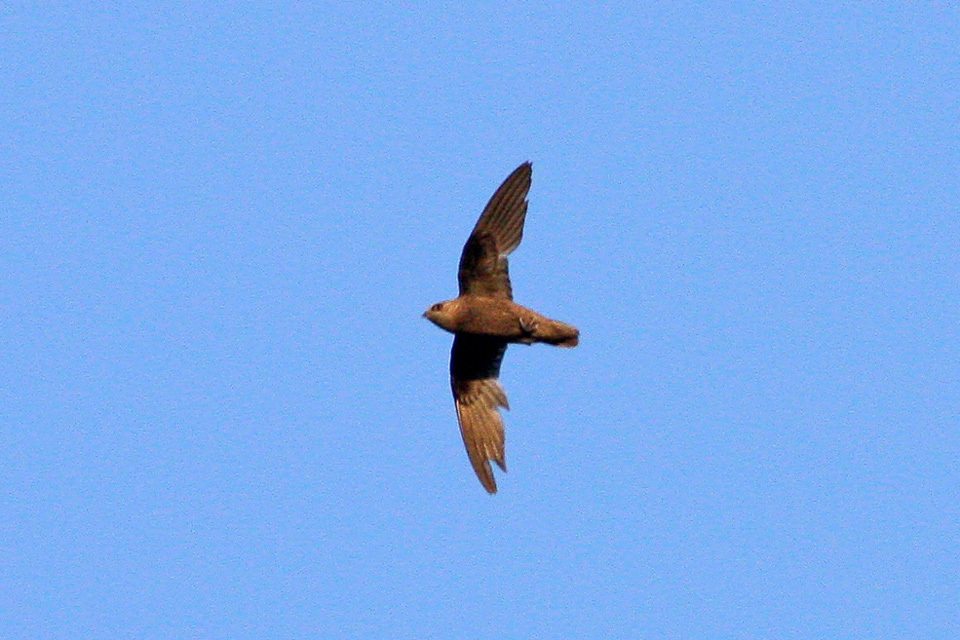
The great dusky swift (Cypseloides senex) is a South American species of swift in the family Apodidae. At 18 cm in length, it is large relative to other swifts, and dark brown in colour with a pale coloured head.
From the article Great dusky swift on Wikipedia (CC BY-SA), quoted section by section
Description
The great dusky swift is the largest member of genus Cypseloides. It is 18 cm (7.1 in) long and weighs 56 to 110 g (2.0 to 3.9 oz). The sexes have the same plumage. Adults have a chocolate brown crown and throat with pale gray edges to the feathers, giving a frosted appearance to the face. Their back is a darker brown, their rump a brown intermediate between the head and back, and their tail blackish brown. Their undersides are a paler brown than the back. The upper side of the wing is mostly brown and the underside somewhat lighter. Juveniles are very similar to adults with the addition on pale fringes to the wing feathers.
Range & habitat
The great dusky swift is found in Brazil from southern Pará and much of Mato Grosso east into Bahia and south to Rio Grande do Sul, in eastern Paraguay, and in northeastern Argentina's Misiones Province. Undocumented sight records in Bolivia lead the South American Classification Committee of the American Ornithological Society to treat it as hypothetical in that country. Its principal habitats are tropical evergreen forest, temperate forest, and second-growth scrublands. The species roosts around waterfalls and is known for flying through the Iguazu Falls on the border of Brazil and Argentina.
Wikipedia: “Distribution and habitat”
What it does
Like all swifts, the great dusky is an aerial insectivore. Its diet is not known in detail but includes insects of at least five families. It often feeds in flocks that sometimes include white-collared swifts (Streptoprocne zonaris).
Wikipedia: “Feeding”
Listen
Looking for field recordings…
Where it lives
Recorded sightings
—
geo-referenced records in GBIF, from museums, herbaria and field observers.
Drag the globe to turn it. Dots are where records exist, not a range map; darker means more records.
In the stacks
Searching the stacks…
Every page naming Cypseloides senex in the Biodiversity Heritage Library →
This page is assembled live from iNaturalist, GBIF, Wikipedia, the Source Library and the Internet Archive. It is not yet part of the hand-edited codex. iNaturalist taxon 6666.