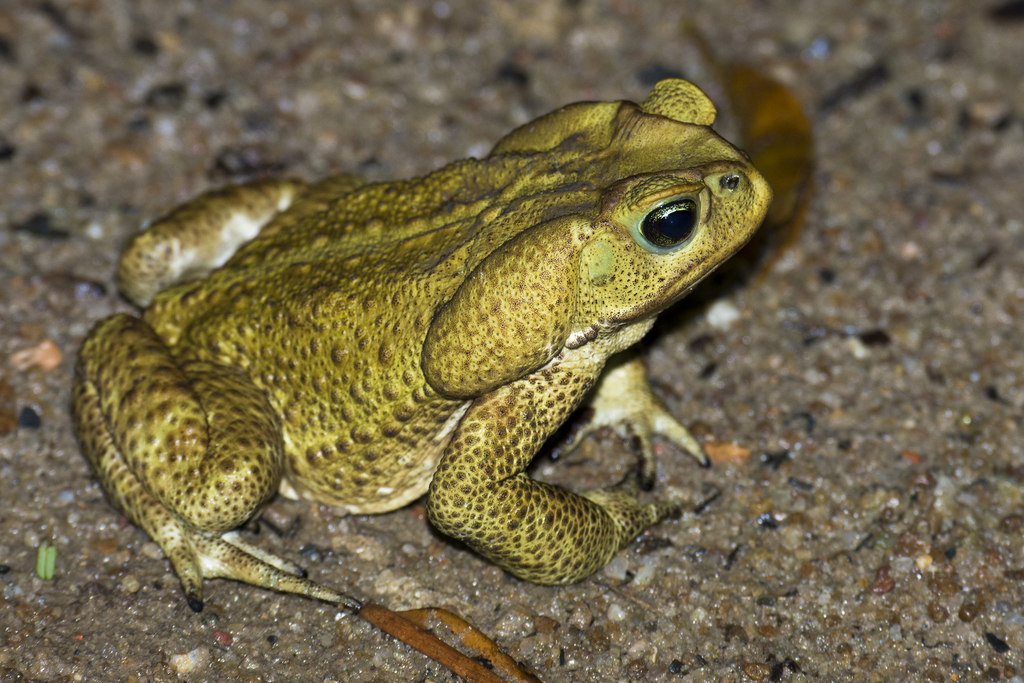
Yellow Cururu Toad
Rhinella icterica
Rhinella icterica (common name: yellow cururu toad) is a species of toad in the family Bufonidae that is found in northeastern Argentina (Misiones Province), southern Brazil, and eastern Paraguay. "Cururu" is its indigenous name and refers to the male advertisement call that is a melodious tremolo. "Cururu toad", without the specifier "yellow", is a common name used for a few other closely related species.
From the article Rhinella icterica on Wikipedia (CC BY-SA), quoted section by section
Description
Rhinella icterica is relatively large, stout-bodied toads. Males measure 100–166 mm (3.9–6.5 in) and females 135–190 mm (5.3–7.5 in) in snout–vent length. The parotoid glands are strong, as are the cephalic crests. The dorsum is yellowish in females and juveniles, with a light midline stripe and a regular pattern of black blotches; in the males the colouration is often a bright greenish yellow, with only a few black blotches. The belly is white and marbled with brown. The skin is scattered with blunt, thorny warts, especially in the males. Rhinella icterica is the most common toad species found in southeastern Brazil and preys on the yellow scorpion (Tityus serrulatus). It has been observed that Rhinella icterica possess the ability to eat scorpions without adverse effects on the toad. This may be due to Rhinella icterica toxic secretion (RITS) that ultimately acts as a concentration independent irreversible neuromuscular blockade. In the presence of the acetylcholinesterase enzyme there was inhibition of Rhinella icterica toxic secretion. Additionally, RITS acts as an inhibitor on the cardiac Na+, K+-ATPase pump. Scientists have concluded that the toxic secretion from the toad acts as an inhibitor of calcium pumps in the heart causing a twitching action, AChE, and Na+, K+-ATPase pump. This toad species has been found to possess a defense mechanism against predators. …
Range & habitat
Rhinella icterica is found in the Atlantic Forest, spanning southeastern and southern Brazil, eastern Paraguay, and in the Misiones and Corrientes provinces of Argentina. When it is time for them to reproduce, thus species is found mainly in streams or ponds in large congregations. They get their food from hanging matter and submerged plants. This common toad occurs in a large range of habitats, from forests to open habitats such as Cerrado savanna, and including disturbed habitats. Breeding takes place from August to January in permanent and temporary ponds and streams. It is an adaptable species that also occurs in many protected areas, and is not considered threatened. Initially, these toads remained in the forested and less urbanized areas of Brazil. However, due to more recent deforestation and the building of new roads, there has been a decrease in the ability of toads to access water which is necessary for their breeding. Because of this, the population of Rhinella icterica is gradually decreasing, causing an increase in the number of scorpions found in this area.
== References ==
Wikipedia: “Habitat and conservation”
Listen
Looking for field recordings…
Where it lives
Recorded sightings
—
geo-referenced records in GBIF, from museums, herbaria and field observers.
Drag the globe to turn it. Dots are where records exist, not a range map; darker means more records.
In the stacks
Searching the stacks…
Every page naming Rhinella icterica in the Biodiversity Heritage Library →
This page is assembled live from iNaturalist, GBIF, Wikipedia, the Source Library and the Internet Archive. It is not yet part of the hand-edited codex. iNaturalist taxon 67117.