On eBird ↗
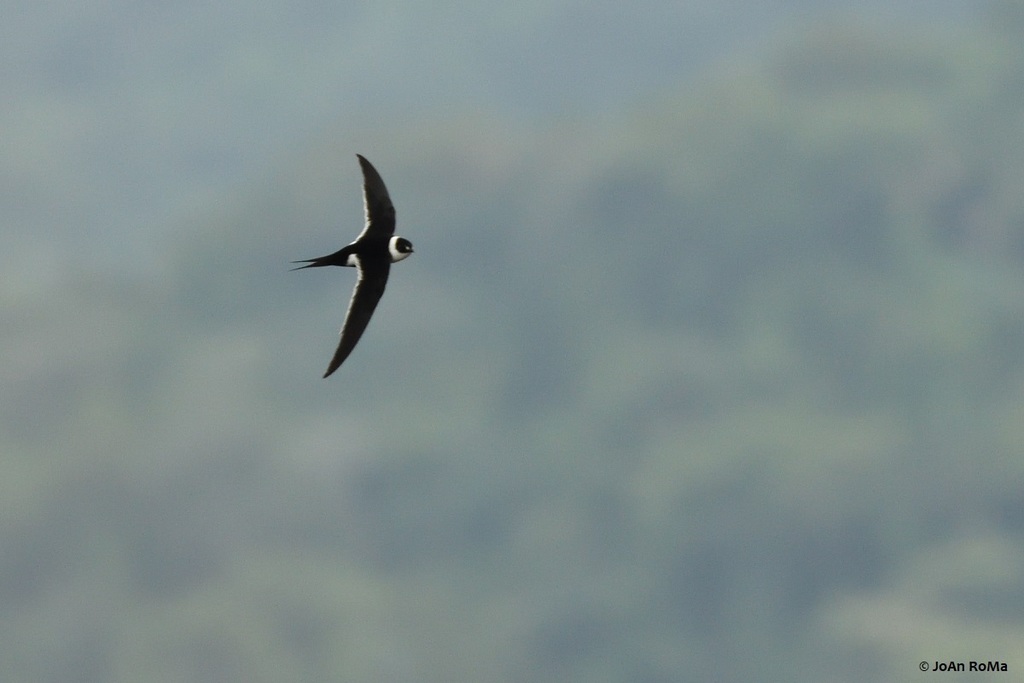
Great Swallow-tailed Swift
Live sightings near you, the range map, bar charts of when it is seen, and Macaulay Library photos and recordings.
Great Swallow-tailed Swift
Panyptila sanctihieronymi
The great swallow-tailed swift (Panyptila sanctihieronymi) is a species of swift in the family Apodidae. It is found in Costa Rica, Guatemala, Honduras, Mexico, and Nicaragua. Its natural habitats are subtropical or tropical moist montane forests, subtropical or tropical high-altitude shrubland, and heavily degraded former forest.
From the article Great swallow-tailed swift on Wikipedia (CC BY-SA), quoted section by section
Description
The great swallow-tailed swift is 18 to 20.5 cm (7.1 to 8.1 in) long and weighs about 48 g (1.7 oz). It has long narrow wings and a long deeply forked tail. The sexes are alike. Adults have a black crown and upper face with two white spots on the forehead. Most of their body is bluish black. Their lower face, throat, collar, upper chest, and flanks are white. Their flight feathers have grayish ends and white tips.
Range & habitat
The great swallow-tailed swift is found from Nayarit in western Mexico south through Guatemala and Honduras into northern Nicaragua. There are also a few records in Costa Rica. It generally inhabits arid to semi-arid highland landscapes characterized by canyons and large cliffs. In elevation it typically ranges between 1,000 and 2,000 m (3,300 and 6,600 ft) but sometimes wanders to humid areas as low as 600 m (2,000 ft).
Wikipedia: “Distribution and habitat”
What it does
Like all swifts, the great swallow-tailed swift is an aerial insectivore. It usually forages alone or in small flocks of its species. Details of its diet are lacking.
Wikipedia: “Feeding”
Listen
Looking for field recordings…
Where it lives
Recorded sightings
—
geo-referenced records in GBIF, from museums, herbaria and field observers.
Drag the globe to turn it. Dots are where records exist, not a range map; darker means more records.
In the stacks
Searching the stacks…
Every page naming Panyptila sanctihieronymi in the Biodiversity Heritage Library →
This page is assembled live from iNaturalist, GBIF, Wikipedia, the Source Library and the Internet Archive. It is not yet part of the hand-edited codex. iNaturalist taxon 6808.