- Animals
- ›Chordates
- ›Vertebrates
- ›Birds
- ›Parrots
- ›Old World Parrots
- ›Long-tailed Parrots and allies
- ›Psittacula
On eBird ↗
Plum-headed Parakeet
Live sightings near you, the range map, bar charts of when it is seen, and Macaulay Library photos and recordings.
Plum-headed Parakeet
Psittacula cyanocephala
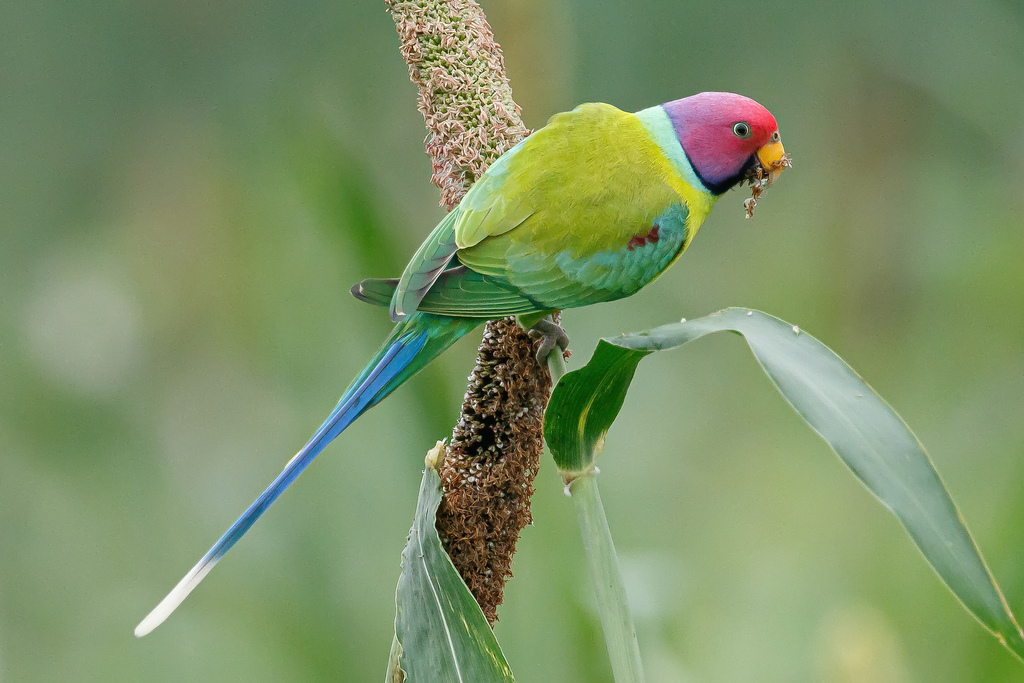
The plum-headed parakeet (Psittacula cyanocephala) is a species of parakeet in the family Psittacidae. It is endemic to the Indian subcontinent and was once thought to be conspecific with the blossom-headed parakeet (P. roseata) before being elevated to a full species. Plum-headed parakeets are found in flocks, the males having a pinkish purple head and the females, a grey head. They fly swiftly with twists and turns accompanied by their distinctive calls.
From the article Plum-headed parakeet on Wikipedia (CC BY-SA), quoted section by section
Description
The plum-headed parakeet is a mainly green parrot, 33–37 cm (13–15 in) long with a weight of 55–85 g (1.9–3.0 oz). Its tail has a length of up to 22 cm (8.7 in). The male has a red head which shades to purple-blue on the back of the crown, nape and cheeks, while the female has a blueish-gray head. There is a narrow black neck collar with verdigris below on the nape and a black chin stripe that extends from the lower mandible. There is a red shoulder patch and the rump and tail are bluish-green, the latter tipped white. The upper mandible is orangish-yellow, and the lower mandible is dark. The female has a dull bluish grey head and lacks the black and verdigris collar, which is replaced by yellow. The upper-mandible is corn-yellow and there is no black chin stripe or red shoulder patch. Immature birds have a green head and both mandibles are yellowish. The dark head is acquired after a year. The delicate bluish red appearance resembling the bloom of a peach is produced by a combination of blue from the optical effects produced by the rami of the feather and a red pigment in the barbules. Some authors have considered the species to have two subspecies, the nominate from peninsular India (type locality restricted to Gingee) and the population from the foothills of the Himalayas as bengalensis on the basis of the colour of the head in the male which is more red and less blue. …
Range & habitat
The plum-headed parakeet is a bird of forest and open woodland, even in city gardens. They are found from the foothills of the Himalayas south to Sri Lanka. They are not found in the dry regions of western India. They are sometimes kept as pets and escaped birds have been noted in New York, Florida and in some places in the Middle East.
Wikipedia: “Habitat and distribution”
What it does
The plum-headed parakeet is a gregarious and noisy species with a range of raucous calls. The usual flight and contact call is tuink? repeated now and then. The flight is swift, and the bird often twists and turns rapidly. It makes local movements, driven mainly by the availability of the fruit and blossoms which make up its diet. They feed on grains, fruits, the fleshy petals of flowers (Salmalia, Butea) and sometimes raid agricultural fields and orchards. The breeding season in India is mainly from December to April, and July to August in Sri Lanka. Courtship includes bill rubbing and courtship feeding. It nests in holes, chiselled out by the pair, in tree trunks, and lays 4–6 white eggs. The female appears to be solely responsible for incubation and feeding. They roost communally. In captivity, it can learn to mimic beeps and short whistling tunes, and can talk very well. Neoaulobia psittaculae, a quill mite, has been described from the species. A species of Haemoproteus, H. handai, has been described from blood samples from the plum-headed parakeet.
Wikipedia: “Behaviour and ecology”
In human culture
Ctesias of Cnidus, a 5th-century BC Greek physician to the emperor Artaxerxes II, who ruled the Achaemenid Empire, accompanied Artaxerxes on his 401 BC campaign against his brother Cyrus the Younger. He was author of the lost Indica, a description of India which he wrote based on his experience in Persia and information he gathered from Persian accounts. Fragments of the Indica were preserved by Photius of Constantinople in his Bibliotheca in the 9th century AD; one of these has been identified as describing Psittacula cyanocephala and its abilities as a talking bird. It is likely Ctesias saw the bird himself, with an Indian handler; though his description could also apply to Psittacula roseata, that species is native to areas far further east and is a much less likely candidate in Greater Iran. In his summary of Ctesias, Photius wrote:
Wikipedia: “History”
Listen
Looking for field recordings…
Where it lives
Recorded sightings
—
geo-referenced records in GBIF, from museums, herbaria and field observers.
Drag the globe to turn it. Dots are where records exist, not a range map; darker means more records.
In the stacks
Searching the stacks…
Every page naming Psittacula cyanocephala in the Biodiversity Heritage Library →
This page is assembled live from iNaturalist, GBIF, Wikipedia, the Source Library and the Internet Archive. It is not yet part of the hand-edited codex. iNaturalist taxon 68499.