- Animals
- ›Chordates
- ›Vertebrates
- ›Ray-finned Fishes
- ›Spiny-rayed fishes
- ›Perches, Scorpionfishes, Sticklebacks, and Allies
- ›Sculpins and Allies
- ›Greenlings
- ›Typical Greenlings
- ›Hexagrammos
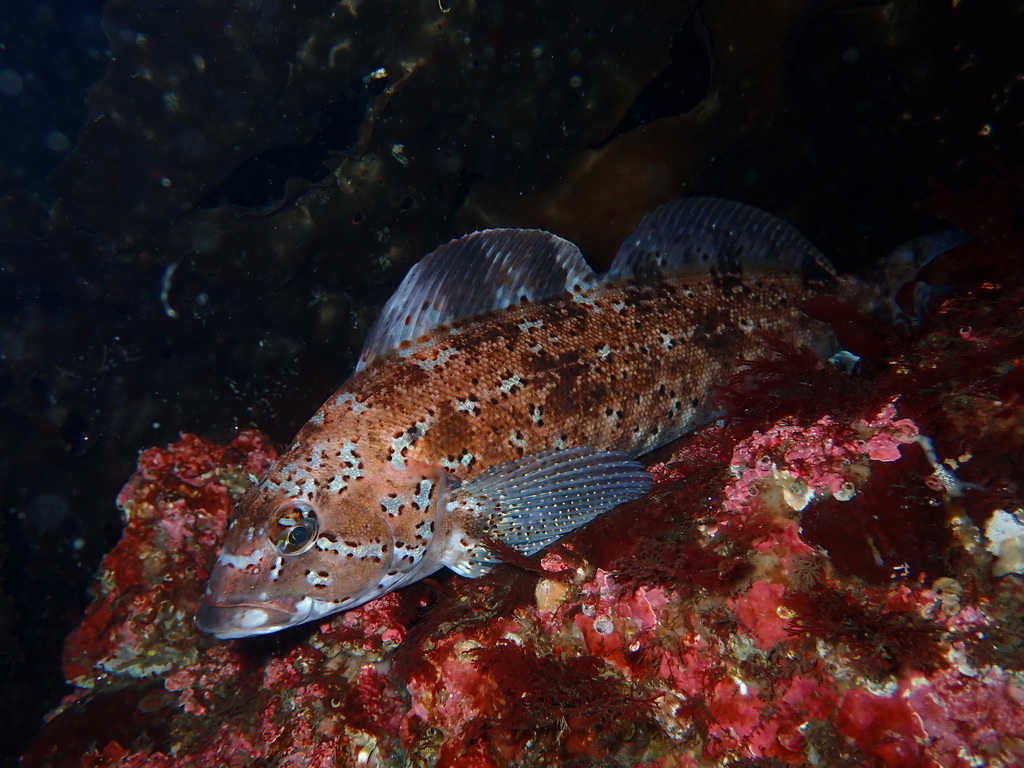
Kelp Greenling
Hexagrammos decagrammus
Hexagrammos decagrammus, the kelp greenling, is a species of greenling that occurs in rocky nearshore areas of the northern Pacific especially around British Columbia and Alaska, and is common on kelp beds and on sand bottoms. They feed on crustaceans, polychaete worms, brittle stars, mollusks, and small fishes. The young are food for large predators such as lingcod and halibut.
From the article Kelp greenling on Wikipedia (CC BY-SA), quoted section by section
Description
Kelp greenlings 21 or 22 spines in their first dorsal fin and 24 soft rays in their second dorsal fin while the anal fin contains a single spine and 23 or 24 soft rays. The males are gray to brownish olive in color, dotted with irregular blue spots over the anterior half to two-thirds of their body. Each of these spots has a ring of small rusty spots around it. The females are also gray to brownish in color but they are marked all over with rust colored or golden spots. They have yellowish orange fins. In both males and females the inside of the oral cavity is yellowish and there is frequently an eye-like spot, an ocellus. at the rear of the second dorsal fin. There are five lateral lines on each flank, as well as a fleshy cirrhi over the eye with another halfway between the eye and the origin of the dorsal fin. This species has a maximum published total length of 61 cm (24 in) and a maximum published weight of 2.1 kg (4.6 lb).
Range & habitat
The kelp greenling is found in the eastern pacific Ocean where its range extends from the Aleutian Islands of Alaska to La Jolla in southern California. This species occurs in rocky nearshore areas of the northern is common on kelp beds and on sand bottoms.
Wikipedia: “Distribution and habitat”
In human culture
The kelp greenling was first formally described in 1810 as Labrax decagrammus by the German naturalist Peter Simon Pallas with its type locality given as Cape St. Elias in Alaska. The specific name, decagrammus, means "ten lines" refers to the 5 lateral line canals on each flank, giving a total of 10.
Wikipedia: “Species description and etymology”
Where it lives
Recorded sightings
—
geo-referenced records in GBIF, from museums, herbaria and field observers.
Drag the globe to turn it. Dots are where records exist, not a range map; darker means more records.
In the stacks
Searching the stacks…
Every page naming Hexagrammos decagrammus in the Biodiversity Heritage Library →
This page is assembled live from iNaturalist, GBIF, Wikipedia, the Source Library and the Internet Archive. It is not yet part of the hand-edited codex. iNaturalist taxon 68596.