On eBird ↗
Papuan Spinetail
Live sightings near you, the range map, bar charts of when it is seen, and Macaulay Library photos and recordings.
Papuan Spinetail
Mearnsia novaeguineae
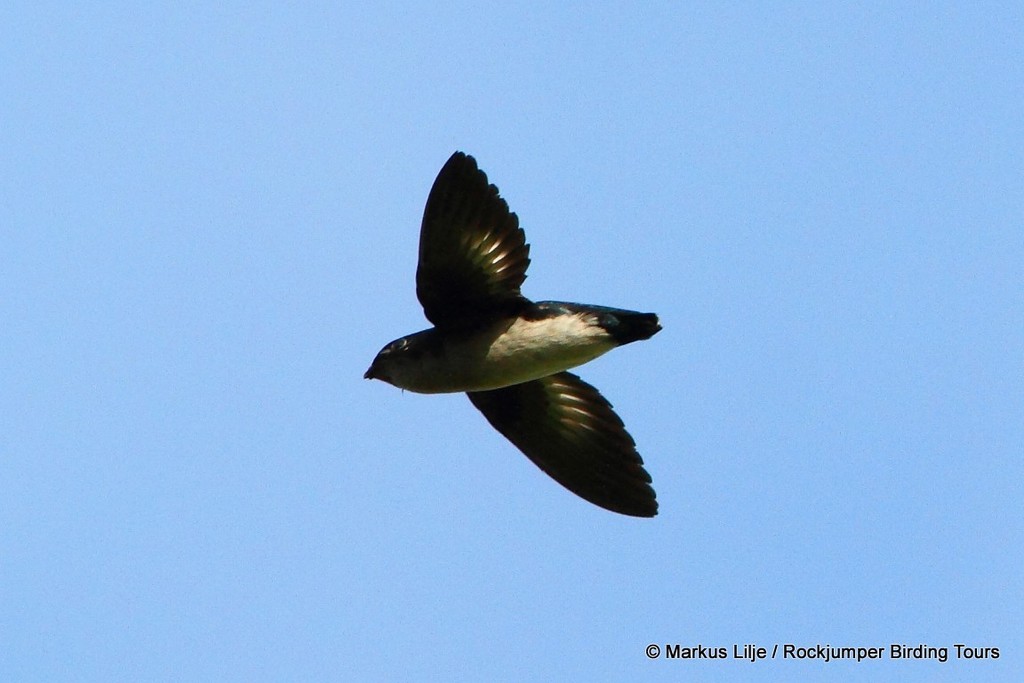
The Papuan spine-tailed swift (Mearnsia novaeguineae), also known as the Papuan needletail, New Guinea spine-tailed swift or Papua spinetail, is a small (11.5 cm in length), stocky swift with a short, rounded tail and very fast flight. Head and upperparts glossy blue-black, white or whitish belly and undertail coverts, dark underwing with pale central stripe. The small spines at the end of the tail are not visible in flight.
From the article Papuan spinetail on Wikipedia (CC BY-SA), quoted section by section
Description
Mearnsia novaeguineae is a small (11.5 cm in length), stocky swift with a short, rounded tail. Tail spines extend up to 1 mm beyond the web of the tail. Head and upperparts glossy green-black, grey-throat with a white underside. Wings display hooked ends, and are widest at the middle before tapering into the body.
Range & habitat
Endemic to New Guinea where it is widespread in the lowlands and hills up to 550 m. In 2004, the species was first recorded in Australia when three individuals were observed on Boigu Island, Queensland.
Wikipedia: “Distribution”
Listen
Looking for field recordings…
Where it lives
Recorded sightings
—
geo-referenced records in GBIF, from museums, herbaria and field observers.
Drag the globe to turn it. Dots are where records exist, not a range map; darker means more records.
In the stacks
Searching the stacks…
Every page naming Mearnsia novaeguineae in the Biodiversity Heritage Library →
This page is assembled live from iNaturalist, GBIF, Wikipedia, the Source Library and the Internet Archive. It is not yet part of the hand-edited codex. iNaturalist taxon 6860.