On eBird ↗
Pygmy Palm Swift
Live sightings near you, the range map, bar charts of when it is seen, and Macaulay Library photos and recordings.
Pygmy Palm Swift
Tachornis furcata
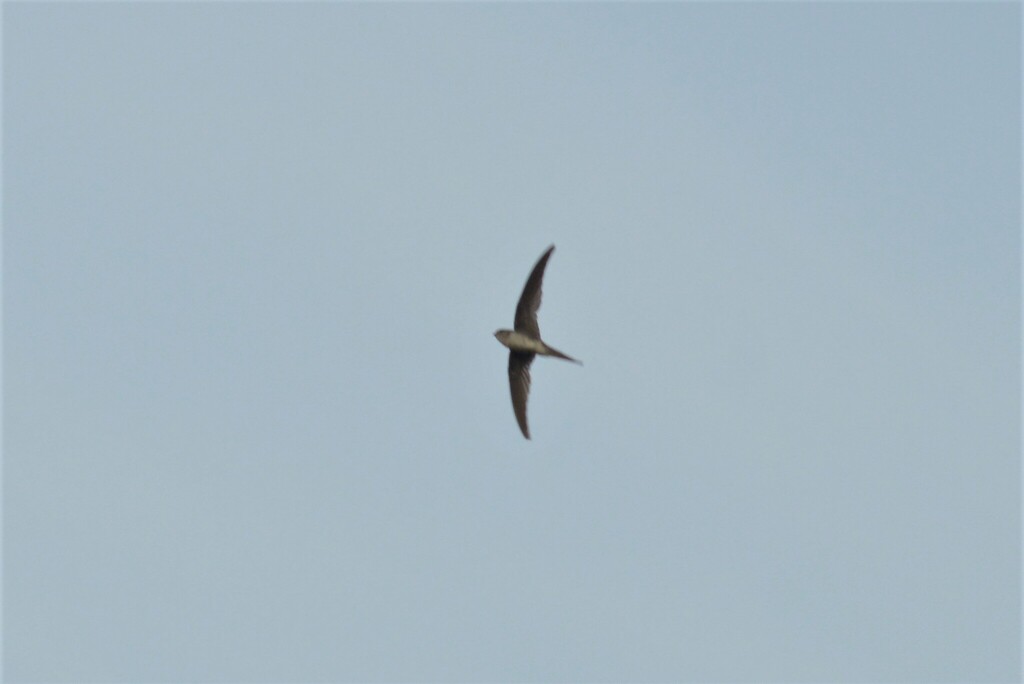
The pygmy palm swift (Tachornis furcata), also known as the pygmy swift, is a species of bird in subfamily Apodinae of the swift family Apodidae. It is found in Colombia and Venezuela.
From the article Pygmy palm swift on Wikipedia (CC BY-SA), quoted section by section
Description
The pygmy palm swift is about 10 cm (3.9 in) long. It has long, thin, pointed wings and a long deeply forked tail. The sexes are alike. The nominate subspecies has entirely brown upperparts. Its whitish throat and upper belly are separated by a brown band, and the lower belly and undertail coverts are brown. Subspecies T. f. nigrodorsalis has blacker upperparts than the nominate and its throat is whiter.
Range & habitat
The nominate subspecies of pygmy palm swift is found in northeastern Colombia's Norte de Santander Department and the adjoining southern part of Venezuela's Maracaibo Basin. T. f. nigrodorsalis is found in the western part of the Maracaibo Basin. The species primarily inhabits lowland tropical evergreen forest, secondary forest, and regrowing scrublands. It is also found in cultivated and other open areas as long as they contain palm trees.
Wikipedia: “Distribution and habitat”
What it does
Like all swifts, the pygmy palm swift is an aerial insectivore, but details of its diet are lacking. It usually forages in small flocks.
Wikipedia: “Feeding”
Listen
Looking for field recordings…
Where it lives
Recorded sightings
—
geo-referenced records in GBIF, from museums, herbaria and field observers.
Drag the globe to turn it. Dots are where records exist, not a range map; darker means more records.
In the stacks
Searching the stacks…
Every page naming Tachornis furcata in the Biodiversity Heritage Library →
This page is assembled live from iNaturalist, GBIF, Wikipedia, the Source Library and the Internet Archive. It is not yet part of the hand-edited codex. iNaturalist taxon 6870.