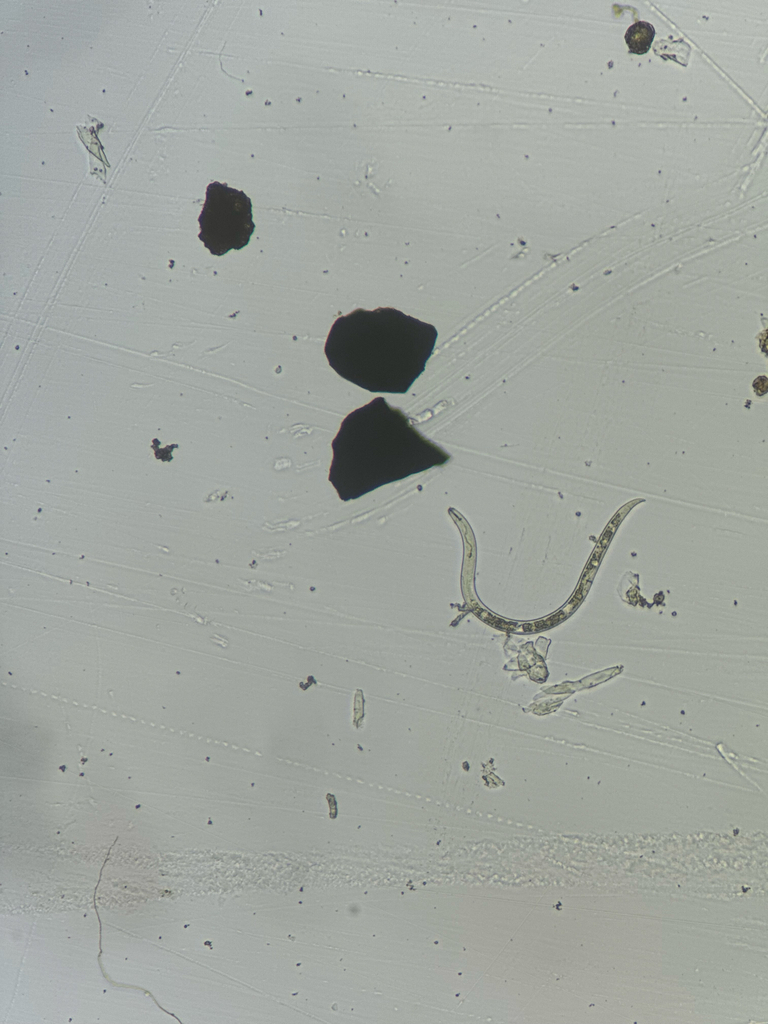
Rotylenchulus reniformis
Rotylenchulus reniformis, the reniform nematode, is a species of parasitic nematode of plants with a worldwide distribution in the tropical and subtropical regions.
From the article Rotylenchulus reniformis on Wikipedia (CC BY-SA), quoted section by section
Description
The reniform nematode has esophageal glands overlapping the intestine and a short stylet. The dorsal esophageal gland orifice is located posterior to the stylet knobs. The immature female is slender and may be spiral- or C-shaped in death. It is about 0.3 to 0.5 millimeters long. The mature female has a swollen, kidney-shaped body with a short tail, a short, thin stylet with rounded stylet knobs, a three-part esophagus, a long and narrow isthmus, and a well-developed metacarpus. The vulva is just behind the middle of the body. The male is vermiform: with a wormlike appearance. It has a weak stylet, curved spicules, and a pointed tail. The esophagus is reduced.
Wikipedia: “Morphology”
Range & habitat
R. reniformis has been reported from thousands of localities in the Americas, Africa, Europe, Asia, and Australia. It has a wide host range that includes fruit trees, lentil, cotton, pigeon pea, tea, tobacco, soybean, pineapple, banana, okra, coconut, cabbage, sweet potato, alfalfa, corn, asparagus, palm, cucumber, tomato, squash, cassava, radish, eggplant, guava, melon, chickpea, and ginger. Certain plants are considered to be non-hosts of the nematode, such as little barley, common barnyard grass, pangola grass, peppers, and some cultivars of black mustard, oat, spinach, and sugarcane.
Wikipedia: “Distribution and host range”
What it does
R. reniformis is sedentary semi-endoparasite on the roots of plants. The female penetrates the root and remains in one position at a permanent feeding site with its posterior end projecting from the root. The immature female is the infective agent, attacking the root and growing to maturity at its feeding site. Males and juveniles live in the soil; males are not parasites and do not feed. Under drought conditions the nematode can persist up to two years outside a host by entering an anhydrobiotic state. The life cycle is 17 to 29 days long. The juvenile molts once while still inside the egg. The eggs hatch in 8 to 10 days. The juvenile molts three times to reach the immature stage. The immature female parasitizes the root for one to two weeks. During this time the male deposits sperm, which the female stores until her gonads mature. The nematode can also reproduce via parthenogenesis, without fertilization. Upon maturity the female exits the root and lays up to 200 eggs in a gelatinous matrix.
Wikipedia: “Life cycle”
Where it lives
Recorded sightings
—
geo-referenced records in GBIF, from museums, herbaria and field observers.
Drag the globe to turn it. Dots are where records exist, not a range map; darker means more records.
In the stacks
Searching the stacks…
Every page naming Rotylenchulus reniformis in the Biodiversity Heritage Library →
This page is assembled live from iNaturalist, GBIF, Wikipedia, the Source Library and the Internet Archive. It is not yet part of the hand-edited codex. iNaturalist taxon 687934.