On eBird ↗
Spotted Whistling-Duck
Live sightings near you, the range map, bar charts of when it is seen, and Macaulay Library photos and recordings.
Spotted Whistling-Duck
Dendrocygna guttata
The spotted whistling duck (Dendrocygna guttata) is a member of the duck family Anatidae. It is also referred to as the "spotted tree duck". This duck can be found in Indonesia, New Guinea, Australia and the Philippines. Spotted ducks are also held in captive populations.
From the article Spotted whistling duck on Wikipedia (CC BY-SA), quoted section by section
Description
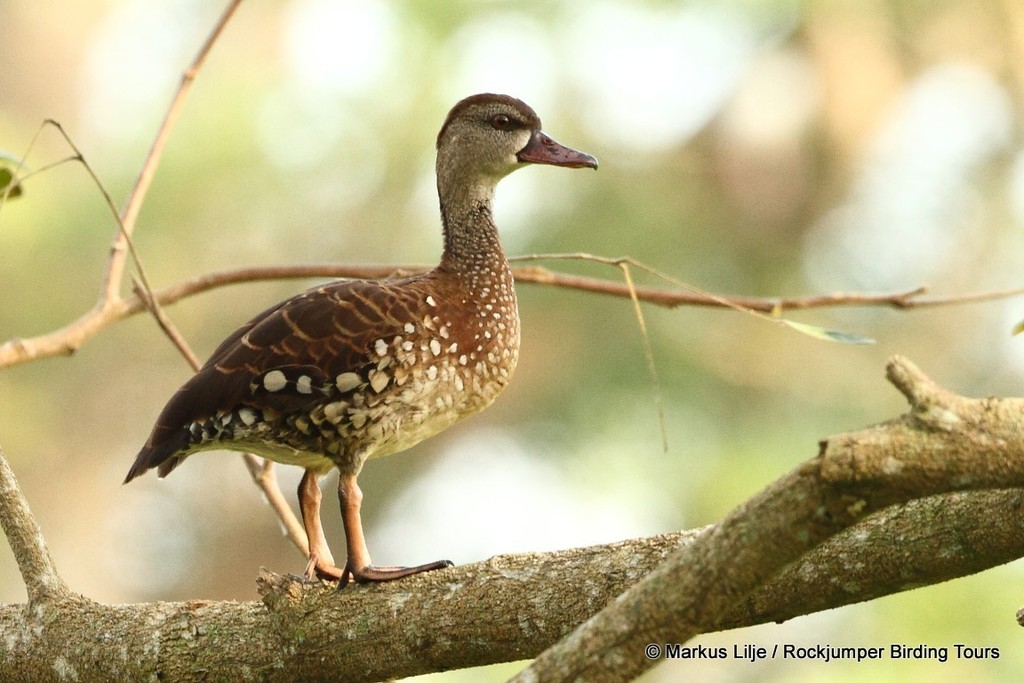
The Spotted whistling duck is one of the smaller species in the genus Dendrocygna. This duck grows to 43–50 cm tall. Males can weigh anywhere from 590g to 650g while females weigh 610g to 860g. White spots on their flanks and breasts gave these ducks the spotted name. The sides of the neck, faces, and eyebrows are all grey. Black or dark brown coloring stretches from the crown nape to the hindneck. This dark coloring is also found in the eyepatch. Their coloring resembles a cape with a thick collar. This cape starts as a light brown then fades into a darker brown closer to the tail. Their underbelly is mostly brown, sometimes spotted, and significantly lighter than the wings and the "collar." A white bar on the upper tail coverts can be seen during flight aiding in identification. They have dull pink legs with black webbed feet and sharp nails. The bill is dark, yet often seen with portions of red and a small white mark on the lower mandible. Spotted whistling ducks look as though they are raised from the ground, as though they are standing up tall. (look more into this). Their wings pressed strongly against the body. Inner vanes of the outer primaries are jagged and can be seen in flight (check on this). While flying, the head is positioned down causing the whole bird to look hunched. The tail stays pointed and looks long when in flight. …
Range & habitat
Whistling ducks are found all over the world. The spotted whistling duck is distributed throughout the Philippines, Australia, and New Guinea. These ducks live in the southern part of the Philippines and several islands of Indonesia. In Indonesia spotted whistling ducks stretch from the Eastern Lesser Sundas islands to new guinea. Spotted whistling ducks are also found in Weipa and Iron ranges of Australia, but have also been seen at Wonga Beach. Scientists hypothesize the Indonesian population was introduced due to a storm blowing the birds off course.
Wikipedia: “Distribution”
What it does
The Diet of the spotted whistling duck contains grass seeds, aquatic invertebrates, aquatic plants, and small fish. These ducks obtain their food by dabbling and diving. The ducks dabble at the surface of the ponds, filtering the water through their bills. The birds bounce on the surface to enter the water headfirst, after being underwater for a maximum of 15 seconds they emerge with another bounce. Scientists never observed food in the bill after the diving behavior. They concluded the birds consume the food while underwater. (Beruldsen) The majority of feeding occurs at night.
Wikipedia: “Diet and Feeding”
Listen
Looking for field recordings…
Where it lives
Recorded sightings
—
geo-referenced records in GBIF, from museums, herbaria and field observers.
Drag the globe to turn it. Dots are where records exist, not a range map; darker means more records.
In the stacks
Searching the stacks…
Every page naming Dendrocygna guttata in the Biodiversity Heritage Library →
This page is assembled live from iNaturalist, GBIF, Wikipedia, the Source Library and the Internet Archive. It is not yet part of the hand-edited codex. iNaturalist taxon 6897.