On eBird ↗
Magpie Goose
Live sightings near you, the range map, bar charts of when it is seen, and Macaulay Library photos and recordings.
Magpie Goose
Anseranas semipalmata
The magpie goose (Anseranas semipalmata) is the sole living representative species of the family Anseranatidae. This waterbird is found in northern Australia and southern New Guinea. The species is not truly migratory but it sometimes travels large distances to find food and water, especially when not breeding, and is sometimes recorded outside its core range. The species was once also widespread in southern Australia but disappeared from there largely due to the drainage of the wetlands where the birds once bred. Due to their importance to Aboriginal people as a seasonal food source, as subjects of recreational hunting, and as a tourist attraction, their expansive and stable presence in northern Australia has been "ensured [by] protective management".
From the article Magpie goose on Wikipedia (CC BY-SA), quoted section by section
Description
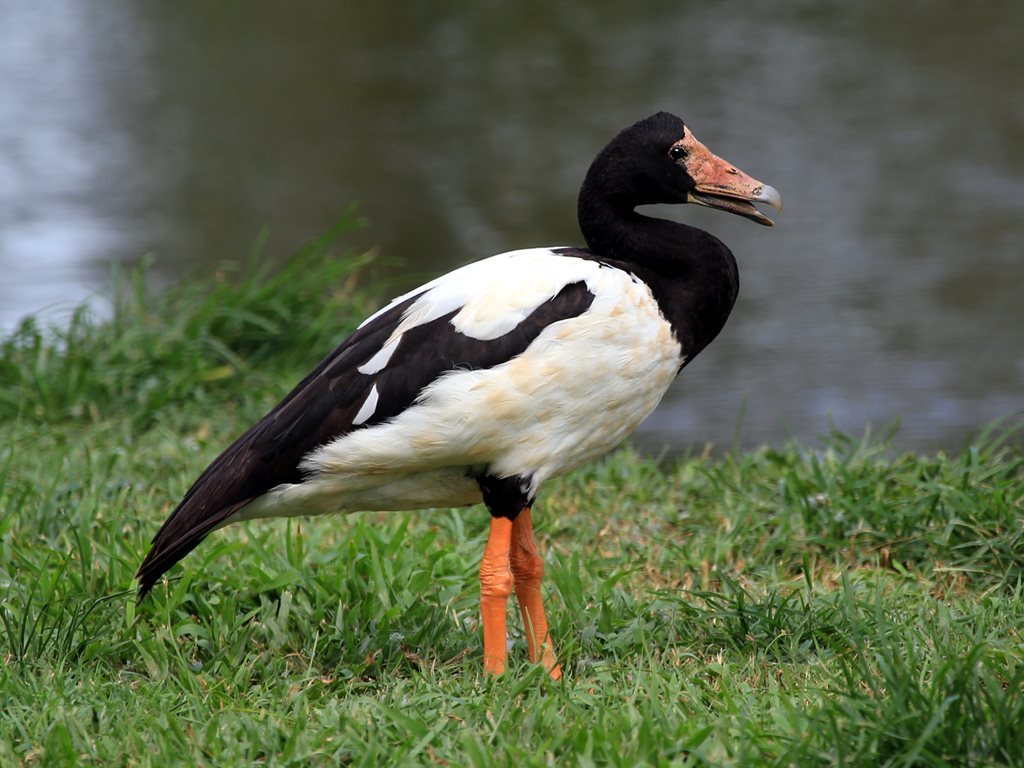
The magpie goose has black-and-white plumage in both sexes, with a long neck and legs and a long hooked bill. The males are 75–90 cm (30–35 in) in length and weigh 2.76 kg (6.1 lb) on average. The female is smaller, being 70–80 cm (28–31 in) in length and weighing 2.07 kg (4.6 lb). The wingspan of this bird spans 130–180 cm (4.3–5.9 ft). Their voice is a loud resonant honking. Its legs and feet are orange.
What it does
The magpie goose is found in a variety of open wetland areas such as floodplains and swamps, where they wade and swim. They eat mostly vegetation such as dry grass blades, grass seeds, spike rush bulbs and wild rice. Magpie geese are fairly sedentary apart from some movement during the dry season. They are colonial breeders and are gregarious outside of the breeding season when they can form large and noisy flocks of up to a few thousand individuals. Magpie geese nest on the ground or in trees where they can be five meters or higher above the ground. Their typical clutch is between five and nine eggs. Eggs measure 64–84 mm (2.5–3.3 in) in length and 46–63 mm (1.8–2.5 in) in width, weighing 76–138 g (2.7–4.9 oz). Often, males mate with two females, all of which raise the young, unlike some other polygamous birds.
Wikipedia: “Ecology”
Listen
Looking for field recordings…
Where it lives
Recorded sightings
—
geo-referenced records in GBIF, from museums, herbaria and field observers.
Drag the globe to turn it. Dots are where records exist, not a range map; darker means more records.
In the stacks
Searching the stacks…
Every page naming Anseranas semipalmata in the Biodiversity Heritage Library →
This page is assembled live from iNaturalist, GBIF, Wikipedia, the Source Library and the Internet Archive. It is not yet part of the hand-edited codex. iNaturalist taxon 6905.