On eBird ↗
Tundra Swan
Live sightings near you, the range map, bar charts of when it is seen, and Macaulay Library photos and recordings.
Tundra Swan
Cygnus columbianus
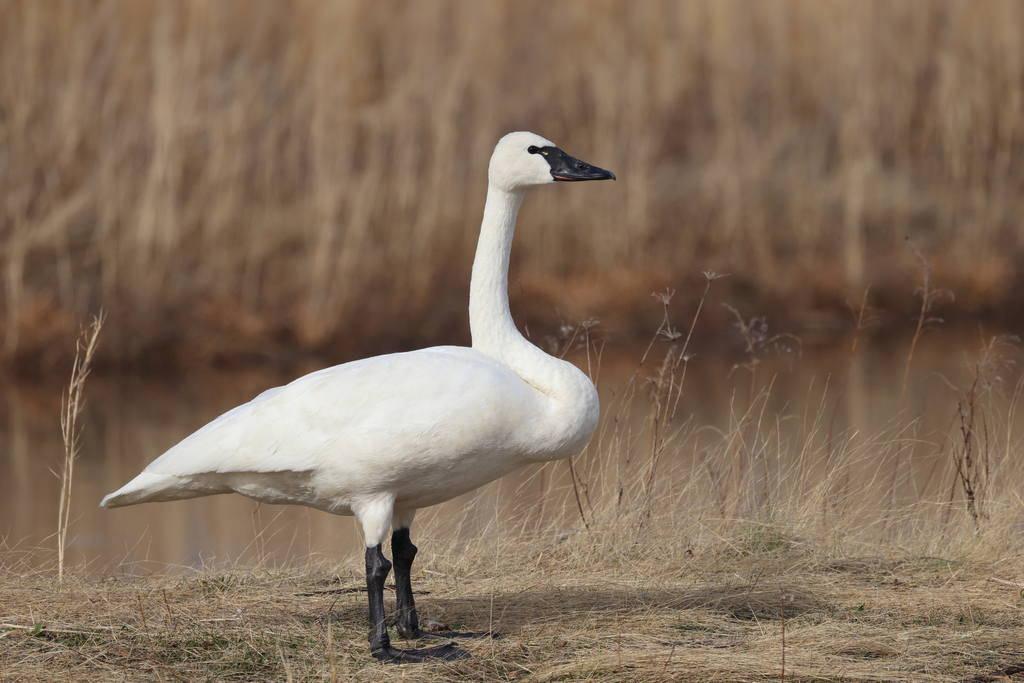
The tundra swan (Cygnus columbianus) is a species of swan which breeds in the arctic, and overwinters in North America, Europe, and Asia. It is the smallest of the Holarctic swans, at 115–150 cm (45–59 in) in length, 168–211 cm (66–83 in) in wingspan and 3.4–9.6 kg (7.5–21.2 lb) in weight. Typically, the plumage of adults is entirely white, with solid black feet, a black beak that has varying amounts of yellow, and a thin streak of pink along the mouthline, although colour variation is common.
In the summer, they mainly eat aquatic vegetation, while at other times of year they often eat leftover crops, such as potatoes. They have few natural predators, although sometimes Arctic foxes, parasitic jaegers, and glaucous gulls will prey upon their eggs and chicks. Their main cause of death is poaching. During the breeding season, tundra swans become aggressive, and may attack passing animals and other tundra swans; outside of the breeding season, they can form groups. They make a high-pitched honk, similar to a black goose.
From the article Tundra swan on Wikipedia (CC BY-SA), quoted section by section
Description
C. columbianus is the smallest of the Holarctic swans, at 115–150 cm (45–59 in) in length, 168–211 cm (66–83 in) in wingspan and a weight range of 3.4–9.6 kg (7.5–21.2 lb). In adult birds, the plumage of both subspecies is entirely white, with black feet, and a bill that is mostly black, with a thin salmon-pink streak running along the mouthline and – depending on the subspecies – more or less yellow in the proximal part. The iris is dark brown. In birds living in waters that contains large amounts of iron ions (e.g. bog lakes), the head and neck plumage acquires a golden or rusty hue. Pens (females) are slightly smaller than cobs (males), but do not differ in appearance otherwise. Immatures of both subspecies are white mixed with some dull grey feathering, mainly on the head and upper neck, which are often entirely light grey; their first-summer plumage is quite white already, and in their second winter they moult into the adult plumage. Their bills are black with a large dirty-pink patch taking up most of the proximal half and often black nostrils, and their feet are dark grey with a pinkish hue. Downy young are silvery grey above and white below.
Bewick's swans are the smaller subspecies. There is a slight size cline, with the eastern birds being slightly larger; good measurement data only exists for the western populations however. …
Range & habitat
As their common name implies, the tundra swan breeds in the tundra of the Arctic and subarctic, where they inhabit shallow pools, lakes and rivers. These birds, unlike mute swans (C. olor) but like the other Arctic swans, are migratory birds. The winter habitat of both subspecies is grassland and marshland, often near the coast; they like to visit fields after harvest to feed on discarded grains and while on migration may stop over on mountain lakes. According to National Geographic, when migrating these birds can fly at altitudes of 8 km (5.0 mi) in a V formation.
C. c. bewickii distribution. The breeding range of C. c. bewickii extends across the coastal lowlands of Siberia, from the Kola Peninsula east to the Pacific. They start to arrive on the breeding grounds around mid-May, and leave for winter quarters around the end of September. The populations west of the Taymyr Peninsula migrate via the White Sea, Baltic Sea and the estuary of the Elbe to winter in Denmark, the Netherlands and the British Isles. They are common in winter in the wildfowl nature reserves of the Royal Society for the Protection of Birds and of the Wildfowl & Wetlands Trust. Some birds also winter elsewhere on the southern shores of the North Sea. …
Wikipedia: “Distribution”
What it does
About 15% of the adults die each year from various causes, and thus the average lifespan in the wild is about 10 years. The oldest recorded tundra swan was over 24 years old.
Diet. In summer, their diet consists mainly of aquatic vegetation, e.g. mannagrass (Glyceria), Potamogeton pondweeds and marine eelgrass (Zostera), acquired by sticking the head underwater or upending while swimming; they also eat some grass growing on dry land. At other times of year, leftover grains and other crops such as potatoes, picked up in open fields after harvest, make up much of their diet. Tundra swans forage mainly by day. In the breeding season, they tend to be territorial and are aggressive to many animals who pass by; outside the breeding season they are rather gregarious birds.
Predation. Healthy adult birds have few natural predators. The Arctic fox (Vulpes lagopus), parasitic jaegers (Stercorarius parasiticus), and glaucous gull (Larus hyperboreus) can take the eggs and hatchlings. Adults typically can stand their ground and displace foxes and birds but occasionally they are successful when both adults are absent due to disturbance or territorial dispute. Another surprisingly serious nest predator for tundra swans are brown bears (Ursus arctos), which were apparently the primary cause of nesting failure in both the Arctic National Wildlife Refuge and Izembek National Wildlife Refuge. …
Wikipedia: “Ecology and biology”
In human culture
Bewick's swan was named in 1830 by William Yarrell after the engraver Thomas Bewick, who specialised in illustrations of birds and animals. Cygnus is the Latin for "swan", and columbianus comes from the Columbia River, the type locality.
Wikipedia: “Etymology”
Listen
Looking for field recordings…
Where it lives
Recorded sightings
—
geo-referenced records in GBIF, from museums, herbaria and field observers.
Drag the globe to turn it. Dots are where records exist, not a range map; darker means more records.
In the stacks
Searching the stacks…
Every page naming Cygnus columbianus in the Biodiversity Heritage Library →
This page is assembled live from iNaturalist, GBIF, Wikipedia, the Source Library and the Internet Archive. It is not yet part of the hand-edited codex. iNaturalist taxon 6917.