On eBird ↗
Eaton's Pintail
Live sightings near you, the range map, bar charts of when it is seen, and Macaulay Library photos and recordings.
Eaton's Pintail
Anas eatoni
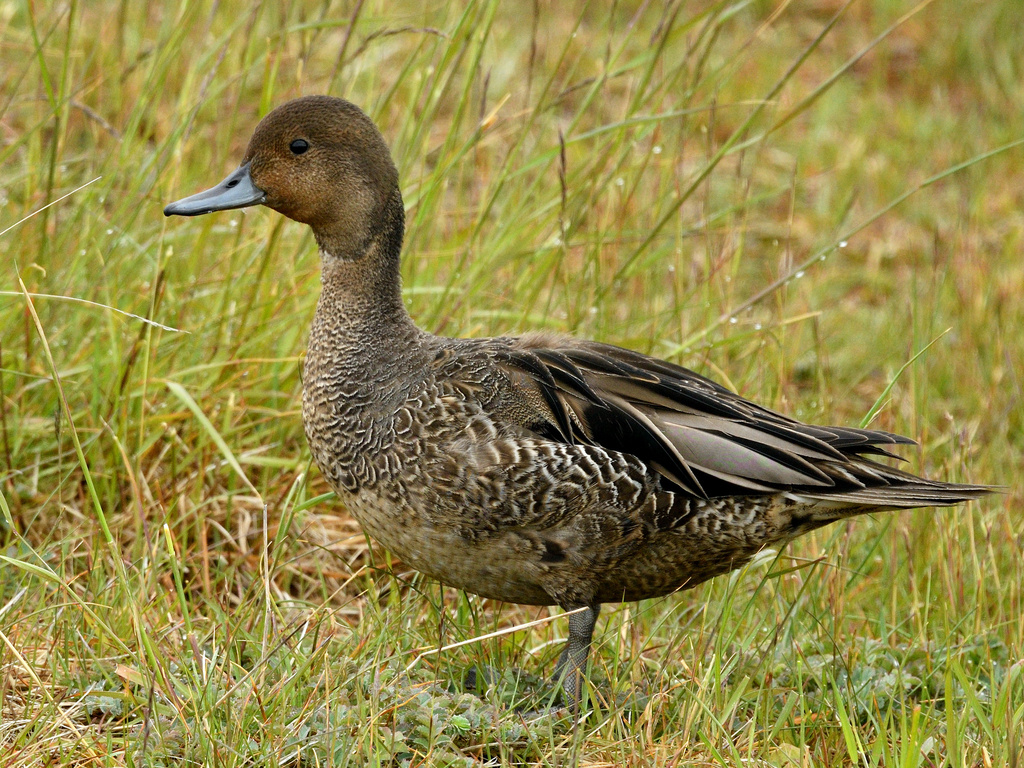
Eaton's pintail (Anas eatoni) is a dabbling duck of the genus Anas. It is also known as the southern pintail. The species is restricted to the island groups of Kerguelen and Crozet in the southern Indian Ocean. It resembles a small female northern pintail. It was named after the English explorer and naturalist Alfred Edwin Eaton. It is threatened by introduced species, particularly feral cats, which prey on it, particularly during the post-breeding molt, when it is unable to fly.
From the article Eaton's pintail on Wikipedia (CC BY-SA), quoted section by section
Description
The Eaton's pintail is a small duck, 35-45 cm in length, with a 65-70 cm wingspan and weighing 430-502 g in males and 400-500 g in females. Its adult male and female plumage is similarly brownish overall with cinnamon underparts, though the two sexes can be separated by the color of the speculum (green in males and brown in females) and the longer central rectrices in males. Juveniles are similar to adults in plumage, but more streaked below.
Range & habitat
The Eaton's pintail is found exclusively on Kerguelen and Crozet Islands, though it has appeared as a vagrant on the nearby Prince Edward Islands. It summers on small lakes, pools, marshes, and other freshwater wetlands, then migrates down to coastal bays in the winter when most freshwater bodies freeze over.
Wikipedia: “Distribution and habitat”
What it does
The Eaton's pintail's diet mostly consists of small crustaceans and other invertebrates, but will also forage on seeds. It occasionally visits southern elephant seal wallows to feed. It breeds from November to March. Its nest is built in tussock or grass, and lined with moss and down. This pintail's vocalization is similar to the northern pintail's: a soft proop-proop whistle in males and a quack in females, but higher-pitched and quieter. The brown skua is a primary predator of the Eaton's pintail, especially during its post-breeding molt when it is flightless. During this period, Eaton's pintails will often shelter themselves in dense vegetation or caves.
Wikipedia: “Behavior”
Listen
Looking for field recordings…
Where it lives
Recorded sightings
—
geo-referenced records in GBIF, from museums, herbaria and field observers.
Drag the globe to turn it. Dots are where records exist, not a range map; darker means more records.
In the stacks
Searching the stacks…
Every page naming Anas eatoni in the Biodiversity Heritage Library →
This page is assembled live from iNaturalist, GBIF, Wikipedia, the Source Library and the Internet Archive. It is not yet part of the hand-edited codex. iNaturalist taxon 6963.