On eBird ↗
Gray Teal
Live sightings near you, the range map, bar charts of when it is seen, and Macaulay Library photos and recordings.
Grey Teal
Anas gracilis
The grey teal (Anas gracilis) is a dabbling duck found in open wetlands in Australia and New Zealand.
From the article Grey teal on Wikipedia (CC BY-SA), quoted section by section
Description
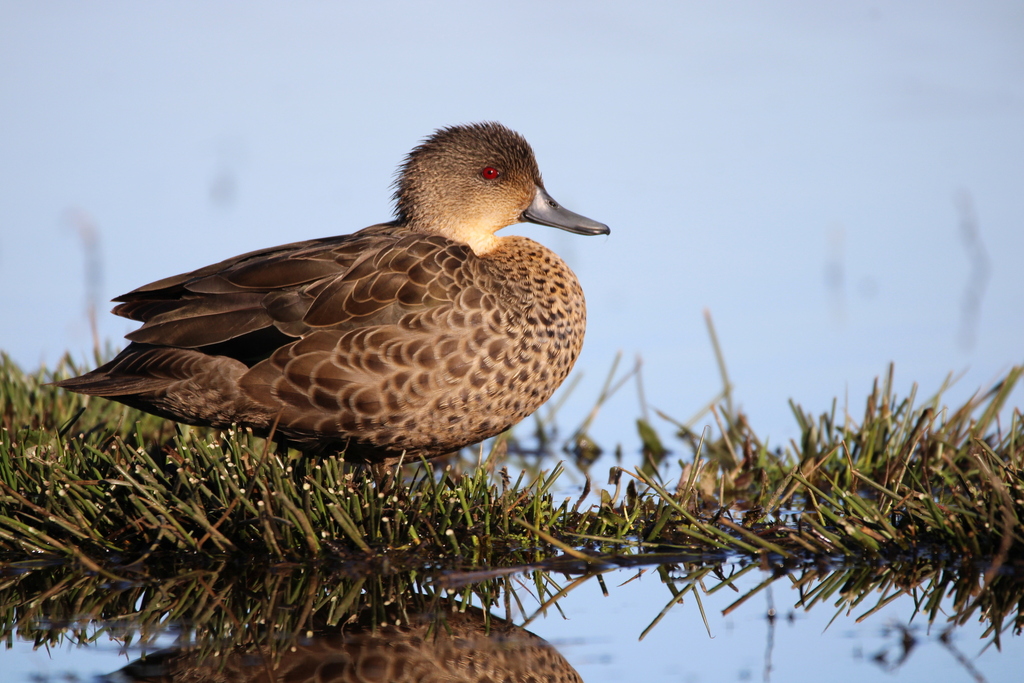
It is identified by the presence of a crimson coloured iris in its eyes, which is relatively more prominent in adult males. It is a mottled brown duck with white and green flashes on its wings. Males and females share the same colouration, in contrast to the related chestnut teal, male and female of which are strikingly different. The grey teal has almost identical colouration to the female chestnut teal and the grey can only be distinguished by its lighter coloured neck and paler face. Juveniles are paler than adults, especially on the head. However, they can be identified by having a dull brown eye until matured. The bill of the grey teal is a blue-grey colour with dark lining around the edges. Feet are a similar colour to that of the bill being grey. The head of the grey teal can be described as plain/slightly streaked, with a dark crown and cream coloured chin/throat and cheeks.
The eggs of the grey teal are creamy white and are not distinctly speckled. An average egg is 49.3 mm (1.94 in) in length and 35.6 mm (1.40 in) in width. The grey teal nests near its favoured freshwater lakes and marshes, usually on the ground, but also in tree holes or rabbit burrows. It is a vocal duck, especially at night. The male gives a soft preep, and the female has a loud quack. The grey teal is a gregarious species. …
Range & habitat
The grey teal can be found as a breeding species a number of places across the globe: Australia, New Zealand, New Guinea and Indonesia. However, it can also be seen in the Solomons and New Caledonia, where it is vagrant.
Wikipedia: “Natural global range”
What it does
When establishing a pair-bond, male grey teal will perform a series of displays; some of these include headshakes and head rolls. These displays tend to occur in adolescent birds before breeding season, whereas for mature birds in established pair-bonds courtship rituals are used. This is because grey teal pair-bonds are long term and monogamous, which means they keep the same mate through multiple seasons. Couples stay together all year; however, when late summer moult comes they often join large flocks and stay with them until July. Moreover, "after breeding, [they] often gather at estuaries to feed on exposed mudflats". On average, the grey teal starts breeding at one year old. In Australia there is no reproductive season as breeding is linked to rainfall and food abundance. The species had to adapt and breed in shallow temporary water. However, in New Zealand where the climate is more humid, breeding is more seasonal even if it is still related to water level. In terms of seasonality, grey teal will tend to breed in the summer-rainfall period. However, they will also breed at any time after a significant amount of rainfall. Thus, in New Zealand laying occurs between June and September "but replacement clutches can be laid through to January". …
Wikipedia: “Reproduction”
Listen
Looking for field recordings…
Where it lives
Recorded sightings
—
geo-referenced records in GBIF, from museums, herbaria and field observers.
Drag the globe to turn it. Dots are where records exist, not a range map; darker means more records.
In the stacks
Searching the stacks…
Every page naming Anas gracilis in the Biodiversity Heritage Library →
This page is assembled live from iNaturalist, GBIF, Wikipedia, the Source Library and the Internet Archive. It is not yet part of the hand-edited codex. iNaturalist taxon 6969.