On eBird ↗
Brazilian Merganser
Live sightings near you, the range map, bar charts of when it is seen, and Macaulay Library photos and recordings.
Brazilian Merganser
Mergus octosetaceus
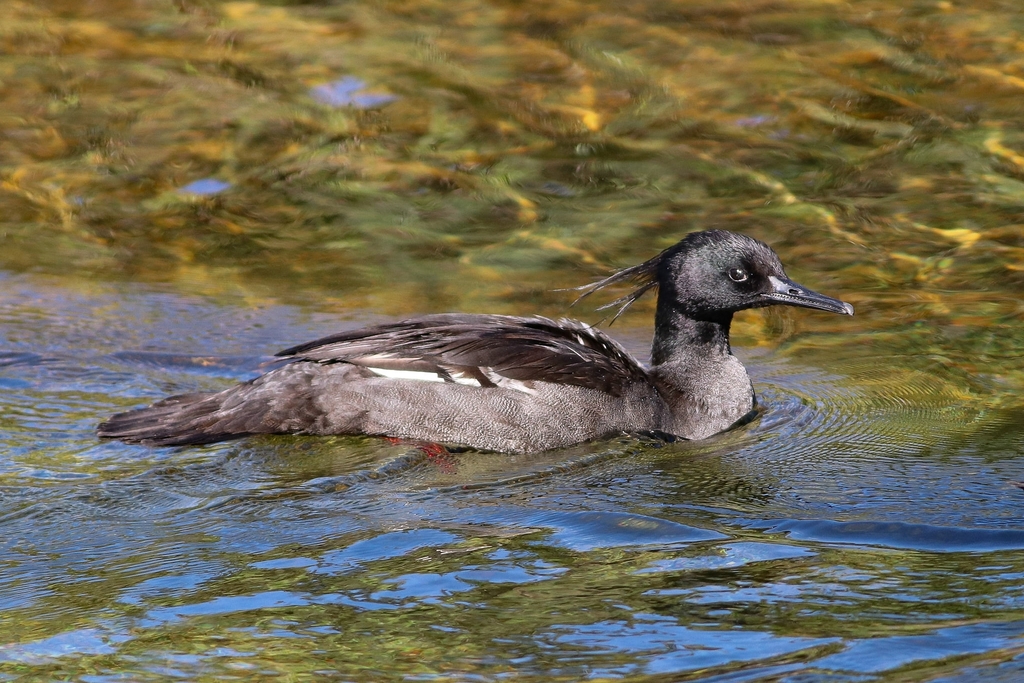
The Brazilian merganser (Mergus octosetaceus) is a duck in the typical merganser genus. It is one of the six most threatened waterfowl in the world with possibly fewer than 250 birds in the wild and currently 4 kept in captivity at 2 different Brazilian locations. The origin of its name is from its long, sharp-edged beak that has a great number of teeth-looking edges.
From the article Brazilian merganser on Wikipedia (CC BY-SA), quoted section by section
Description
This merganser is a dark, slender duck with a shiny dark-green hood with a long crest, which is usually shorter and more worn-looking in females. Upperparts are dark grey while the breast is light grey, getting paler toward the whitish belly, and a white speculum is particularly noticeable in flight. It has a long thin jagged black bill with red feet and legs. Although females are smaller with a shorter bill and crest, both sexes are alike in color. The slender ducks range in size from 49 to 56 centimetres (19 to 22 in) as an adult. Young Brazilian mergansers are mainly black with white throat and breast. The Brazilian mergansers are generally silent birds, but may make barking calls in certain situations. Four calls have been recorded. A harsh krack-krack acts as an alarm call emitted in flight. Males make a barking dog-like call, females make a harsh rrr-rrrr and the contact call is a soft rak-rak-rak. Ducklings give a high pitched ik-ik-ik. Depending on the availability of suitable nesting and feeding sites, Brazilian merganser pairs occupy permanent territories of 8-to-14-kilometre (5.0 to 8.7 mi) stretches of rivers. Tree cavities, rock crevices, or disused burrows predominantly made by armadillos are the ideal places for these mergansers to build their nests. …
Range & habitat
The slender Brazilian mergansers live in low densities in remote and mountainous regions where it inhabits clean rivers and streams with river rapids and riparian vegetation. Brazilian mergansers are very territorial birds defending large stretches of river and the land surrounding the fast-flowing water. They are recognized as a resident species that does not abandon the watercourses where it established its territory. They do not move or want to move once their habitats have disappeared. The birds need large territories and their habitat is fast dwindling.
Wikipedia: “Habitat”
Listen
Looking for field recordings…
Where it lives
Recorded sightings
—
geo-referenced records in GBIF, from museums, herbaria and field observers.
Drag the globe to turn it. Dots are where records exist, not a range map; darker means more records.
In the stacks
Searching the stacks…
Every page naming Mergus octosetaceus in the Biodiversity Heritage Library →
This page is assembled live from iNaturalist, GBIF, Wikipedia, the Source Library and the Internet Archive. It is not yet part of the hand-edited codex. iNaturalist taxon 6999.