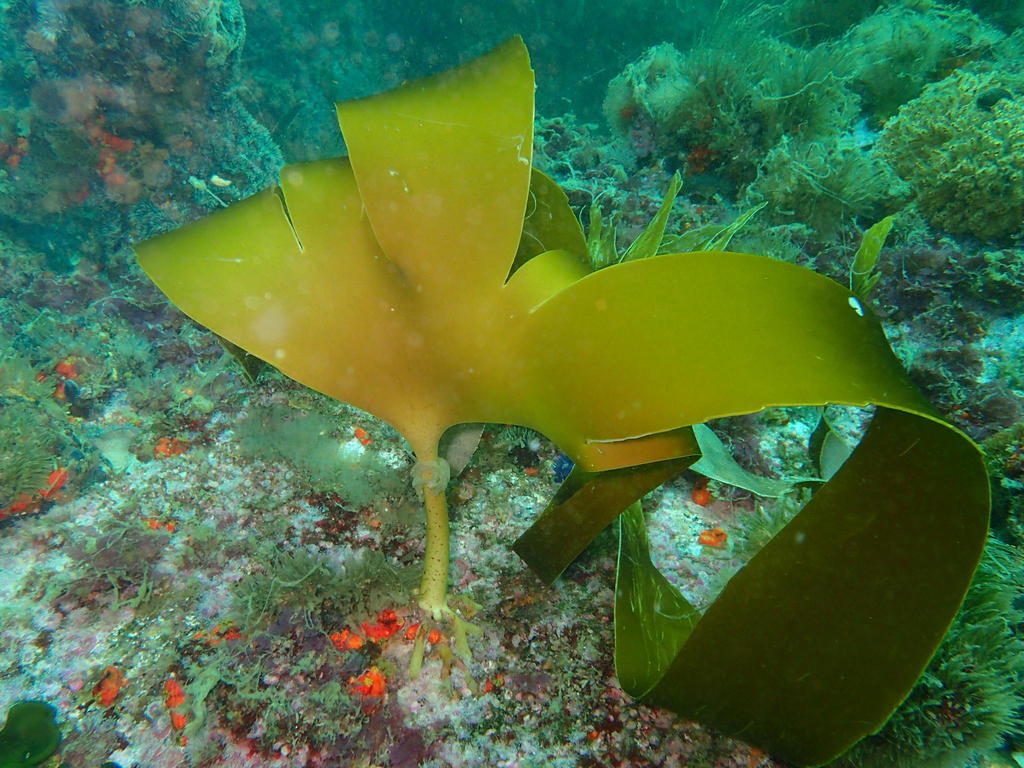
Split-fan Kelp
Laminaria pallida
Laminaria pallida, the split-fan kelp, is a species of large brown seaweed of the class Phaeophyceae found from Danger Point on the south coast of South Africa to Port Nolloth, Tristan da Cunha and Gough islands in the Atlantic and Île Saint-Paul in the Indian Ocean.
From the article Laminaria pallida on Wikipedia (CC BY-SA), quoted section by section
Description
The large thallus is up to 10m long, with a single smooth broad blade which splits into several parallel longitudinal straps. The holdfast is multiply branched, and the stipe is usually solid, fairly stiff, round in section and tapers gradually toward the blade. In specimens with hollow stipes the stipe narrows towards the base.
Range & habitat
Danger Point on the south coast of South Africa to Port Nolloth in Namibia, Tristan da Cunha and Gough islands in the Atlantic and St Paul Island in the Indian Ocean. Type locality: Table Bay, Cape Province, South Africa (Silva, Basson & Moe 1996: 641).
Wikipedia: “Distribution”
What it does
Commonly found below a canopy of the Sea bamboo Ecklonia maxima down to 15 m, and replaces it in deeper water to 30 m the frond tips sweep the surrounding reef surface, reducing the numbers of animals that may eat sporelings.
== References ==
Wikipedia: “Ecology”
Where it lives
Recorded sightings
—
geo-referenced records in GBIF, from museums, herbaria and field observers.
Drag the globe to turn it. Dots are where records exist, not a range map; darker means more records.
In the stacks
Searching the stacks…
Every page naming Laminaria pallida in the Biodiversity Heritage Library →
This page is assembled live from iNaturalist, GBIF, Wikipedia, the Source Library and the Internet Archive. It is not yet part of the hand-edited codex. iNaturalist taxon 700447.