On eBird ↗
Pink-footed Goose
Live sightings near you, the range map, bar charts of when it is seen, and Macaulay Library photos and recordings.
Pink-footed Goose
Anser brachyrhynchus
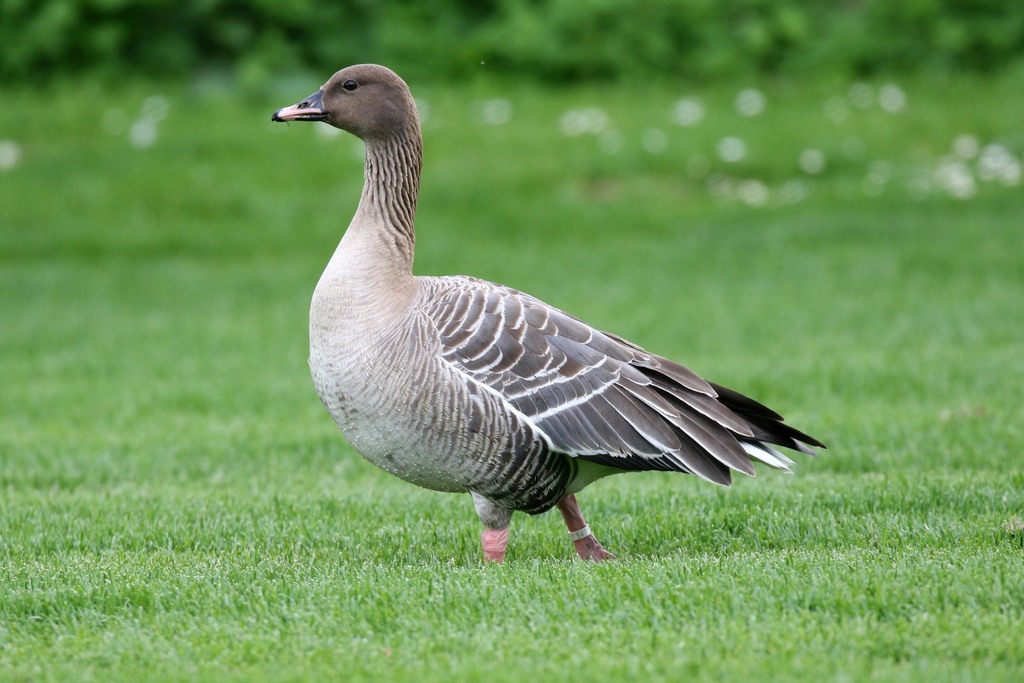
The pink-footed goose (Anser brachyrhynchus) is a goose which breeds in eastern Greenland, Iceland, Svalbard, and recently Novaya Zemlya. It is migratory, wintering in northwest Europe, especially Ireland, Great Britain, the Netherlands, and western Denmark. The name is often abbreviated in colloquial usage to "pinkfoot" (plural "pinkfeet"). Anser is the Latin for "goose", and brachyrhynchus comes from the ancient Greek brachus, meaning "short", and rhunchos, meaning "bill".
From the article Pink-footed goose on Wikipedia (CC BY-SA), quoted section by section
Description
It is a medium-sized goose, 60–75 cm (24–30 in) long, the wingspan 135–170 cm (53–67 in), and weighing 1.8–3.4 kg (4.0–7.5 lb). It has a short bill, bright pink in the middle with a black base and tip, similar in pattern to tundra bean goose but pink where that species is orange, and pink feet. The body is mid-grey-brown, the head and neck a richer, darker brown, the rump and vent white, and the tail grey with a broad white tip. The upper wing-coverts are of a somewhat similar pale bluish-grey as in the greylag goose, and the flight feathers blackish-grey.
What it does
Nesting is often on cliffs close to glaciers to provide protection from mammalian predators (mainly Arctic fox), also on islets in lakes. Three to five eggs are laid, with incubation lasting 25–28 days. Eggs measure 7–9 cm (2.8–3.5 in) in length and 4.8–5.8 cm (1.9–2.3 in) in width. On hatching, the goslings accompany the parents on foot to the nearest lake, where they fledge after about 56 days. Southbound migration is from mid-September to early October, and northbound from mid-April to early May. The diet is almost entirely herbivorous. In summer, they feed on a wide range of tundra plants, both on land and in water. In winter, they graze primarily on oilseed rape, sugar beet, potato, and various grasses; damage to crops can be extensive, though their grazing can also benefit particularly sugar beet and potato farmers by gleaning leaves and roots left behind after the crop is harvested, reducing the transmission of crop diseases from one year to the next.
Wikipedia: “Ecology”
Listen
Looking for field recordings…
Where it lives
Recorded sightings
—
geo-referenced records in GBIF, from museums, herbaria and field observers.
Drag the globe to turn it. Dots are where records exist, not a range map; darker means more records.
In the stacks
Searching the stacks…
Every page naming Anser brachyrhynchus in the Biodiversity Heritage Library →
This page is assembled live from iNaturalist, GBIF, Wikipedia, the Source Library and the Internet Archive. It is not yet part of the hand-edited codex. iNaturalist taxon 7007.