On eBird ↗
Bar-headed Goose
Live sightings near you, the range map, bar charts of when it is seen, and Macaulay Library photos and recordings.
Bar-headed Goose
Anser indicus
The bar-headed goose (Anser indicus) is a goose that breeds in Central Asia in colonies of thousands near mountain lakes and winters in South Asia, as far south as peninsular India. It lays three to eight eggs at a time in a ground nest. It is known for the extreme altitudes it reaches when migrating across the Himalayas.
From the article Bar-headed goose on Wikipedia (CC BY-SA), quoted section by section
Description
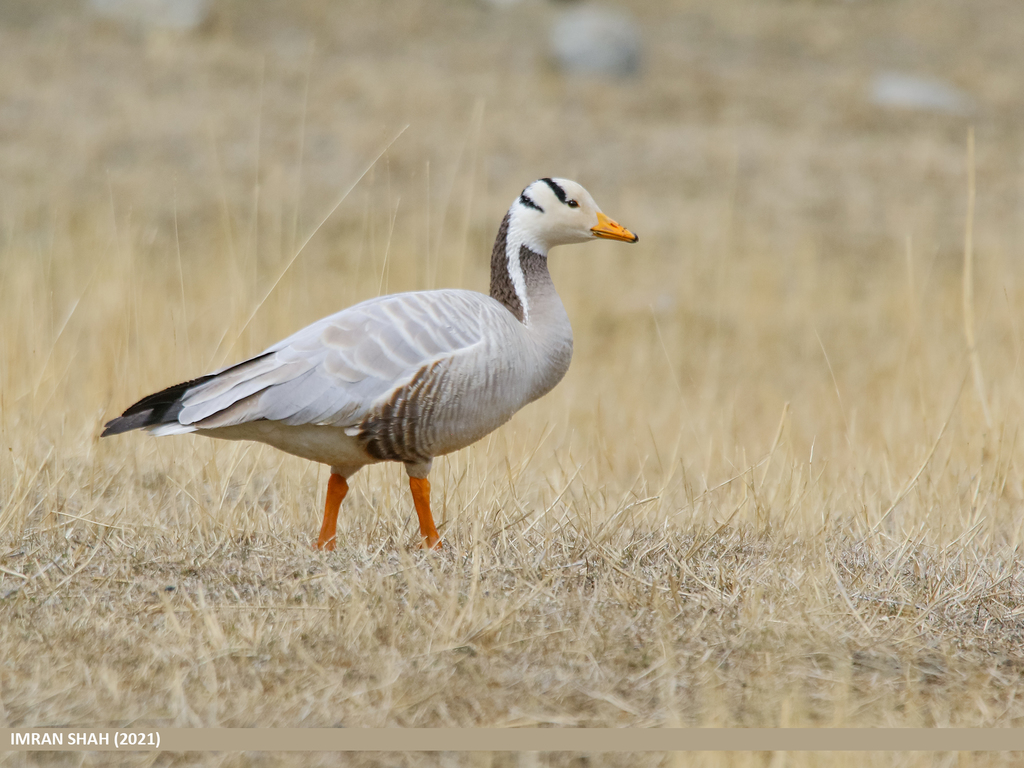
The bird is pale grey and is easily distinguished from any of the other grey geese of the genus Anser by the black bars on its otherwise white head. It is also much paler than the other geese in this genus. In flight, its call is a typical goose honking. A mid-sized goose, it measures 71–76 cm (28–30 in) in total length and weighs 1.87–3.2 kg (4.1–7.1 lb).
What it does
The summer habitat is high-altitude lakes in central Asia, where the bird grazes on short grass. The species migrates south from Tibet, Kazakhstan, Mongolia and Russia before crossing the Himalayas. The bird has come to the attention of medical science in recent years as having been an early victim of the highly pathogenic avian influenza (HPAI, highly pathogenic avian influenza), at Qinghai. It suffers predation from crows, foxes, ravens, sea eagles, gulls and others. The total population may, however, be increasing, but it is complex to assess population trends, as it occurs over more than 2,500,000 km2 (970,000 sq mi). The bar-headed goose is one of the world's highest-flying birds, having been heard flying across Mount Makalu (the fifth highest mountain on earth at 8,481 m (27,825 ft)), and apparently seen over Mount Everest (8,848 m (29,029 ft)), although this is a second-hand report with no verification. This demanding migration has long puzzled physiologists and naturalists; "there must be a good explanation for why the birds fly to the extreme altitudes... particularly since there are passes through the Himalayas at lower altitudes, and which are used by other migrating bird species". …
Wikipedia: “Ecology”
In human culture
The bar-headed goose has been suggested as being the model for the Hamsa of Indian mythology. Another interpretation suggests that the bar-headed goose is likely to be the Kadamb in ancient and medieval Sanskrit literature, whereas Hamsa generally refers to the swan.
Wikipedia: “Cultural depiction”
Listen
Looking for field recordings…
Where it lives
Recorded sightings
—
geo-referenced records in GBIF, from museums, herbaria and field observers.
Drag the globe to turn it. Dots are where records exist, not a range map; darker means more records.
In the stacks
Searching the stacks…
Every page naming Anser indicus in the Biodiversity Heritage Library →
This page is assembled live from iNaturalist, GBIF, Wikipedia, the Source Library and the Internet Archive. It is not yet part of the hand-edited codex. iNaturalist taxon 7008.