On eBird ↗
Common Eider
Live sightings near you, the range map, bar charts of when it is seen, and Macaulay Library photos and recordings.
Common Eider
Somateria mollissima
The common eider (pronounced ) (Somateria mollissima), also called St. Cuthbert's duck or Cuddy's duck, is a large (50–71 cm (20–28 in) in body length) sea-duck that is distributed over the northern coasts of Europe, North America and eastern Siberia. It breeds in Arctic and some northern temperate regions, but winters somewhat farther south in temperate zones, when it can form large flocks on coastal waters. It can fly at speeds up to 113 km/h (70 mph).
The eider's nest is built close to the sea and is lined with eiderdown, plucked from the female's breast. This soft and warm lining has long been harvested for filling pillows and quilts, but in more recent years has been largely replaced by down from domestic farm-geese and synthetic alternatives. Although eiderdown pillows or quilts are now a rarity, typically being marketed as luxury goods, eiderdown harvesting continues and is sustainable, as it can be done after the ducklings leave the nest with no harm to the birds.
From the article Common eider on Wikipedia (CC BY-SA), quoted section by section
Description
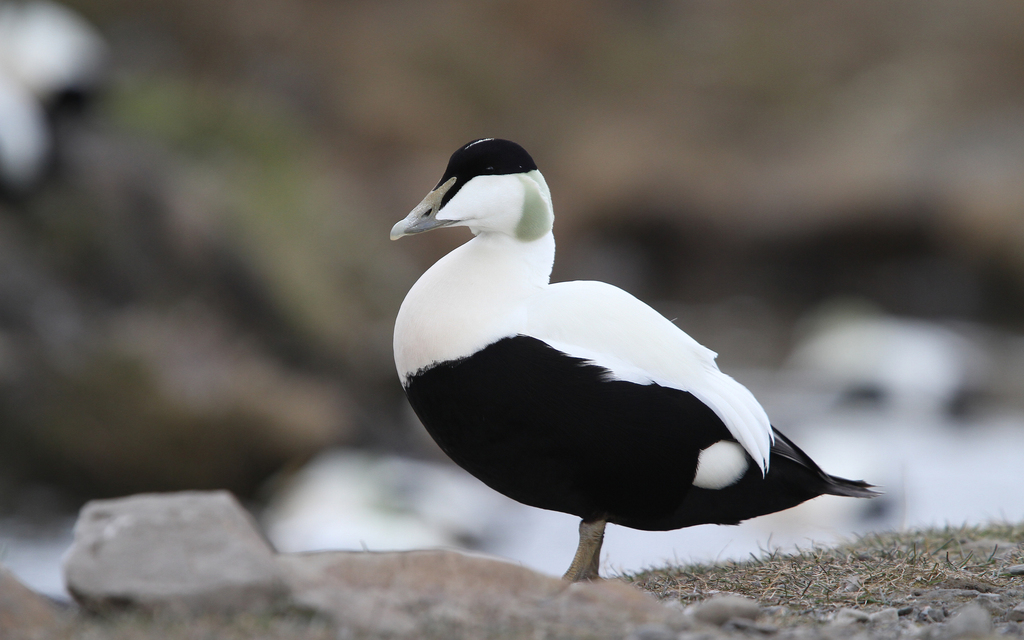
The common eider is the largest of the four eider species, measuring 50 to 71 cm (19+1⁄2 to 28 in) in length, weighs 0.81 to 3.04 kg (1 lb 12+1⁄2 oz to 6 lb 11 oz) and spans 80–110 cm (31–43 in) across the wings. The average weight of 22 males in the North Atlantic was 2.21 kg (4 lb 14 oz) while 32 females weighed an average of 1.92 kg (4 lb 3+1⁄2 oz). It is distinguished by its bulky shape and large, wedge-shaped bill. The male is distinct, with its black and white plumage and green nape. The female is a brown bird, but can still be readily distinguished from all ducks, except other eider species, on the basis of size and head shape. The drake's display call is a strange almost human-like "ah-ooo", while the duck utters hoarse quacks. The species is often readily approachable. Drakes of the European, Asian, and eastern and western North American subspecies can be distinguished by small differences in plumage and bill colour. Nominate S. m. mollissima has a yellowish-green bill, while S. m. dresseri has a greenish-grey bill, as does the slightly smaller S. m. faeroeensis. The Arctic Atlantic S. m. borealis and the Arctic Pacific S. m. v-nigrum have bright orange-yellow bills.
What it does
This species dives for crustaceans and molluscs, with mussels being a favoured food. The eider will eat mussels by swallowing them whole; the shells are then crushed in their gizzard and excreted. When eating a crab, the eider will remove all of its claws and legs, and then eat the body in a similar fashion. It is abundant, with populations of about 1.5–2 million birds in both North America and Europe, and also large but unknown numbers in eastern Siberia (HBW). Some populations are small and declining, notably the isolated Crimean population in the Black Sea is declining and of conservation concern, with only around 700–1,100 pairs. A particularly famous colony of eiders lives on the Farne Islands in Northumberland, England. About 1,000 pairs still nest there every year. It has been claimed that these birds were the subject of one of the first-ever bird protection laws, and that the first wildlife preserve was established for them by Saint Cuthbert in the year 676, though this is not likely to be true. No mention of the hermit having any affinity with birds is found in any documents until the publication of a story about 500 years after his death. The stories told in these later works also do not involve any concerns about habitat loss or other concepts in modern nature conservation. Because St. …
Wikipedia: “Ecology”
Listen
Looking for field recordings…
Where it lives
Recorded sightings
—
geo-referenced records in GBIF, from museums, herbaria and field observers.
Drag the globe to turn it. Dots are where records exist, not a range map; darker means more records.
In the stacks
Searching the stacks…
Every page naming Somateria mollissima in the Biodiversity Heritage Library →
This page is assembled live from iNaturalist, GBIF, Wikipedia, the Source Library and the Internet Archive. It is not yet part of the hand-edited codex. iNaturalist taxon 7024.