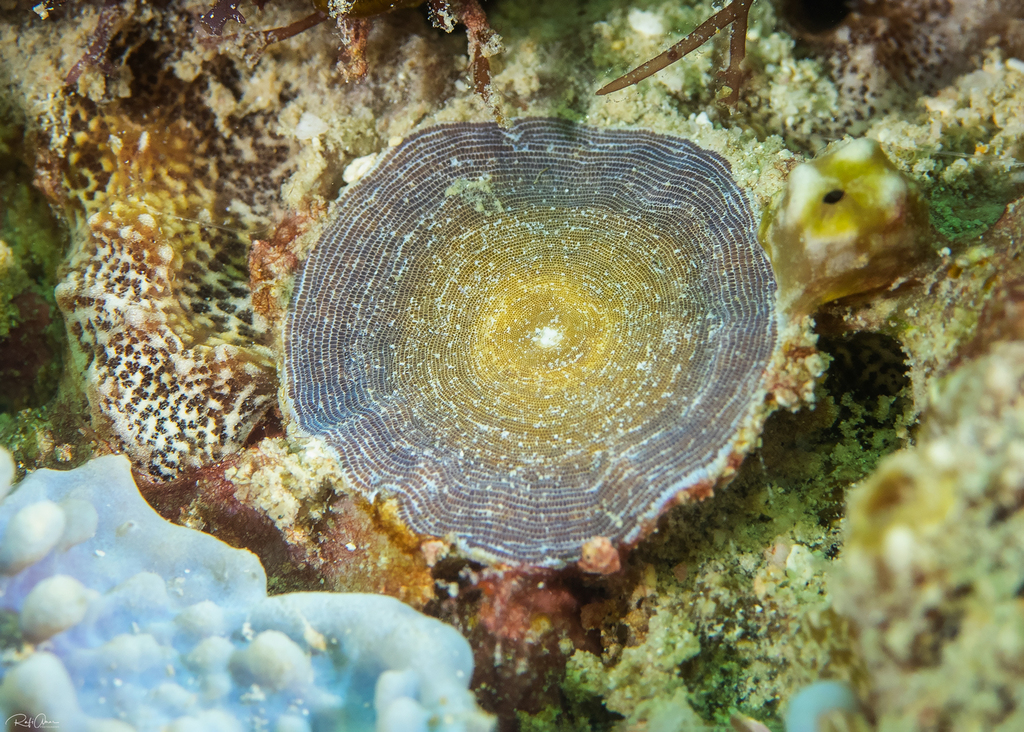
Marginopora vertebralis
Marginopora vertebralis is a foraminiferan, 1 to 2 centimetres (0.4 to 0.8 in) in diameter found in the tropical Indo-Pacific region. It is a disc-shaped, macroscopic unicellular organism, with a hard calcareous test.
From the article Marginopora vertebralis on Wikipedia (CC BY-SA), quoted section by section
Description
Foraminiferans are single-celled lifeforms, and Marginopora vertebralis is exceptionally large, forming discs that can be 1.5 to 2 cm (0.6 to 0.8 in) in diameter, or even larger. Each disc is thicker at the margin than it is in the middle, and the central portion may have eroded away. The test or calcareous shell is secreted by the foram, and is surrounded by the cell membrane, a thin layer of cytoplasm. The foram grows by adding a concentric ring of new calcareous material to the periphery. The new growth is divided into chambers by internal walls. The compartments are interconnected, and there are fine holes in the exterior surface of the test through which pseudopodia extend. The pseudopodia have a locomotory and food capturing function, as well as helping the organism adhere to the substrate. Living Marginopora vertebralis have a yellowish-greenish-brown colour, with a pale-coloured, creamy thickened margin. After death, the bleached test remains relatively intact.
What it does
Marginopora vertebralis is host to symbiotic zooxanthellae, most commonly Gymnodinium rotundatum, which are present in large numbers in the protoplasm, and give the living foraminiferan its colour. Marginopora vertebralis, and other related foraminiferans, tend to occupy similar habitats to reef-building corals, and may have an ecological relationship with the corals, serving as alternate hosts to the zooxanthellae which sometimes get expelled by the corals under stressful conditions. During the day, Marginopora vertebralis obtains nutrients from the symbiotic zooxanthellae. At night, it moves to a new location and attaches itself to the substrate. It feeds on the diatoms, microalgae and fragments of organic detritus that are within reach of its pseudopodia, absorbing them by phagocytosis. When it moves on, it leaves behind a small, mucous pellet of indigestible material. Marginopora vertebralis exhibits an alternation between haploid and diploid generations, and there may be several instances of asexual reproduction between the sexual generations. Whether produced by sexual or asexual means, the embryos are stored in the marginal compartments. …
Wikipedia: “Ecology”
Where it lives
Recorded sightings
—
geo-referenced records in GBIF, from museums, herbaria and field observers.
Drag the globe to turn it. Dots are where records exist, not a range map; darker means more records.
In the stacks
Searching the stacks…
Every page naming Marginopora vertebralis in the Biodiversity Heritage Library →
This page is assembled live from iNaturalist, GBIF, Wikipedia, the Source Library and the Internet Archive. It is not yet part of the hand-edited codex. iNaturalist taxon 702593.