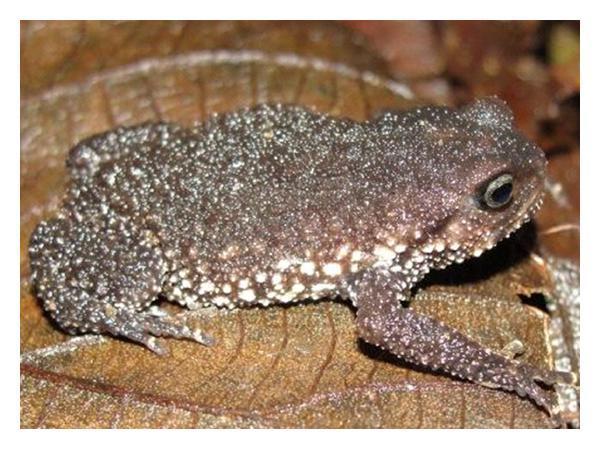
Taita Warty Frog
Callulina dawida
Callulina dawida, also known as Taita warty frog, is a species of frogs in the family Brevicipitidae. It is endemic to Kenya, where it is only found in severely fragmented montane forests in Taita Hills in the south-eastern part of the country. Originally Callulina was thought to be monotypic and widely distributed through Eastern Arc Mountains in Tanzania and in southern Kenya. However, within the last decade eight new species have been identified, many which are considered critically endangered by IUCN. C. dawida was described in 2009 by a team led by Simon Loader; it received its specific name after Dawida language, which is spoken in Taita Hills.
From the article Callulina dawida on Wikipedia (CC BY-SA), quoted section by section
Description
Callulina dawida is a medium-sized frog in which females can reach 55 mm and males 35 mm. The toes of the hind feet are arranged in two opposable groups, with the fourth and fifth together, pointing backward when walking on the forest floor. The skin is warty and dorsal adult colour is variable from light brown, grey, dark brown, orange to yellowish. In terms of colouration there is no well-marked sexual dimorphism. Males have larger tympanum than females.
Range & habitat
Callulina dawida is a high-elevation species occurring in indigenous forest fragments above 1400 m (4600 ft) within Dawida and Mbololo blocks of the Taita Hills. The species is most abundant in the high altitude, but is absent in typical farmland and plantation habitats. Callulina dawida is most active during the warm months of January to March and August to October and less so during the cold months of June and July. They are also less active during the peak rainy seasons in April and November/December, and especially in July, which is the coldest month in the Taita Hills. Callulina dawida is a solitary species. Movement is limited in this species justifying its survival in tiny forest patches. The frogs are good climbers and may perch higher than 1 m on tree stems.
Wikipedia: “Habitat”
Listen
Looking for field recordings…
Where it lives
Recorded sightings
—
geo-referenced records in GBIF, from museums, herbaria and field observers.
Drag the globe to turn it. Dots are where records exist, not a range map; darker means more records.
In the stacks
Searching the stacks…
Every page naming Callulina dawida in the Biodiversity Heritage Library →
This page is assembled live from iNaturalist, GBIF, Wikipedia, the Source Library and the Internet Archive. It is not yet part of the hand-edited codex. iNaturalist taxon 70537.