- Animals
- ›Chordates
- ›Vertebrates
- ›Amphibians
- ›Frogs and Toads
- ›Poison Frogs
- ›Poison Dart Frogs
- ›Hyloxalinae
- ›Hyloxalus
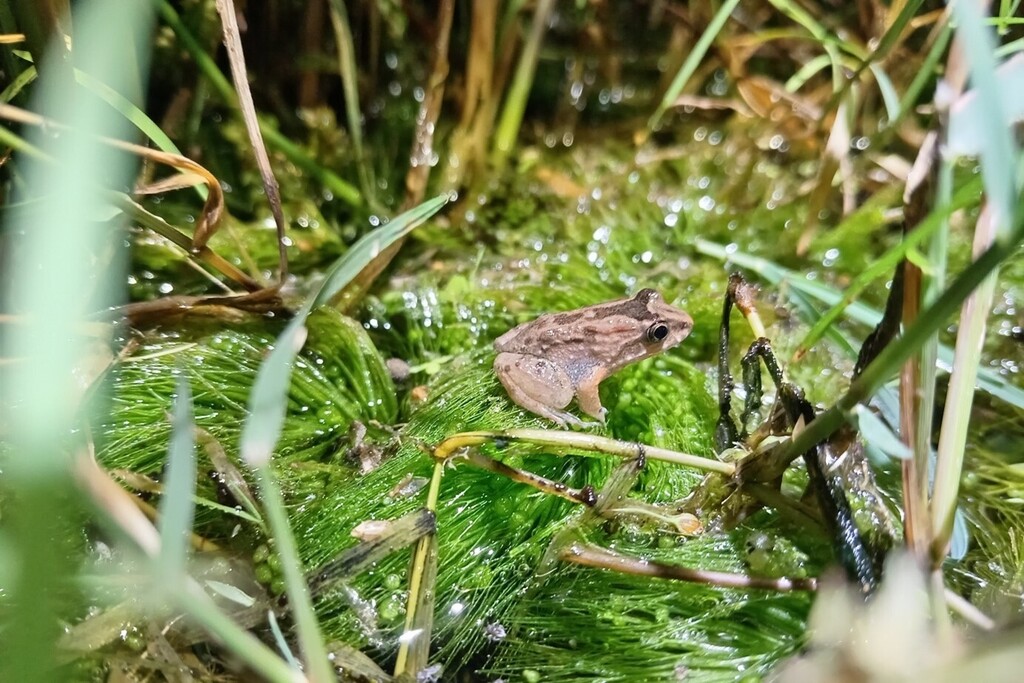
Zapatero Rocket Frog
Hyloxalus sordidatus
Hyloxalus sordidatus is a species of frog in the family Dendrobatidae. It is endemic to Peru.
From the article Hyloxalus sordidatus on Wikipedia (CC BY-SA), quoted section by section
Description
The adult male frog measures 29.9 mm in snout-vent length and the adult female frog is 36.1 mm. This frog has climbing disks on the toes of all four feet. The skin of the dorsum is light brown in color. There are dark brown bars on all four legs. The posterior surfaces of the legs are light brown. There is a dark brown stripe from the nose to the eye to the ear all the way to the groin. There is a dull white stripe from the middle of the body to the groin. There is a dark brown crescent-shaped mark on each foreleg. The adult male frog has a gray belly and the adult female frog has a white belly. The throat and chest are bright yellow. The scutes are gray-tan in color. The iris of the eye is red-bronze in color with black marks and a brown stripe in it. The male frog's testes are white in color. The frog's voice sounds like a high-pitched whistle. It emits ten notes at a time.
Range & habitat
Scientists observed this frog in exactly two places, both in the Cordillera Central, one 500 meters above sea level and the other 520 meters above sea level. This frog has been found cut-over rainforests and in dry thorn forests. This frog was observed near streams. During the day, this frog hides under big rocks. This frog is nocturnal.
Wikipedia: “Habitat”
What it does
Scientists observed tadpoles swimming in streams. At stage 25, the tadpole is 12.5 mm long in body and 30.0 mm long including the tail. The body is globular and wider than it is tall. The nose is round as viewed from above or from the sides. Its eyes are on the top of its head and look out to the top and sides. The body is brown in color and the tail is light orange in color.
Wikipedia: “Reproduction”
Listen
Looking for field recordings…
Where it lives
Recorded sightings
—
geo-referenced records in GBIF, from museums, herbaria and field observers.
Drag the globe to turn it. Dots are where records exist, not a range map; darker means more records.
In the stacks
Searching the stacks…
Every page naming Hyloxalus sordidatus in the Biodiversity Heritage Library →
This page is assembled live from iNaturalist, GBIF, Wikipedia, the Source Library and the Internet Archive. It is not yet part of the hand-edited codex. iNaturalist taxon 70666.