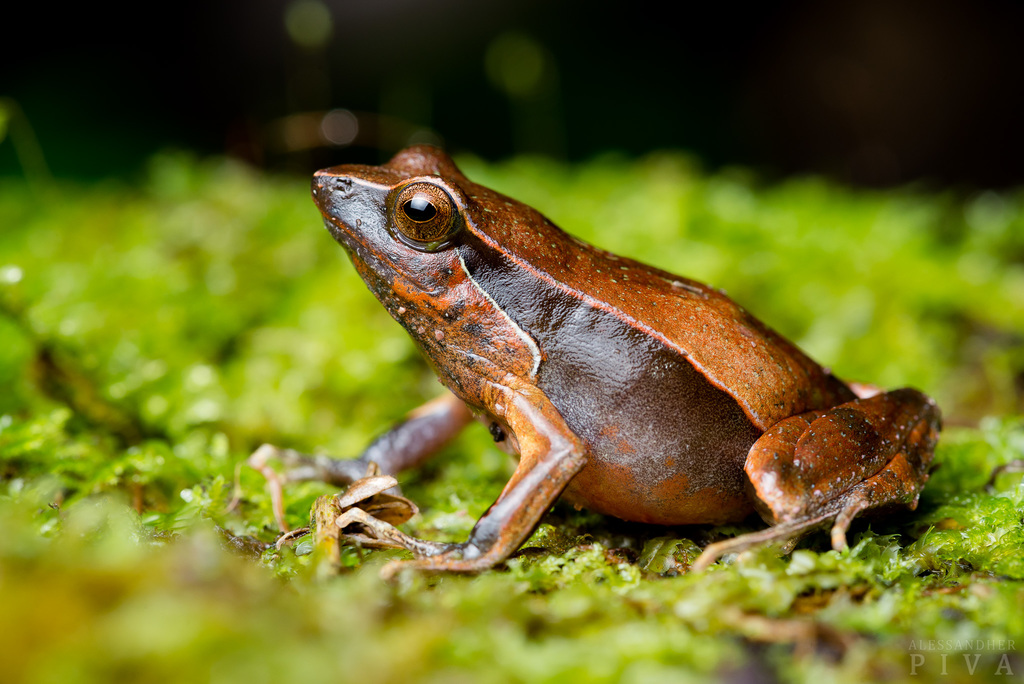
Physalaemus lateristriga
Physalaemus lateristriga is a species of frog in the family Leptodactylidae. It is endemic to Brazil.
From the article Physalaemus lateristriga on Wikipedia (CC BY-SA), quoted section by section
Description
The adult male frog measures 30.3–37.8 mm in snout-vent length and the adult female frog 32.6–40.3 mm. The skin is gray or light brown in color with a line down the middle of the back. There is a black stripe on each side of the body. The upper eyelid has a white line on it. There is a dark brown rectangle on the top of each front leg and brown stripes on the tops of the hind legs. There is a brown mark further down on each hind leg near the heel. There are white spots on the anterior abdomen. The plantar surfaces of all four feet are red in color.
Range & habitat
This frog lives in grassy habitats, rainforests, and the edges of forests. People see them near ponds, rivers, and streams with vegetation nearby. People have also seen them in pasture, secondary forest, and disturbed forests. Scientists have reported it between 45 and 980 m (148 and 3,215 ft) above sea level. Scientists have also reported the frog in many protected places, including Curitiba City Parks and Campos Gerais National Park.
Wikipedia: “Habitat”
Listen
Looking for field recordings…
Where it lives
Recorded sightings
—
geo-referenced records in GBIF, from museums, herbaria and field observers.
Drag the globe to turn it. Dots are where records exist, not a range map; darker means more records.
In the stacks
Searching the stacks…
Every page naming Physalaemus lateristriga in the Biodiversity Heritage Library →
This page is assembled live from iNaturalist, GBIF, Wikipedia, the Source Library and the Internet Archive. It is not yet part of the hand-edited codex. iNaturalist taxon 70823.