On eBird ↗
Hooded Merganser
Live sightings near you, the range map, bar charts of when it is seen, and Macaulay Library photos and recordings.
Hooded Merganser
Lophodytes cucullatus
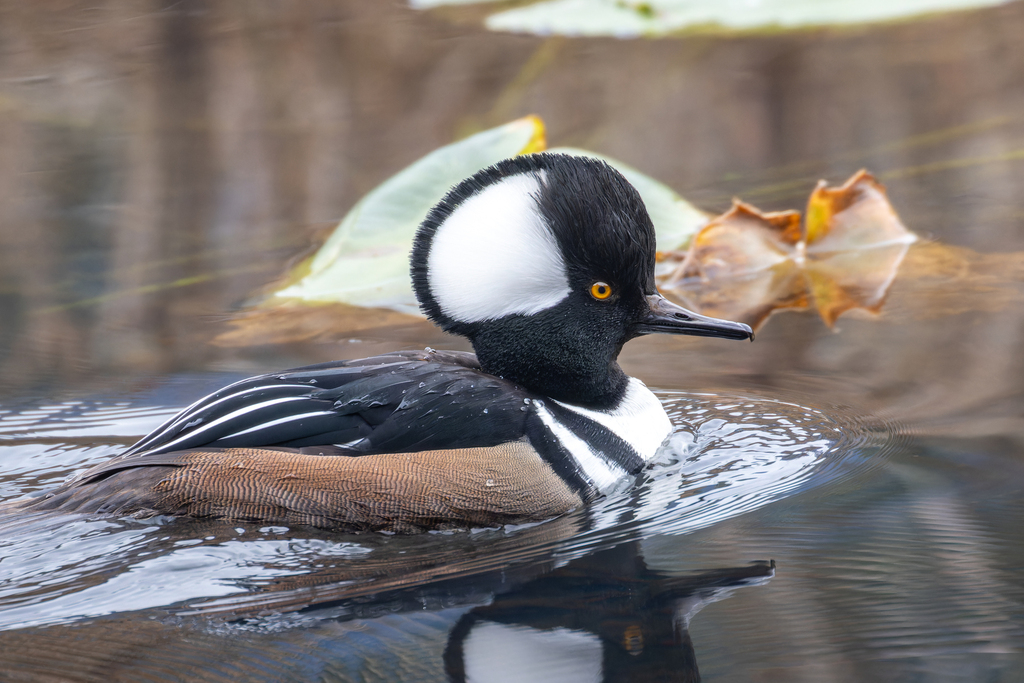
The hooded merganser (Lophodytes cucullatus) is a species of fish-eating duck in the subfamily Anatinae. It is the only extant species in the genus Lophodytes. The genus name derives from Greek: lophos meaning 'crest', and dutes meaning 'diver'. The bird is striking in appearance; both sexes have crests that they can raise or lower, and the breeding plumage of the male is handsomely patterned and colored. The hooded merganser has a sawbill but is not classified as a typical merganser.
Hooded mergansers are the second-smallest species of merganser, with only the smew of Europe and Asia being smaller, and it also is the only merganser whose native habitat is restricted to North America.
From the article Hooded merganser on Wikipedia (CC BY-SA), quoted section by section
Description
The hooded merganser is a sexually dimorphic species. The adult female has a greyish-brown body, with a narrow white patch over the lower breast and belly. She has a light reddish-brown crest extending from the back of the head. During the nonbreeding season the male looks similar to the female, except that his eyes are yellow and the female's eyes are brown. In breeding plumage the dorsal areas and the head, neck and breast of the mature male are mainly black with white markings; there are large white patches on either side of the crest, and they are particularly conspicuous when he raises his crest during courtship. His lower flanks are a rich reddish-brown or chestnut in colour, and the breast and undersides are more or less white, extending into white stripes across the crop and breast. In both sexes there are narrow white stripes along the tertial wing feathers; when the bird is in repose they have the appearance of longitudinal white stripes along the bird's lower back, if they are visible. First-winter birds differ from adult females in appearance in that they have a grey-brown neck and upper parts; the upper parts of adult females are much darker — nearly black. Furthermore, the young birds have narrower white edges to their tertial feathers than adults do. …
Range & habitat
Hooded mergansers are short-distance migrants, and they winter in the United States in regions where winter temperatures allow for ice-free conditions on ponds, lakes and rivers. They have two major year-round ranges. One is in the eastern United States from the southern Canada–US border along the Atlantic Coast to the Gulf Coast in the region of the Mississippi delta. A smaller year-round range extends from Washington state and southern British Columbia to northern Idaho. They also breed to some extent in regions from Missouri to southern Canada and from Nova Scotia to eastern North Dakota and Saskatchewan, migrating when necessary to avoid winter conditions. From 1966 to 2015, the hooded merganser experienced a >1.5% yearly population increase throughout its breeding range. For preference the hooded merganser lives on small bodies of water such as ponds and small estuaries where there is ample emergent aquatic vegetation, but it also inhabits larger wetlands, impoundments, flooded timber, and rivers. They prefer fresh water but do occur on brackish water bodies as well.
Feral to Europe. Although the hooded merganser is a common species in captivity in Europe and most specimens recorded in the wild are regarded as escapes, or feral animals, a small number of birds have been regarded as genuinely wild vagrants. …
Wikipedia: “Distribution and habitat”
What it does
The hooded merganser is a diving predator that largely hunts by sight while under water. Most studies report that its diet varies according to circumstances, usually being dominated by fish (44–81%). In addition it feeds on aquatic insects (13–20% of its diet) and other aquatic invertebrates such as crabs and crayfish (22 to 50%).
Wikipedia: “Food and feeding”
Listen
Looking for field recordings…
Where it lives
Recorded sightings
—
geo-referenced records in GBIF, from museums, herbaria and field observers.
Drag the globe to turn it. Dots are where records exist, not a range map; darker means more records.
In the old herbals & bestiaries

In the stacks
Searching the stacks…
Every page naming Lophodytes cucullatus in the Biodiversity Heritage Library →
This page is assembled live from iNaturalist, GBIF, Wikipedia, the Source Library and the Internet Archive. It is not yet part of the hand-edited codex. iNaturalist taxon 7109.