On eBird ↗
Rosy-billed Pochard
Live sightings near you, the range map, bar charts of when it is seen, and Macaulay Library photos and recordings.
Rosy-billed Pochard
Netta peposaca
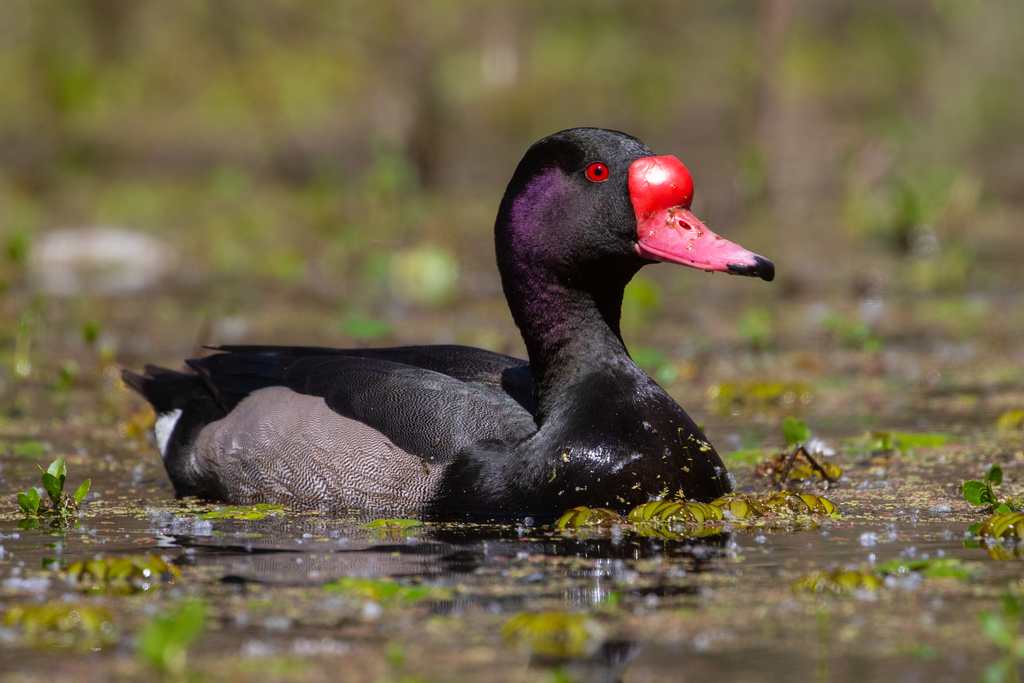
The rosy-billed pochard (Netta peposaca), alternatively named rosybill or rosybill pochard, is a member of family Anatidae. Though classified as a diving duck, this pochard feeds more like a dabbling duck feeding on seeds roots, sedges, aquatic plants and other grasses. Netta is Ancient Greek for "duck" and peposaca is a transcription of the Guaraní name of this species which means "showy wings", referring to the broad white stripe that is only visible with stretched out wings. Male characteristic features include a bright red bill with a rounded knob at the base.
The rosy-billed pochard is endemic to South America. It is found in Argentina, central Chile, Paraguay, Uruguay and southern Brazil. The population in southern Argentina migrates northward during the austral winter, reaching Brazil and southern Bolivia. It is a vagrant to the Falkland Islands.
From the article Rosy-billed pochard on Wikipedia (CC BY-SA), quoted section by section
Description
Like many other members of family Anatidae, the rosy-billed pochard exhibits significant sexual dimorphism. Males have a purplish-black head, neck and breast with gray sides, a white area on the crissum (the area around the cloaca), and a bright red bill and red eyes. The bill has a large rounded knob, which is bright red, and rest of the bill gradually fades towards a pale pink before ending with a black tip. The rounded knob of the bill increases in size and intensity in colour during the mating season. When in flight, the mostly dark plumage noticeably contrasts with the white primaries and secondaries. The legs and feet are yellow to orange. On the other hand, females are dull and brown. The bill is bluish-gray with a black tip and the legs are yellow-orange to gray. The contrasting white crissum is the most noticeable feature on females. Young are almost identical in appearance to the females, but their underparts are darker. Rosybill adults lack the dull eclipse plumage that is characteristic of northern individuals of the genera Aytha and Anas. Males tend to be slightly larger than females, but in general both sexes are very similar in terms of body size. Adults can grow to about 22 inches (56 cm) in length and weigh 2.2-2.6 pounds (1-1.2 kg). …
Range & habitat
Rosy-billed pochards nest within tall grasses in wetlands, mainly in areas that extend from the central provinces of Córdoba, Santa Fe, Entre Ríos, and Buenos Aires, southwards to Río Negro. Individuals are also found in shallow freshwater swamps, marshes and small lakes. They are a fully migrant species and their movements are heavily associated with water conditions. Seasonal dry periods are common in central Argentina and they force birds to move towards larger water areas in late summer. By early fall, these areas are often dry and individuals are forced to move to find more water and better food sources elsewhere. An increase in population size can be seen during wet periods.
Wikipedia: “Distribution and habitat”
What it does
Rosy-billed pochards are highly sociable ducks and may congregate in flocks of thousands of individuals.
Diet. Rosybills are omnivorous ducks, feeding on mostly knotgrass and barnyard grasses, but also roots, sedges, aquatic plants and other grasses and some animal products. However, their diet is dominated by seed consumption. This seed-dominated diet is due to the need to obtain carbohydrate-rich food, which is essential for meeting their thermoregulation requirements for the season. The seeds are high in energy, and this energy is also important for controlling temperature stressors. Though they are classified as diving ducks, they feed by dabbling on the surface of the water, upending in shallow water and occasionally grazing on land, but they rarely dive. Since the rosybill has a relative general diet and does not depend on a single food source, the species is said to be relatively adaptable to the offer of alternate food sources.
Reproduction. Each breeding season, a male and female rosy-billed pochard will form a seasonal bond. The pairs, however, are not monogamous and they do not pair for life. A distinct spring courtship period exists during which courtship displays are important. The courtship displays are performed before breedings and consist of distinct movements performed by both sexes. …
Wikipedia: “Behaviour”
Listen
Looking for field recordings…
Where it lives
Recorded sightings
—
geo-referenced records in GBIF, from museums, herbaria and field observers.
Drag the globe to turn it. Dots are where records exist, not a range map; darker means more records.
In the stacks
Searching the stacks…
Every page naming Netta peposaca in the Biodiversity Heritage Library →
This page is assembled live from iNaturalist, GBIF, Wikipedia, the Source Library and the Internet Archive. It is not yet part of the hand-edited codex. iNaturalist taxon 7124.