On eBird ↗
Falkland Steamer-Duck
Live sightings near you, the range map, bar charts of when it is seen, and Macaulay Library photos and recordings.
Falkland Steamer Duck
Tachyeres brachypterus
The Falkland steamer duck (Tachyeres brachypterus) is a species of flightless duck found on the Falkland Islands in the South Atlantic Ocean. The steamer ducks get their name from their unconventional swimming behaviour in which they flap their wings and feet on the water in a motion reminiscent of an old paddle steamer. The Falkland steamer duck is one of only two bird species endemic to the Falkland Islands, the other being Cobb's wren.
From the article Falkland steamer duck on Wikipedia (CC BY-SA), quoted section by section
Description
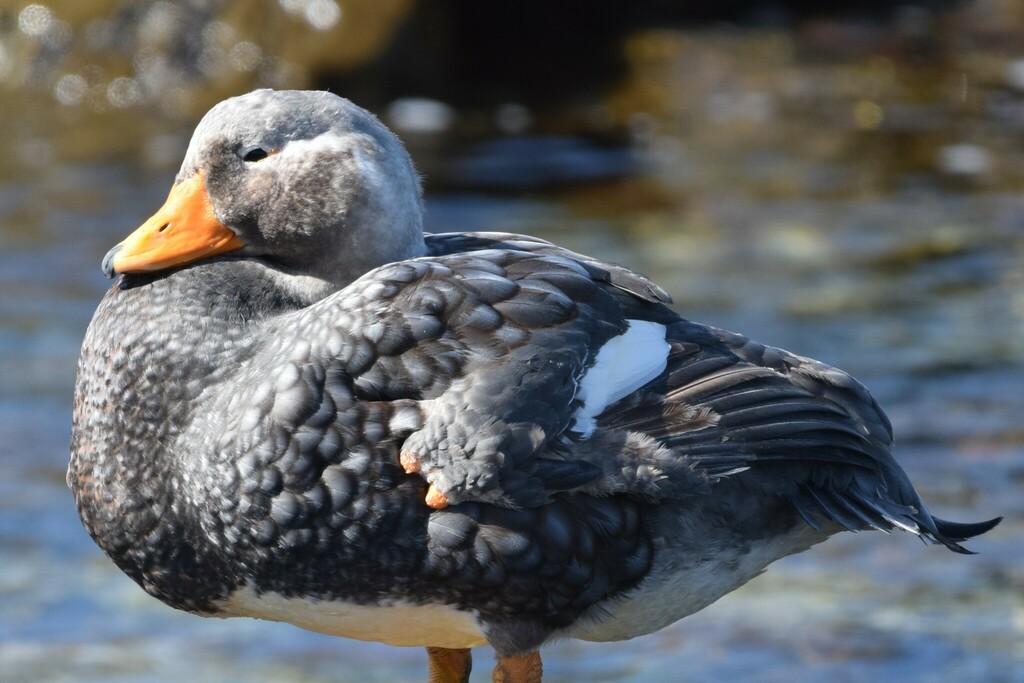
The Falkland steamer duck measures between 61 and 74 cm in length and has a wingspan of 84 to 94 cm. It is a fairly large species of duck with males weighing between 3300 and 4800 g, and females between 2900 and 4196 g. The male's plumage is brown to grey with a contrasting light grey-white head. They have a distinctive orange bill. The wings have white secondary feathers and large, featherless spurs. The stubby tail is brown-grey. The eyes are brown with a contrasting white eye-ring and a faint white eye-streak. The females are darker in colour with a brown neck and head and an olive green beak. Females also have a distinctive white eye ring and a white line behind their eyes. Both males and females have characteristic yellow-orange feet. Juveniles can be differentiated from females by the black marks and overall paler colour of their feet. They also lack or have a very reduced white line behind their eyes. This species is visually similar to another steamer duck species with which it shares its range: the flying steamer duck. Although they are difficult to tell apart in the field, the Falkland steamer duck has shorter wings and tail and a thicker neck and bill. Finally, as its name implies, the flying steamer duck is capable of flight while the Falkland steamer duck is strictly flightless. …
Range & habitat
The species' distribution is limited to the Falkland Islands in the South Atlantic Ocean. These ducks are year-round residents of the islands and the surrounding archipelago, and can be found mainly on rugged shores and in sheltered bays. Falkland steamer ducks also venture inland to freshwater ponds up to 400 m from the coast.
Wikipedia: “Habitat and distribution”
What it does
This species spends most of its time in small family groups composed of the female, the male and the chicks. However, non-breeding adults and juveniles might gather in larger groups of up to 300. These gatherings can happen at any time of the year and their purpose remains unknown.
Vocalization. The Falkland steamer duck's vocalizations are similar to those of the flying steamer duck. Males can be heard year-round, but they are especially vocal during the breeding season, during which they use their vocalization to defend their territory. Their call consists of loud rasping whistles and repeated sharp ticking notes. Females usually sing with the males and produce deeper grunts. This bird is loud and can easily be heard on and around the shores of the Falklands.
Diet. The Falkland steamer duck feeds mainly on marine mollusks and, occasionally, on crustaceans. Although they can upend when feeding in shallower waters, they mainly dive to find their preys on the sea floor. They used their small wings and large feet to effectively propel themselves in the water. Interestingly, they have been observed to feed collectively with many individuals diving at the same time.
Reproduction. The breeding season lasts from mid September to the end of December, but breeding can take place year-round. Adults breed in single pairs on and around the coastline. …
Wikipedia: “Behavior”
Listen
Looking for field recordings…
Where it lives
Recorded sightings
—
geo-referenced records in GBIF, from museums, herbaria and field observers.
Drag the globe to turn it. Dots are where records exist, not a range map; darker means more records.
In the stacks
Searching the stacks…
Every page naming Tachyeres brachypterus in the Biodiversity Heritage Library →
This page is assembled live from iNaturalist, GBIF, Wikipedia, the Source Library and the Internet Archive. It is not yet part of the hand-edited codex. iNaturalist taxon 7132.