On eBird ↗
Flying Steamer-Duck
Live sightings near you, the range map, bar charts of when it is seen, and Macaulay Library photos and recordings.
Flying Steamer Duck
Tachyeres patachonicus
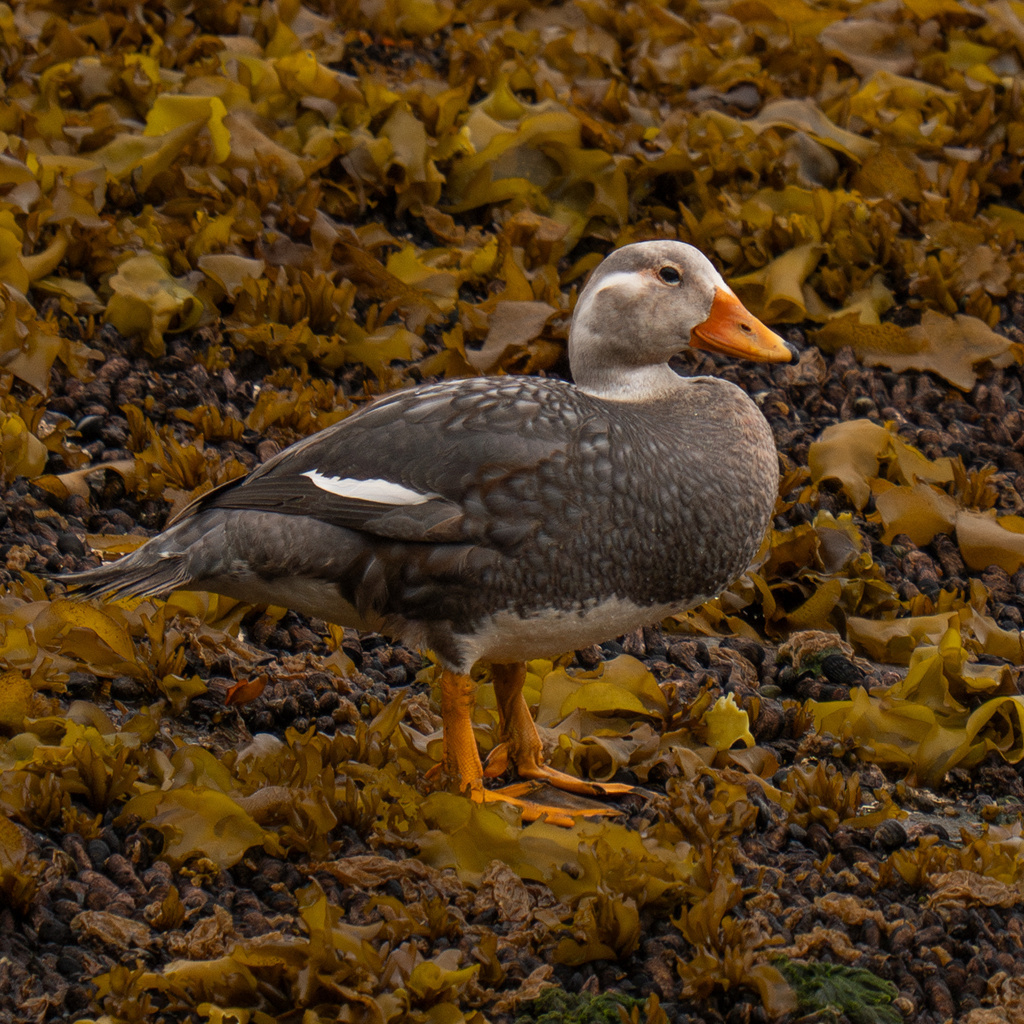
The flying steamer duck (Tachyeres patachonicus) is a steamer duck. It is the most widespread steamer duck, resident in southern Chile and Argentina, Tierra del Fuego and the Falkland Islands. Its plumage is very similar to the other three steamer ducks. It is the only steamer duck which can fly, and the only one to occur on inland fresh waters.
From the article Flying steamer duck on Wikipedia (CC BY-SA), quoted section by section
Description
Though they are the smallest of the four Tachyeres species, flying steamer ducks share similar plumage traits with other steamer ducks including female brown head and neck feathers with white stripes stretching from their eyes to the napes of their necks, and brown-gray gradient body feathers. Their underbellies are mostly white, and their feet are orange. Female flying steamer ducks have smaller bills relative to males that are orange with black tips, while males have darker gray bills with slight yellow accents. Flying steamer ducks are also sexually dimorphic to the extent that males are heavier but have smaller cranial elements and wingspans than females. Males and females both possess cornified orange carpal knobs on the proximal part of the carpometacarpus bone, and these knobs are used in display as well as interspecies and intraspecies combat by males. Sexual dimorphism can also be observed in the duration and pitch of their various calls, which sound much like grunts. The females' grunts have been described as lower pitched than the males' grunts, and usually occur in rapid succession of similar pitch. Males have three distinct grunts that have been described as whistle-like, including a 'rasping' grunt, a 'ticking' grunt, and a 'sibilant' grunt. Flying steamer ducks undergo three molts per annual cycle, and these molts vary widely with geographic location. …
Range & habitat
Flying steamer ducks inhabit aquatic areas of central/southern Chile and Argentina. Genetic comparisons of Falkland Island steamer ducks suggest the species diverged from continental steamer duck species between 2.2 and 2.6 million years ago, coinciding with a proposed land bridge that may have once connected the Falkland Islands to the mainland. The three steamer duck species that inhabit the mainland share a common ancestor roughly 15,000 years ago, and the species show genetic differentiation as well as different stages between flightless-ness and flying ability. For this reason, steamer ducks have been praised as an excellent potential genus for studying the evolution of flightless-ness in birds. Flying steamer ducks are widely distributed compared to other steamer duck species, likely due to their flying ability, and have been observed to reside in both freshwater and marine environments throughout Chile, Argentina, and the Falkland Islands.
Wikipedia: “Distribution and Habitat”
What it does
Both flightless and flying steamer ducks engage in foraging behaviors with interspecific and intersexual differences. Flying steamer ducks have almost exclusively been observed to forage in pairs, preferring to dive either around deep-water kelp beds or around shallow water zones. Males and females do not show consistencies among pairs in terms of who is the first to dive, but within pairs the first to dive is consistent in all observed diving instances. Flying steamer ducks share dietary preferences with other steamer duck species and have been reported to feed on mollusks and crustaceans as well as other marine invertebrates, but little is known about the precise species that steamer ducks prey on.
Wikipedia: “Food and Feeding”
Listen
Looking for field recordings…
Where it lives
Recorded sightings
—
geo-referenced records in GBIF, from museums, herbaria and field observers.
Drag the globe to turn it. Dots are where records exist, not a range map; darker means more records.
In the stacks
Searching the stacks…
Every page naming Tachyeres patachonicus in the Biodiversity Heritage Library →
This page is assembled live from iNaturalist, GBIF, Wikipedia, the Source Library and the Internet Archive. It is not yet part of the hand-edited codex. iNaturalist taxon 7133.