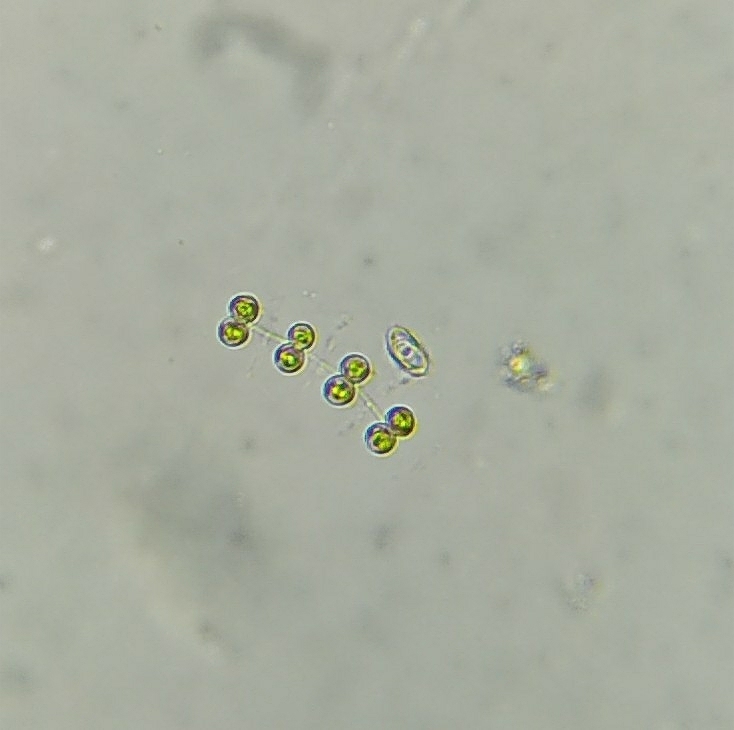
Cosmocladium
Cosmocladium is a genus of freshwater green algae, specifically of the Desmidiaceae. Currently there are 7 accepted species, though there are 11 described. The holotype is Cosmocladium pulchellum Brébisson described in 1856.
Cosmocladium is a colonial organism, consisting of usually up to 16 cells. Colonies may be free-floating or attached to filamentous algae. The cells are typically quite small, consisting of two identical halves called semicells, and are constricted at the isthmus where the semicells are joined. Cells are connected to each other by thin strands (bundles of microfibrils) secreted by special pores near isthmus, forming a branched network. Semicells are ellipsoid or elongate-oval in apical view, with one chloroplast per semicell each containing a central pyrenoid. The cell wall is smooth. A single nucleus is found in the center of each cell.
2 branches of this genus, most-observed first
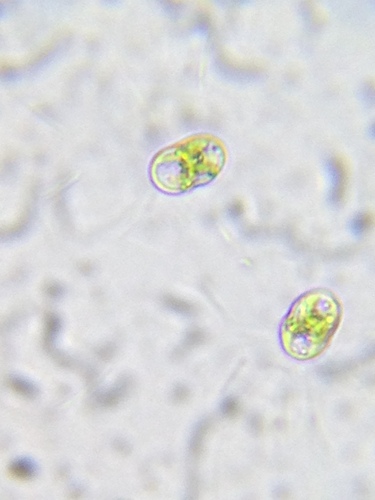
Cosmocladium constrictum
speciesCosmocladium constrictum
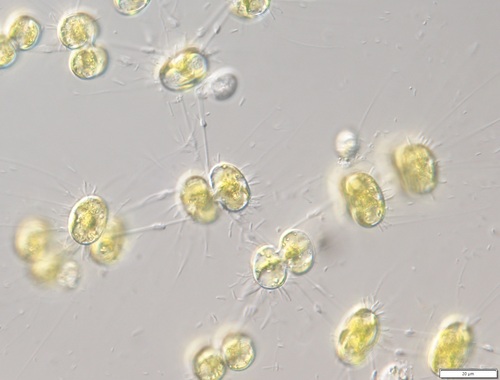
Cosmocladium saxonicum
speciesCosmocladium saxonicum
Where it lives
Recorded sightings
—
geo-referenced records in GBIF, from museums, herbaria and field observers.
Drag the globe to turn it. Dots are where records exist, not a range map; darker means more records.
In the stacks
Searching the stacks…
Every page naming Cosmocladium in the Biodiversity Heritage Library →
This page is assembled live from iNaturalist, GBIF, Wikipedia, the Source Library and the Internet Archive. It is not yet part of the hand-edited codex. iNaturalist taxon 714045.