On eBird ↗
Black-headed Duck
Live sightings near you, the range map, bar charts of when it is seen, and Macaulay Library photos and recordings.
Black-headed Duck
Heteronetta atricapilla
The black-headed duck (Heteronetta atricapilla) is a South American duck allied to the stiff-tailed ducks in the tribe Oxyurini of the family Anatidae. It is the only member of the genus Heteronetta.
From the article Black-headed duck on Wikipedia (CC BY-SA), quoted section by section
Description
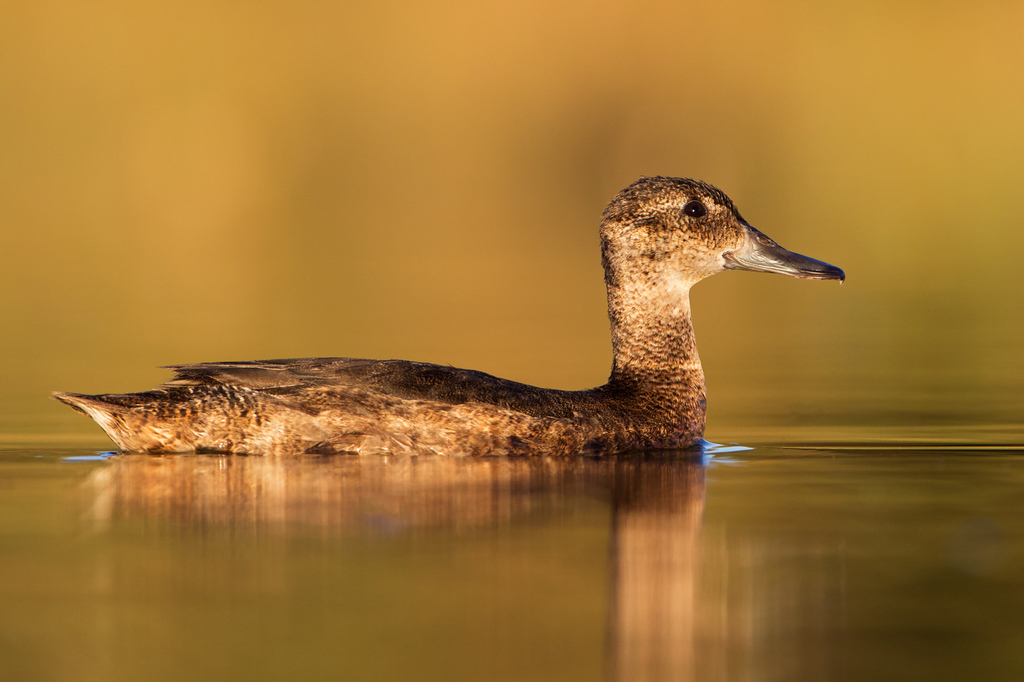
The black-headed duck is the most basal living member of its subfamily, and it lacks the stiff tail and swollen bill of its relatives. Overall much resembling a fairly typical diving duck, its plumage and other peculiarities indicate it may not be a very close relative of the other stiff-tailed ducks, but rather the product of convergent evolution from the ancestors of the stiff-tailed ducks. The black-headed duck is about 35 cm (14 in) long. Males weigh an average of about 510 g (18 oz) and females 565 g (20 oz). The species has a distinctive shape, with a long body and disproportionately short wings. Its bill has a black maxilla and an orange mandible; the maxilla has a rosy patch at its base during the breeding season. Adult males have a glossy black head and upper neck and a white chin. Their upperparts are deep brownish black with cinnamon or pale rufous speckles and vermiculation. The folded wing shows two white bars. Their underparts are whitish with brown mottling and appear silvery. Adult females have a dark brown head and neck and a whitish throat, and are otherwise like the male. Immature birds are similar to the female but have more rufous upperparts, more yellowish underparts, and a pale eye stripe.
Range & habitat
The black-headed duck has two separate ranges. One is the western side of central Chile. The other is from extreme southern Bolivia south through central Paraguay to central Argentina and east through southern Uruguay into southernmost Brazil. Undocumented sight records in the Falkland Islands lead the South American Classification Committee of the American Ornithological Society to treat it as hypothetical there. It mostly inhabits freshwater marshes whose dominant plant is the sedge Scirpus californicus, and outside the breeding season may be found in lakes, water-filled ditches, and sometimes flooded fields.
Wikipedia: “Distribution and habitat”
What it does
The black-headed duck feeds by diving. Though little information is available about its diet, a major component appears to be seeds of Scirpus californicus, and snails a minor component.
Wikipedia: “Feeding”
Listen
Looking for field recordings…
Where it lives
Recorded sightings
—
geo-referenced records in GBIF, from museums, herbaria and field observers.
Drag the globe to turn it. Dots are where records exist, not a range map; darker means more records.
In the stacks
Searching the stacks…
Every page naming Heteronetta atricapilla in the Biodiversity Heritage Library →
This page is assembled live from iNaturalist, GBIF, Wikipedia, the Source Library and the Internet Archive. It is not yet part of the hand-edited codex. iNaturalist taxon 7156.