Heteralocha
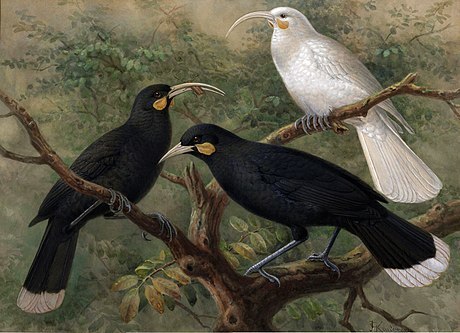
The huia ( HOO-yə, -ee-ə; Māori: [ˈhʉia]; Heteralocha acutirostris) is an extinct species of New Zealand wattlebird, endemic to the North Island of New Zealand. The last confirmed sighting of a huia was in 1907, although there was another credible sighting in 1924.
It was already a rare bird before the arrival of Europeans, confined to the Ruahine, Tararua, Rēmutaka and Kaimanawa mountain ranges in the south-east of the North Island. It was remarkable for its pronounced sexual dimorphism in bill shape; the female's beak was long, thin and arched downward, while the male's was short and stout, like that of a crow. Males were 45 cm (18 in) long, while females were larger at 48 cm (19 in). The sexes were otherwise similar, with orange wattles and deep metallic, bluish-black plumage with a greenish iridescence on the upper surface, especially about the head. The tail feathers were unique among New Zealand birds in having a broad white band across the tips.
1 branches of this genus, most-observed first
See this branch on the Wheel of Life →
Where it lives
Recorded sightings
—
geo-referenced records in GBIF, from museums, herbaria and field observers.
Drag the globe to turn it. Dots are where records exist, not a range map; darker means more records.
In the stacks
Searching the stacks…
Every page naming Heteralocha in the Biodiversity Heritage Library →
This page is assembled live from iNaturalist, GBIF, Wikipedia, the Source Library and the Internet Archive. It is not yet part of the hand-edited codex. iNaturalist taxon 71702.