On eBird ↗
Pink-eared Duck
Live sightings near you, the range map, bar charts of when it is seen, and Macaulay Library photos and recordings.
Pink-eared Duck
Malacorhynchus membranaceus
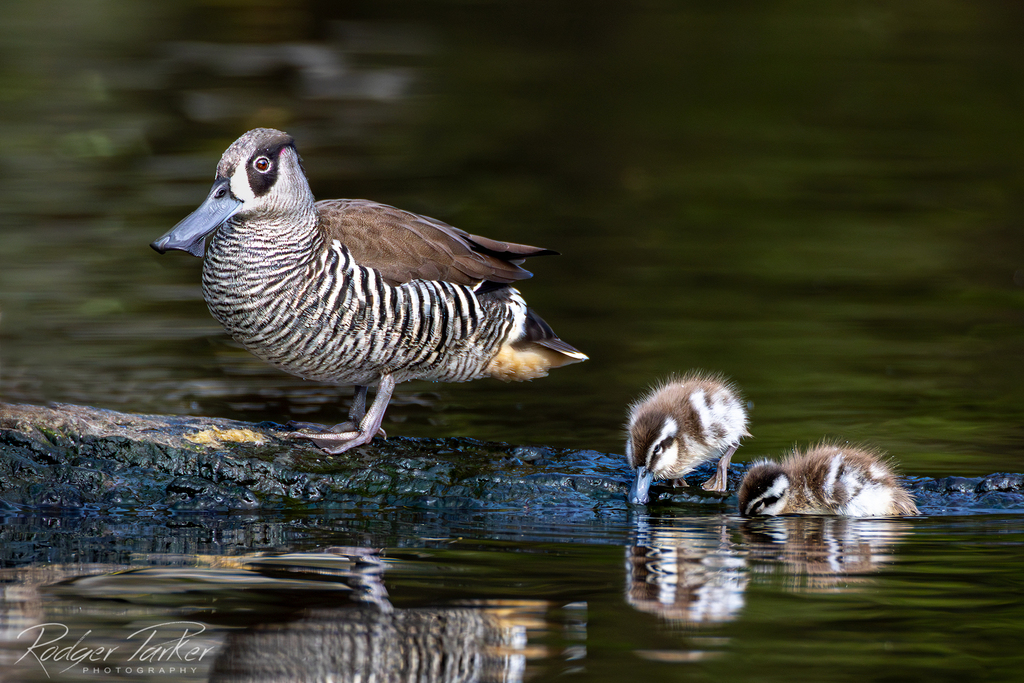
The pink-eared duck (Malacorhynchus membranaceus) is a species of duck found in Australia. It has a large spatulate bill like the Australasian shoveler, but is smaller at 38–40 cm length. Its brown back and crown, black and white barred sides and black eye patches on its otherwise white face make this bird unmistakable. Juveniles are slightly duller, but otherwise all plumages are similar. Its vernacular name refers to a pink spot in the corner formed by the...
From the article Pink-eared duck on Wikipedia (CC BY-SA), quoted section by section
Description
The pink-eared duck has a large spatulate bill like the Australasian shoveler, but is smaller at 38–40 cm length. Its brown back and crown, black and white barred sides and black eye patches on its otherwise white face make this bird unmistakable. Juveniles are slightly duller, but otherwise all plumages are similar. Its vernacular name refers to a pink spot in the corner formed by the black head pattern; it is only noticeable at close distance however, making the origin of the seldom-used Australian name of zebra duck more readily apparent.
Range & habitat
Widely distributed throughout Australia and highly mobile, these ducks can appear anywhere there is standing water, especially in dry inland regions, where annual rainfall rarely exceeds 15 in (380 mm).
Wikipedia: “Distribution”
At the table
They are dependent on plankton, as well as crustaceans, mollusks and insects. Their bill is well designed for straining minute organisms, with pliable mandibular flaps that channel water in a manner that allow the ducks to filter algae and other plankton efficiently. They also feed by vortexing, in which two ducks spin about a central point with the head of one opposite the tail of the other, concentrating food in a gyrating water column.
Wikipedia: “Food”
Listen
Looking for field recordings…
Where it lives
Recorded sightings
—
geo-referenced records in GBIF, from museums, herbaria and field observers.
Drag the globe to turn it. Dots are where records exist, not a range map; darker means more records.
In the stacks
Searching the stacks…
Every page naming Malacorhynchus membranaceus in the Biodiversity Heritage Library →
This page is assembled live from iNaturalist, GBIF, Wikipedia, the Source Library and the Internet Archive. It is not yet part of the hand-edited codex. iNaturalist taxon 7174.