- Animals
- ›Chordates
- ›Vertebrates
- ›Amphibians
- ›Frogs and Toads
- ›Southern Frogs
- ›Leiuperinae
- ›Pseudopaludicola
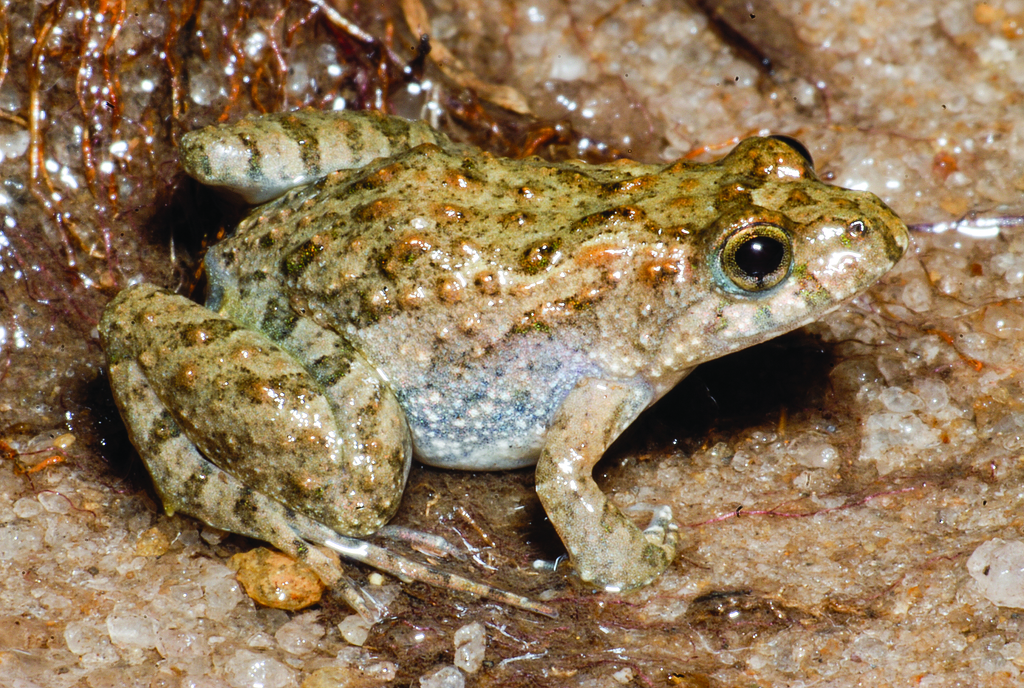
Pseudopaludicola restinga
Pseudopaludicola restinga is a species of amphibian in the family Leptodactylidae, which is found in the coastal region of Espírito Santo, Brazil.
It can be differentiated from the other species of the genus Pseudopaludicola by a number of factors, such as its size, body shape, vocalization pattern, and number of chromosomes. Males have an average length between 11 and 14 millimeters, and females between 14 and 16 millimeters. Males vocalize during the night, right after long rains, with calls consisting of two pulses.
From the article Pseudopaludicola restinga on Wikipedia (CC BY-SA), quoted section by section
Description
Its average length varies between 11.7 and 14.6 millimeters in males and between 14 and 16.7 in females. The length of its head is longer than its width, its snout is tapered when viewed dorsally and more prominent than the jaw when viewed laterally. The distance between the nostrils is slightly smaller than the eyes, and the eardrum is not visible. It has a developed vocal sac with a central fold, its loreal region is flat and its canthus rostralis is not noticeable. Its tongue is complete, oval, with a loose front part and a base without pigment. It has maxillary and premaxillary teeth. Its body is slender, with smooth skin and small flattened warts on the side of the body. Its belly is whitish, with black spots on the abdomen, throat, and thighs. Its upper limbs have 4 fingers, the last being the longest, and its lower limbs have 5 fingers, the fourth being the longest. It can be differentiated from Pseudopaludicola falcipes by having an incomplete abdominal fold, and from P. hyleaustralis by the presence of protuberances on the eyebrow. It can also be differentiated from P. atragula by the fact that the latter has a reticulate vocal sac with a dark tone and no central folds. Some individuals may have variations in the coloration of the back, which can vary from brownish to dark brown. …
Range & habitat
Currently, there are only reports of the species in six cities in Espírito Santo: Serra, Guarapari, Vitória, Presidente Kennedy, Vila Velha, and Itapemirim. The local biome is restinga, and individuals can be found among dunes or on the edge of wet or flooded lagoons. The restingas, which are composed of herbaceous and marshy vegetation, are suffering destruction from anthropic actions, caused mainly by economic expansions, such as the use of the site for the creation of ports and exploration of oil and natural gas, which may endanger the local fauna. However, with the discovery of this new species, it is possible that environmental laws will be created to protect the sandbanks of Espírito Santo. It has not yet been evaluated by the International Union for Conservation of Nature (IUCN).
Wikipedia: “Distribution and conservation”
Listen
Looking for field recordings…
Where it lives
Recorded sightings
—
geo-referenced records in GBIF, from museums, herbaria and field observers.
Drag the globe to turn it. Dots are where records exist, not a range map; darker means more records.
In the stacks
Searching the stacks…
Every page naming Pseudopaludicola restinga in the Biodiversity Heritage Library →
This page is assembled live from iNaturalist, GBIF, Wikipedia, the Source Library and the Internet Archive. It is not yet part of the hand-edited codex. iNaturalist taxon 717583.