On eBird ↗
Brazilian Teal
Live sightings near you, the range map, bar charts of when it is seen, and Macaulay Library photos and recordings.
Brazilian Teal
Amazonetta brasiliensis
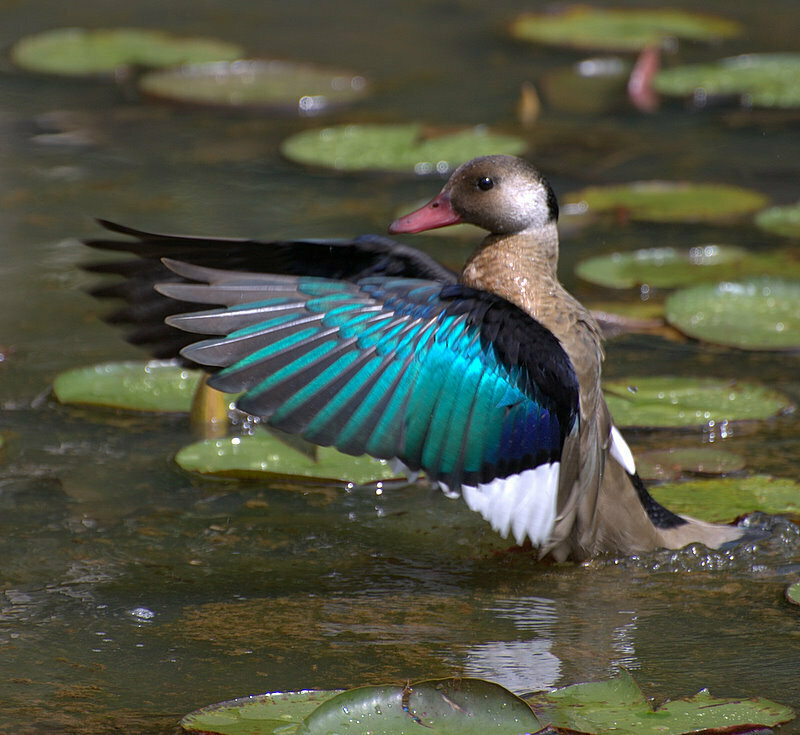
The Brazilian teal or Brazilian duck (Amazonetta brasiliensis) is the only extant species of duck in the genus Amazonetta. It is widely distributed in eastern South America.
From the article Brazilian teal on Wikipedia (CC BY-SA), quoted section by section
Description
The ducks are light brown in colour. Drakes distinguish themselves from females in having red beaks and legs, and in having a distinctive pale grey area on the side of its head and neck. The colour of these limbs is much duller in females.
Range & habitat
They can be found throughout eastern South America, from central Brazil, to Uruguay, to northern and eastern Argentina, Paraguay, central Venezuela, northeastern Peru, Suriname, Guyana, French Guiana, eastern Bolivia, and eastern Colombia. Their preferred habitat is a body of freshwater away from the coast with dense vegetation nearby.
Wikipedia: “Distribution and habitat”
What it does
Brazilian teal live in pairs or in small groups of up to twenty birds. Both parents look after their hatchlings. They eat seeds, fruits, roots and insect, while ducklings eat only insects.
Wikipedia: “Behaviour”
Listen
Looking for field recordings…
Where it lives
Recorded sightings
—
geo-referenced records in GBIF, from museums, herbaria and field observers.
Drag the globe to turn it. Dots are where records exist, not a range map; darker means more records.
In the stacks
Searching the stacks…
Every page naming Amazonetta brasiliensis in the Biodiversity Heritage Library →
This page is assembled live from iNaturalist, GBIF, Wikipedia, the Source Library and the Internet Archive. It is not yet part of the hand-edited codex. iNaturalist taxon 7182.