On eBird ↗
Black-crowned Barwing
Live sightings near you, the range map, bar charts of when it is seen, and Macaulay Library photos and recordings.
Black-crowned Barwing
Actinodura sodangorum
The black-crowned barwing (Actinodura sodangorum) is a non-migratory bird from Indochina in the family Leiothrichidae (laughingthrushes and allies). The genus name Actinodura is from Ancient Greek meaning "ray-like tail" (actinodes and ura), while the specific epithet sodangorum is from the Xo Dang tribe which lives in Ngoc Linh and other areas in Vietnam, Cambodia and Laos where black-crowned barwings are found.
From the article Black-crowned barwing on Wikipedia (CC BY-SA), quoted section by section
Description
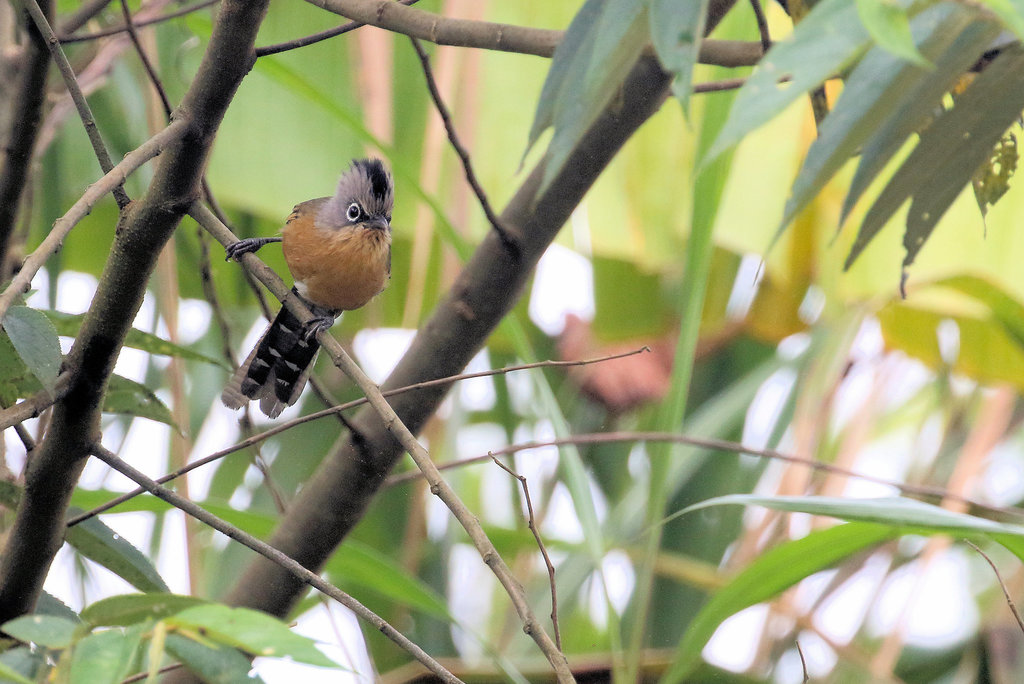
The black-crowned barwing is the only bird in the genus Actinodura to have a black crown. The transverse barring on the wings (wingbars) and the crest are characteristic of the genus. The sexes are similar in appearance. It has a grey head and nape, black crown and lore (space between eye and beak), white eye rings, dark brown irises, and dark beak with a flesh coloured tip. The throat is streaked with black-brown on a base of rufous-orange that matches the breast and belly area. The posterior parts of the body (mantle, back, rump, and uppertail coverts) are olive-brown with indistinct dark bars. The wings have fine bars on the scapulars (upper wing section) and black-brown with chestnut or orange-buff bars on most of the flight feathers (primaries and secondaries). Their long tail is graduated chestnut with white tips and broad black bars.
Measurements. The lengths are approximately:
Upper beak (culmen) = 17.5 mm (0.69 in) Leg length (starting from under the knees) = 31 mm (1.2 in) Single wing length (measured from chord to mass) = 89 mm (3.5 in) Tail-length = 133 mm (5.2 in)
Range & habitat
They are resident at three locations in Laos and at seven locations in Vietnam. They are also found in Important Bird and Biodiversity Areas (IBA) including the DakChung Plateau, Lo Xo Pass, and Ngoc Linh. Their natural habitats are subtropical or tropical moist montane forest, subtropical or tropical high-altitude shrubland, subtropical or tropical high-altitude grassland, and plantations. Although they use degraded/cleared forests, they are mostly found in secondary growth or evergreen forests. Their elevation maximum was at 2,400 m (7,900 ft), with observers noting fewer sightings above 2,200 m (7,200 ft). The minimum elevation range could not be determined properly since the site contained loss of forest habitat below 1,500 m (4,900 ft), though there were sightings at 1,000 m (3,300 ft).
Wikipedia: “Distribution and habitat”
What it does
Their diet is not well known, but they are suspected to be insectivores that also eat vegetation. The bird is often seen foraging alone or with a partner around the smaller branches of tree canopy, trunk, and along larger moss-covered branches.
Wikipedia: “Diet”
Listen
Looking for field recordings…
Where it lives
Recorded sightings
—
geo-referenced records in GBIF, from museums, herbaria and field observers.
Drag the globe to turn it. Dots are where records exist, not a range map; darker means more records.
In the stacks
Searching the stacks…
Every page naming Actinodura sodangorum in the Biodiversity Heritage Library →
This page is assembled live from iNaturalist, GBIF, Wikipedia, the Source Library and the Internet Archive. It is not yet part of the hand-edited codex. iNaturalist taxon 72457.