On eBird ↗
Yellow-winged Blackbird
Live sightings near you, the range map, bar charts of when it is seen, and Macaulay Library photos and recordings.
Yellow-winged Blackbird
Agelasticus thilius
The yellow-winged blackbird (Agelasticus thilius) is a species of bird in the family Icteridae, the oropendolas, New World orioles, and New World blackbirds. It is found in Argentina, Bolivia, Brazil, Chile, Paraguay, Peru, and Uruguay.
From the article Yellow-winged blackbird on Wikipedia (CC BY-SA), quoted section by section
Description
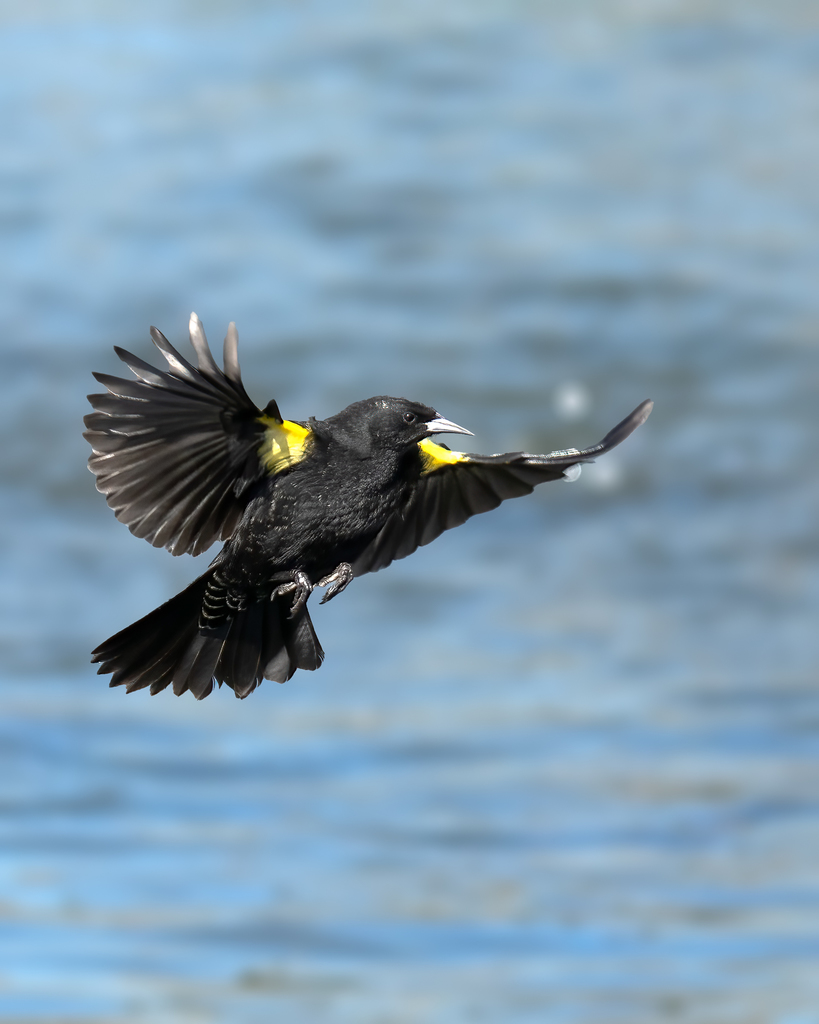
Male yellow-winged blackbirds average 17.9 cm (7.0 in) long. Males weigh an average of 33.5 g (1.2 oz) and females average about 29 g (1.0 oz). The species is sexually dimorphic. Adult males of the nominate subspecies are almost entirely black. Their marginal, lesser upperwing, and underwing coverts are yellow; the first two give the species its English name. Females have a dark brown crown, a wide buff supercilium, and dark brown ear coverts. The rest of their head and their upperparts are brown with wide dusky streaks and some chestnut edges on the lower scapulars and lower back. Their wing feathers are mostly dark brown with paler edges and some chestnut on the inner greater coverts; the marginal coverts have some yellow that is seldom visible. Their tail is blackish with narrow chestnut feather edges. Their underparts are light buff-brown with darker streaks except on the chin and upper throat. Both sexes have a brown iris, a black bill, and black legs and feet. Both sexes of subspecies A. t. petersii have the same plumage as the nominate but are smaller. A. t. alticola is larger than the nominate. Males are like the nominate. Females are darker with more streaking. They have a thin gray supercilium or none at all and more yellow on the upperwing coverts that sometimes is enough to form an epaulet like the male's.
Range & habitat
The yellow-winged blackbird has a disjunct distribution. Each subspecies is separate from the others and A. t. petersii has two populations. The subspecies are found thus:
A. t. alticola: from Cuzco and Puno departments in southwestern Peru south into western Bolivia's La Paz, Cochabamba, and Oruro departments A. t. thilius: Chile from the Atacama Region south to Los Lagos Region (but see below) A. t. petersii (main range): Brazil coastally from Paraná state south and in western Rio Grande do Sul, Uruguay, and Argentina east of the high Andes as far south as Chubut Province (but see below) A. t. petersii (small range): southeastern Chile's Aysén and Magallanes regions and southern Argentina's Santa Cruz Province Some sources include southwestern Argentina in the range of A. t. thilius. Several sources include Paraguay in the main range of A. t. petersii. However, others do not, and the South American Classification Committee places it in that country only as a vagrant. One source states that there are a few records of A. t. petersii in southern Bolivia but others do not include that country in the subspecies' range. The yellow-winged blackbird primarily inhabits marshes and other wetlands and their associated reed beds but also occurs in nearby grasslands and croplands. Subspecies A. t. alticola is found in the wetlands of Lake Titicaca and other Andean lakes. In elevation A. …
Wikipedia: “Distribution and habitat”
What it does
The yellow-winged blackbird feeds primarily on aquatic insects and seeds and also includes other invertebrates like spiders, crustaceans, and mollusks in its diet. It feeds mostly in marshes but also in nearby grass and cultivated fields. In one study it apparently fed only on insects but not seeds in a crop of grass. It forages in flocks.
Wikipedia: “Feeding”
Listen
Looking for field recordings…
Where it lives
Recorded sightings
—
geo-referenced records in GBIF, from museums, herbaria and field observers.
Drag the globe to turn it. Dots are where records exist, not a range map; darker means more records.
In the stacks
Searching the stacks…
Every page naming Agelasticus thilius in the Biodiversity Heritage Library →
This page is assembled live from iNaturalist, GBIF, Wikipedia, the Source Library and the Internet Archive. It is not yet part of the hand-edited codex. iNaturalist taxon 72472.