On eBird ↗
Antioquia Brushfinch
Live sightings near you, the range map, bar charts of when it is seen, and Macaulay Library photos and recordings.
Antioquia Brushfinch
Atlapetes blancae
The Antioquia brushfinch (Atlapetes blancae) is a poorly known species of bird from Colombia. It was scientifically described in 2007 on basis of three museum specimens from Antioquia, Colombia, which were previously mislabelled as slaty brushfinches (Atlapetus schistaceus). The specific epithet blancae refers to the whitish underparts of the new species, while also commemorating the Colombian lepidopterologist Blanca Huertas, the wife of ornithologist Thomas M. Donegan (who described the species). All three museum skins were collected in the 20th century, but only one label has a date, which is given as 1971. Despite recent research attempts, much of what is known of the species remains preliminary.
From the article Antioquia brushfinch on Wikipedia (CC BY-SA), quoted section by section
Description
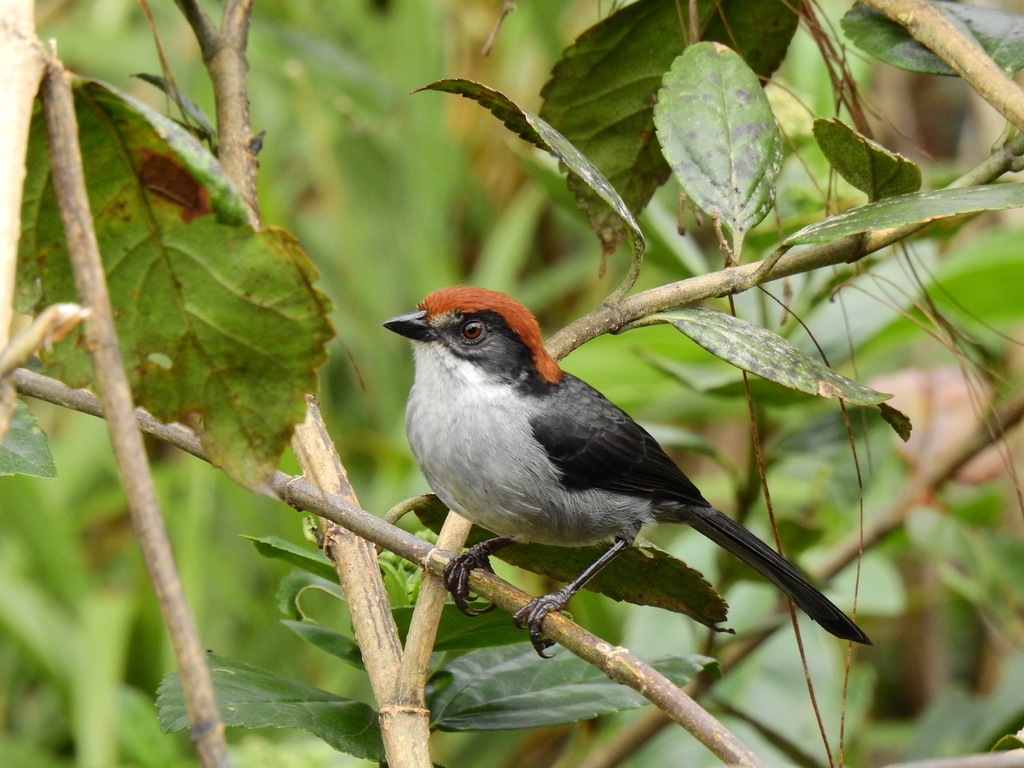
A. blancae is as a large finch with grey plumage; dark grey feathers on its back and tail, with whitish grey on its breast, stomach and throat. It has a reddish-brown crown, a black mask and a narrow pale line along the side of its face called a moustachial stripe. The bird has nine primaries, with some individuals also displaying a small white patch on their wing called a speculum. Individuals have been reported to weigh an average of 27.91 g (0.98 oz), have a wing length around 71.75 mm (2.82 in), and a tail length of 77.75 mm (3.06 in). Males have whiter chests and throats, more reddish crowns, and are generally larger than females. Specifically, males have larger wings and tails, as well as longer beaks. Compared to adults, juveniles have a browner back and underside, with a yellowish lower bill, a browner crown, and a greyer mask. They also have a larger, more lightly colored gape and are smaller than adults due to their shorter tail. The immature stage is a transitional period between juvenility and adulthood, and typically bears a more opaque version of the adult plumage.
Range & habitat
A. blancae is endemic to the Altiplano de Santa Rosa de Osos, a high elevation plateau in the department of Antioquia, Colombia. The bird has been found at altitudes of roughly 2400 to 2900 meters above sea level. Observation records suggest that the population is split into two disconnected areas; one group is in the north of the plateau, spanning the municipalities of Angostura, Santa Rosa de Osos, Belmira and Yarumal, while a smaller southern cluster lives in Bello and San Pedro de los Milagros. The species mainly inhabits disturbed or regenerating habitats consisting of low-growing trees, native shrubs, weedy grasses, and overgrown pasture-shrubland mixes. These habitats are often found on acidic, rocky soil, exposed to intense sunlight and fluctuating winds and temperature, as well as small wetland areas that form in depressions of the landscape. The birds also prefer when the shrubs and herbaceous vegetation are present but incompletely cover the terrain (25%-75% groundcover). The species is estimated to have a possible range of roughly 521 km2 to 789 km2. However, only a third of this area is made of suitable habitat, with as little as roughly 14 to 19 km2 representing unbroken and continuous territory. Indeed, the landscape is highly fragmented, mostly due to agricultural and pasture development. …
Wikipedia: “Habitat and Distribution”
What it does
The Antioquia brushfinch is an omnivore that feeds on a variety of fruits, seeds, nectar and insects. The birds were observed foraging for invertebrates by stripping both larval and adult insects off plants, as well as pecking in wood to find them. Fruits and seeds were collected from plants such as Berberis medellinensis, Weinmannia pubescens and Vaccinium meridionale. When feeding on nectar, the birds have been observed to tear the flowers off for better access to the nutrients.
Wikipedia: “Diet”
Listen
Looking for field recordings…
Where it lives
Recorded sightings
—
geo-referenced records in GBIF, from museums, herbaria and field observers.
Drag the globe to turn it. Dots are where records exist, not a range map; darker means more records.
In the stacks
Searching the stacks…
Every page naming Atlapetes blancae in the Biodiversity Heritage Library →
This page is assembled live from iNaturalist, GBIF, Wikipedia, the Source Library and the Internet Archive. It is not yet part of the hand-edited codex. iNaturalist taxon 72547.