On eBird ↗
Cuzco Brushfinch
Live sightings near you, the range map, bar charts of when it is seen, and Macaulay Library photos and recordings.
Cuzco Brushfinch
Atlapetes canigenis
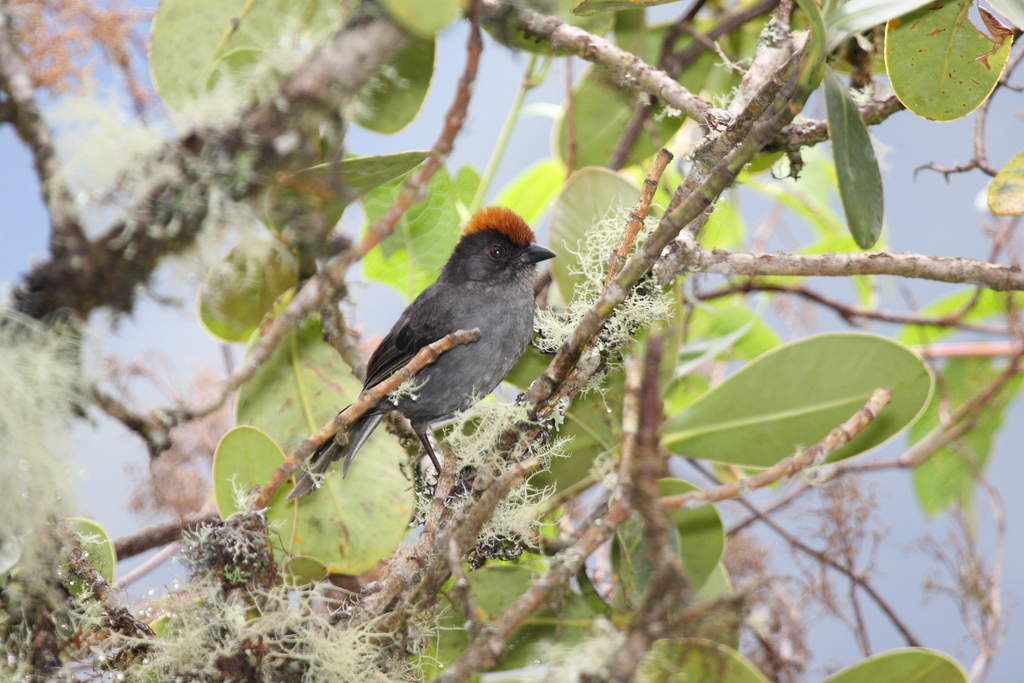
The Cuzco brush finch (Atlapetes canigenis), also known as the grey brush finch or sooty brush finch, is a species of bird in the Emberizidae family. It is endemic humid Andean forests in south-eastern Peru, where mainly found in Cuzco. It is sometimes considered a subspecies of the slaty brush finch.
From the article Cuzco brushfinch on Wikipedia (CC BY-SA), quoted section by section
Description
Brushfinches are typically medium-size sparrows, with long tails. Brushfinches are usually gray or olive in colour with a contrasting crown. Cuzco brushfinches are two-toned with a uniform dusky gray and a rufous crown. The center of the belly, as well as the other underparts, are lighter gray than the outside, which is dark gray and the rufous color extends to the nape. The crown is boarded by a black stripe extending from in front of the eyes until the gray auriculars. The tail and wings are blackish with the primaries margined slightly with a grayish external. There is a slight fulvous or tawny tint to the remiges most external parts. One important note is that the Cuzco brushfinch shows considerable variation with the intensity of gray in the underparts - some almost uniformly dark gray below and others that are pale gray with grayish-white abdomens. Males and females are extremely similar in colour, with the female being slightly smaller.
Measurements. Adults: Male: wing 76 mm (3.0 in), tail 78 mm, tarsus 27 mm (1.1 in), culmen 15.5 mm (0.61 in) Female: wing 72 mm (2.8 in), tail 72 mm, tarsus 25 mm, culmen 15 mm
Range & habitat
The Cuzco brushfinch is native to the Americas. More specifically it is an endemic of south-central Peru where it is found in montane areas of the Andes. The known elevation range for this brushfinch is approximately 2,300–3,600 m (7,550–11,810 ft) above sea level. They are mostly seen in the surrounding areas of Cusco.
Wikipedia: “Distribution”
What it does
Undocumented, but most likely it will eat a mixture of terrestrial invertebrates, seeds, and small fruits and berries. They have been seen to eat seeds from a tree. Similar species have been documented as a group to the sub-canopy type foragers.
Wikipedia: “Diet”
Listen
Looking for field recordings…
Where it lives
Recorded sightings
—
geo-referenced records in GBIF, from museums, herbaria and field observers.
Drag the globe to turn it. Dots are where records exist, not a range map; darker means more records.
In the stacks
Searching the stacks…
Every page naming Atlapetes canigenis in the Biodiversity Heritage Library →
This page is assembled live from iNaturalist, GBIF, Wikipedia, the Source Library and the Internet Archive. It is not yet part of the hand-edited codex. iNaturalist taxon 72548.