- Animals
- ›Chordates
- ›Vertebrates
- ›Birds
- ›Swifts and Hummingbirds
- ›Hummingbirds
- ›Mango Hummingbirds and Allies
- ›Avocettula
On eBird ↗
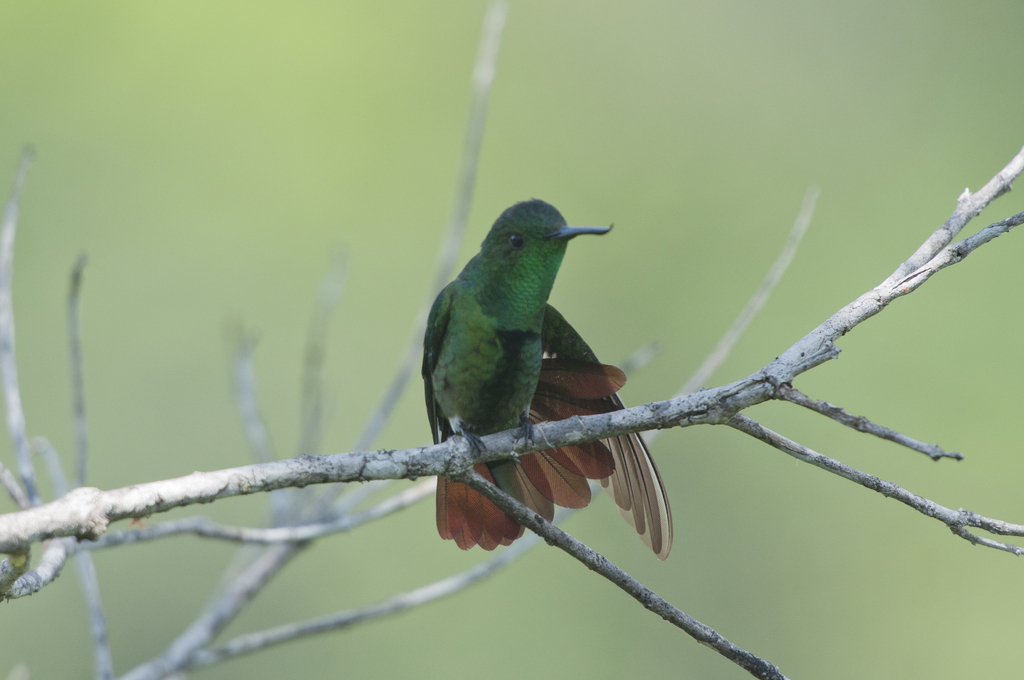
Fiery-tailed Awlbill
Live sightings near you, the range map, bar charts of when it is seen, and Macaulay Library photos and recordings.
Fiery-tailed Awlbill
Avocettula recurvirostris
The fiery-tailed awlbill (Avocettula recurvirostris) is a species of hummingbird in the subfamily Polytminae, the mangoes. It is found in Brazil, Ecuador, French Guiana, Guyana, Suriname, and Venezuela.
From the article Fiery-tailed awlbill on Wikipedia (CC BY-SA), quoted section by section
Description
The fiery-tailed awlbill is 8 to 10 cm (3.1 to 3.9 in) long and weighs about 4.3 g (0.15 oz). Its unique bill is short with a dramatically upturned tip. The adult male has green upperparts. Its throat is shiny emerald green and the belly shiny emerald green with a black center. The top of the tail is violet but for all-green central feathers. The adult female also has green upperparts. Its underparts are white with a black stripe down the middle. Its tail is bluish black and the outer feathers have white tips. Juveniles are similar to the adult female but the underside of the tail is coppery red.
Range & habitat
The fiery-tailed awlbill is found in Amazonia, from southeastern Venezuela east through the Guianas into northern Brazil and south into Brazil as far west as Acre and as far east as Maranhão and Tocantins. There is also a disjunct population along the Napo River in eastern Ecuador. The species has been recorded as a vagrant in Colombia. The fiery-tailed awlbill primarily inhabits open savanna-like areas in primary forest where it favors vegetation near granite outcrops. It can also be found at the edges of low vegetation near rivers, semi-deciduous forest, and cerrado.
Wikipedia: “Distribution and habitat”
What it does
The fiery-tailed awlbill is a "trap-line" feeder, visiting a circuit of flowering plants to collect nectar. It favors Clusia and Dioclea shrubs, and feeds both by inserting its bill into flowers and by piercing the base of flowers to "rob" nectar. It also catches arthropods on the wing and by gleaning from the underside of leaves.
Wikipedia: “Feeding”
Listen
Looking for field recordings…
Where it lives
Recorded sightings
—
geo-referenced records in GBIF, from museums, herbaria and field observers.
Drag the globe to turn it. Dots are where records exist, not a range map; darker means more records.
In the stacks
Searching the stacks…
Every page naming Avocettula recurvirostris in the Biodiversity Heritage Library →
This page is assembled live from iNaturalist, GBIF, Wikipedia, the Source Library and the Internet Archive. It is not yet part of the hand-edited codex. iNaturalist taxon 72556.