On eBird ↗
Rock Eagle-Owl
Live sightings near you, the range map, bar charts of when it is seen, and Macaulay Library photos and recordings.
Rock Eagle-Owl
Bubo bengalensis
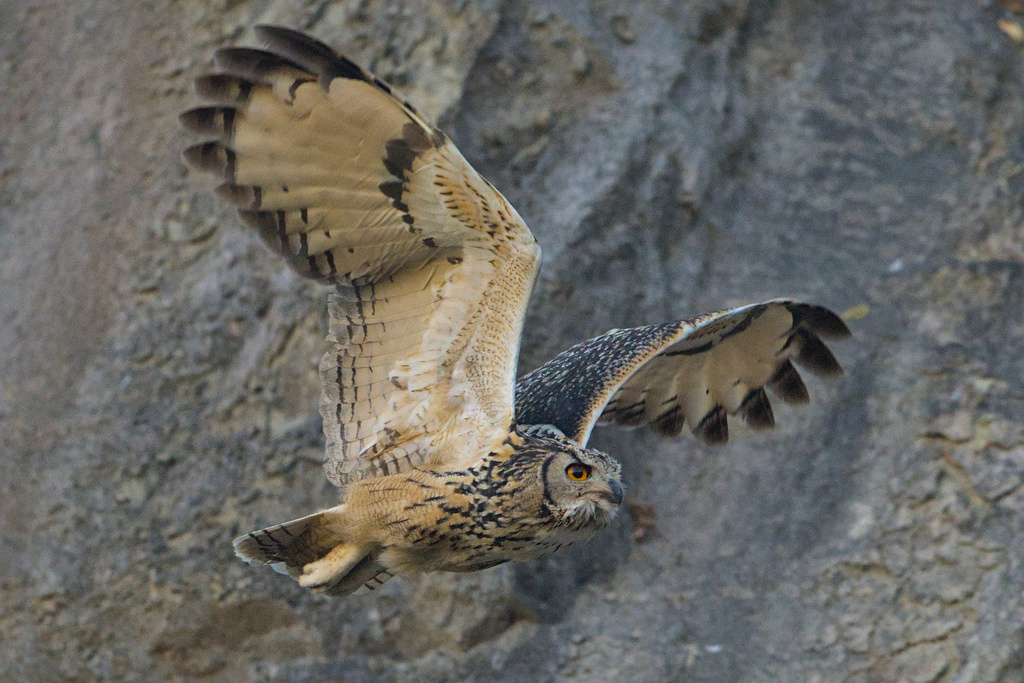
The Indian eagle-owl, also called the rock eagle-owl or Bengal eagle-owl (Bubo bengalensis), is a species of large horned owl restricted to the Indian Subcontinent. They were earlier treated as a subspecies of the Eurasian eagle-owl. They are found in hilly and rocky scrub forests, and are usually seen in pairs. They have a deep resonant booming call that may be heard at dawn and dusk. They are typically large owls, and have "tufts" on their...
From the article Indian eagle-owl on Wikipedia (CC BY-SA), quoted section by section
Description
This species is often considered a subspecies of the Eurasian eagle-owl Bubo bubo and is very similar in appearance. The facial disk is unmarked and has a black border, a feature that is much weaker in the Eurasian form. The base of the primaries is unbanded and rufous. The tail bands have the tawny bands wider than the black ones. Additionally, a large pale scapular patch is visible on the folded wing. The inner claws are the longest. The last joint of the toes are unfeathered. The taxonomy of the group is complex due to a large amount of variation. Dementiev was the first to consider the possibility of B. bengalensis being distinct within the Bubo bubo group. However, Charles Vaurie noted that this species as well as B. ascalaphus appeared to be distinct and not part of a clinal variation. There is a lot of colour variation with the ground colour being dark brown above while some are pale and yellowish. On dark birds the streaks coalesce on the hind crown and nape but are narrow in pale birds. However, Vaurie notes that despite the variation, they are distinct from neighbouring forms B. b. tibetanus, B. b. hemachalana and B. b. nikolskii, in being smaller and richly coloured. …
Range & habitat
They are seen in scrub and light to medium forests but are especially seen near rocky places within the mainland of the Indian Subcontinent south of the Himalayas and below 1,500 m (4,900 ft) elevation. Humid evergreen forest and extremely arid areas are avoided. Bush-covered rocky hillocks and ravines, and steep banks of rivers and streams are favourite haunts. It spends the day under the shelter of a bush or rocky projection, or in a large mango or similar thickly foliaged tree near villages.
Wikipedia: “Distribution”
What it does
The deep resonant two-note calls are characteristic and males deliver these "long calls" mainly at dusk during the breeding season. The peak calling intensity is noticed in February. Young birds produce clicks, hisses and open up their wings to appear larger than they are. Nesting adults will fly in zig-zag patterns and mob any potential predators (including humans) who approach the nest. Its diet through much of the year consists of rodents, but birds seem to be mainly taken towards winter. Prey species of birds include francolins, doves, Indian roller, shikra, black kite, house crow and the spotted owlet. Birds the size of a peafowl are sometimes attacked. Rodents noted in a study in Pondicherry were Tatera indica, Golunda ellioti, Rattus sp., Mus booduga and Bandicota bengalensis. Flying fox were also preyed on. In Pakistan, Nesokia indica is an important prey item in their diet. Mammals the size of an Indian hare (Lepus nigricollis) may be taken. In Pakistan, it has preyed on Lepus capensis and Eupetaurus cinereus. When feeding on rodents, it tears up the prey rather than swallowing it whole. Captives feed on about 61g of prey per day. The nesting season is November to April. The eggs number three or four and are creamy white, broad roundish ovals with a smooth texture. …
Wikipedia: “Behaviour and ecology”
In human culture
This large owl with the distinctive face, large forward-facing eyes, horns and deep resonant call is associated with a number of superstitions. Like many other large owls, these are considered birds of ill omen. Their deep haunting calls if delivered from atop a house are considered to forebode the death of an occupant. A number of rituals involving the capture and killing of these birds have been recorded. Salim Ali notes a wide range of superstitions related to them but notes two as being particularly widespread. One is that if the bird is starved for a few days and beaten, it would speak like a human, predicting the future of the tormentor or bringing them wealth while the other involves the killing of the bird to find a lucky bone that moved against the current like a snake when dropped into a stream.
Wikipedia: “In culture”
Listen
Looking for field recordings…
Where it lives
Recorded sightings
—
geo-referenced records in GBIF, from museums, herbaria and field observers.
Drag the globe to turn it. Dots are where records exist, not a range map; darker means more records.
In the stacks
Searching the stacks…
Every page naming Bubo bengalensis in the Biodiversity Heritage Library →
This page is assembled live from iNaturalist, GBIF, Wikipedia, the Source Library and the Internet Archive. It is not yet part of the hand-edited codex. iNaturalist taxon 72571.