On eBird ↗
Black-and-yellow Tanager
Live sightings near you, the range map, bar charts of when it is seen, and Macaulay Library photos and recordings.
Black-and-yellow Tanager
Chrysothlypis chrysomelas
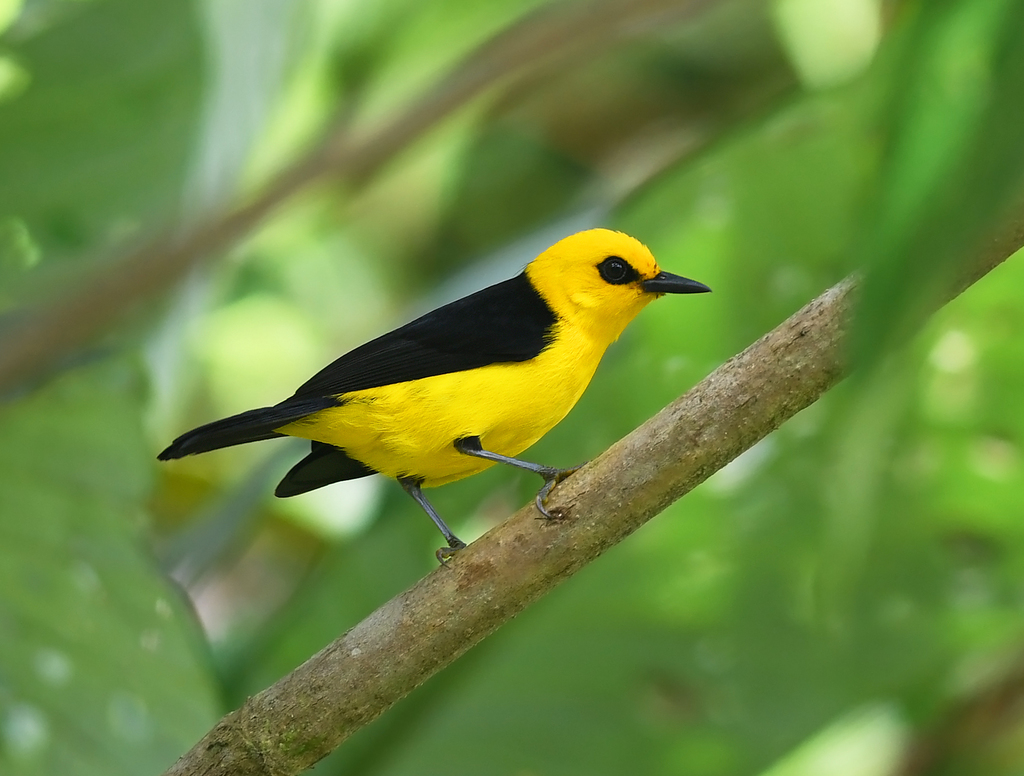
The black-and-yellow tanager (Chrysothlypis chrysomelas) is a fairly small passerine bird. This tanager is an endemic resident in the hills of Costa Rica and Panama. In Panama it has been recorded as far east as the border-region with Colombia, but it has not yet been recorded in the latter country, though it almost certainly occurs.
From the article Black-and-yellow tanager on Wikipedia (CC BY-SA), quoted section by section
Description
The black-and-yellow tanager is 12 cm (4.7 in) to 13 cm (5.1 in) long. It weighs 11 to 15 g (0.39 to 0.53 oz). It has a thin, sharply pointed bill and resembles a New World warbler. The species is sexually dimorphic. Adult males of the nominate subspecies are mostly bright yellow with a thin black ring around the eye and jet-black hindneck, mantle, upper back, wings, and tail. Adult females have a greenish olive head, upperparts, and tail. Their wings' flight feathers are dusky with greenish olive edges. Their throat and breast are yellow, their flanks and sides yellow with an olive-green tinge, their undertail coverts yellowish, and their underwing coverts white. Males of subspecies C. c. ocularis have partially black lores. Females are brighter overall than the nominate with more uniform greenish yellow underparts. Males of C. c. titanota are identical to the nominate. Females have mostly white underparts with a faint yellowish band across the breast and grayish flanks. In all subspecies immature males resemble adult females but with brighter underparts. Both sexes of all subspecies have a brown iris, a black bill, and blackish legs and feet.
Range & habitat
The black-and-yellow tanager has a patchy distribution. Subspecies C. c. titanota is the northernmost. It is found on the Caribbean slopes of Costa Rica's Cordillera Central and Cordillera de Talamanca from Alajuela Province to, and possibly slightly into, far western Panama. The nominate subspecies is found intermittently in Panama from western Chiriquí Province east to western Panamá Province. Subspecies C. c. ocularis is found on the Caribbean slope from Cerro Jefe in western Panamá Province and on the Pacific slope from far eastern Panamá Province south slightly into extreme northwestern Colombia on Cerro Tacarcuna. The black-and-yellow tanager primarily inhabits the canopy and edges of primary and mature secondary evergreen forest in the upper tropical and lower subtropical zones. It also occurs much less often in forest clearings that have tall trees. Sources differ on its elevational range. Two state it is 350 to 1,600 m (1,100 to 5,200 ft) while another says 500 to 1,250 m (1,600 to 4,100 ft). In Costa Rica it ranges between 400 to 1,200 m (1,300 to 3,900 ft).
Wikipedia: “Distribution”
What it does
The black-and-yellow tanager feeds on arthropods and fruit; Miconia berries apparently are an important part of its diet. It typically forages in pairs and groups of up to six individuals and frequently joins mixed-species feeding flocks. It takes arthropod prey by gleaning from leaves and branches (sometimes hanging upside down to do so), by probing clusters of dead leaves, in mid-air with a short flutter-flight, and by briefly hovering.
Wikipedia: “Feeding”
Listen
Looking for field recordings…
Where it lives
Recorded sightings
—
geo-referenced records in GBIF, from museums, herbaria and field observers.
Drag the globe to turn it. Dots are where records exist, not a range map; darker means more records.
In the stacks
Searching the stacks…
Every page naming Chrysothlypis chrysomelas in the Biodiversity Heritage Library →
This page is assembled live from iNaturalist, GBIF, Wikipedia, the Source Library and the Internet Archive. It is not yet part of the hand-edited codex. iNaturalist taxon 72672.