On eBird ↗
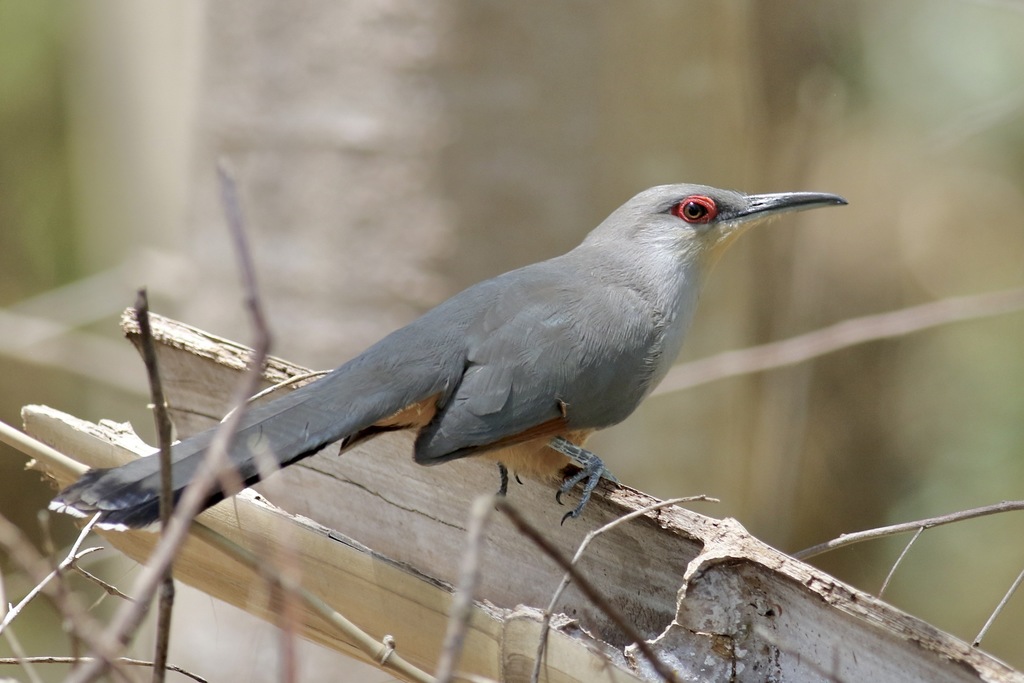
Hispaniolan Lizard-Cuckoo
Live sightings near you, the range map, bar charts of when it is seen, and Macaulay Library photos and recordings.
Hispaniolan Lizard-Cuckoo
Coccyzus longirostris
The Hispaniolan lizard cuckoo (Coccyzus longirostris) is a species of cuckoo in the family Cuculidae. It is found in Haiti and the Dominican Republic. Its natural habitats are subtropical or tropical dry forests and subtropical or tropical moist lowland forests.
From the article Hispaniolan lizard cuckoo on Wikipedia (CC BY-SA), quoted section by section
Description
The Hispaniolan lizard cuckoo is 41 to 46 cm (16 to 18 in) long, about half of which is the tail. Males weigh about 83 to 99 g (2.9 to 3.5 oz) and females about 92 to 128 g (3.2 to 4.5 oz). Both subspecies have a long straight bill with a black maxilla and a paler mandible. The sexes within a subspecies have the same plumage. Adults of the nominate subspecies have entirely gray upperparts. Their wings are chestnut with a rufous patch. Their throat is rufous, the breast pale gray, and the belly rufous. Their tail is black, and the underside of the feathers have large white tips. Their eye is surrounded by bare red skin. Juveniles have brownish gray upperparts, a whitish throat, and a narrower brown tail with buff tips. The subspecies C. l. petersi is paler overall than the nominate, and has a whitish throat.
Range & habitat
The nominate subspecies of Hispaniolan lizard cuckoo is found on the main island of Hispaniola and the offshore islands of Tortuga and Saona. C. l. petersi is found only on Gonâve Island off western Haiti. The species inhabits tropical deciduous and evergreen forests, more open woodland, thickets, mountain slopes with bushes, plantations, and gardens. In elevation, it ranges from sea level to 2,200 m (7,200 ft).
Wikipedia: “Distribution and habitat”
What it does
The Hispaniolan lizard cuckoo usually forages from the middle to upper levels of the forest, though it also hunts near the ground. It hunts by walking along and among branches. Its diet includes lizards, small snakes, and many types of adult and larval insects. It sometimes joins mixed-species feeding flocks.
Wikipedia: “Feeding”
Listen
Looking for field recordings…
Where it lives
Recorded sightings
—
geo-referenced records in GBIF, from museums, herbaria and field observers.
Drag the globe to turn it. Dots are where records exist, not a range map; darker means more records.
In the stacks
Searching the stacks…
Every page naming Coccyzus longirostris in the Biodiversity Heritage Library →
This page is assembled live from iNaturalist, GBIF, Wikipedia, the Source Library and the Internet Archive. It is not yet part of the hand-edited codex. iNaturalist taxon 72742.