On eBird ↗
Great Lizard-Cuckoo
Live sightings near you, the range map, bar charts of when it is seen, and Macaulay Library photos and recordings.
Great Lizard-Cuckoo
Coccyzus merlini
The great lizard cuckoo (Coccyzus merlini) is a species of cuckoo in the family Cuculidae. The species is also known as the Cuban lizard cuckoo. It is found in The Bahamas (on Andros, Eleuthera and New Providence) and Cuba.
From the article Great lizard cuckoo on Wikipedia (CC BY-SA), quoted section by section
Description
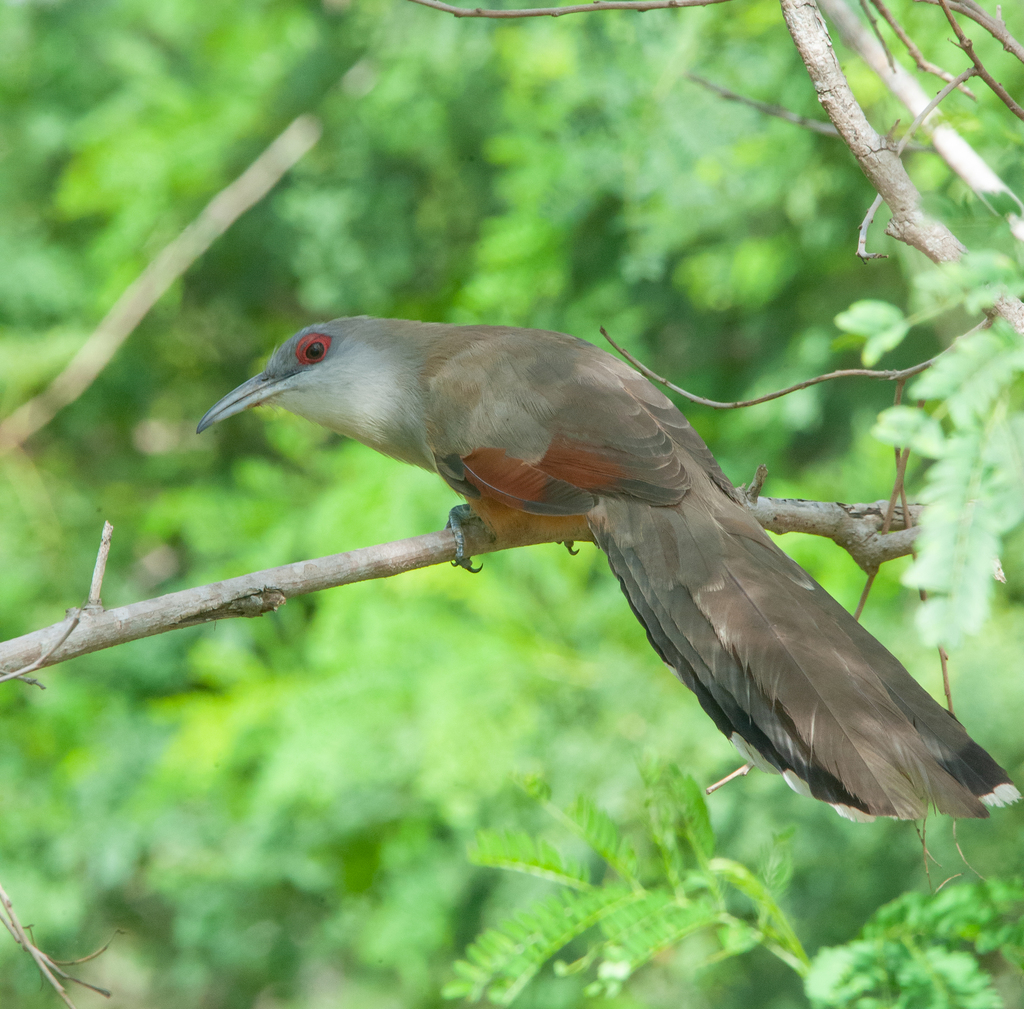
The great lizard cuckoo is the largest species in genus Coccyzus. It is 42 to 54 cm (17 to 21 in) long, about half of which is the tail, and weighs about 100 to 155 g (3.5 to 5.5 oz). Both sexes within each subspecies have the same plumage, but males are larger than females. The species' bill is long and almost straight, with a black or dusky maxilla and a paler mandible. Adults of the nominate subspecies C. m. merlini have an olive-brown crown, nape, and upperparts. Their primaries are rufous, but that color often only shows in flight. They have a whitish throat, pale gray cheeks and breast, and rufous belly and undertail coverts. Their tail's central pair of feathers are gray and the rest are gray with wide white tips and a black bar above the tip. Their eye is surrounded by red to orange bare skin. Juveniles have narrower tail feathers than adults, with faint white ends, and yellow skin around the eye. Subspecies C. m. santamariae is somewhat smaller and paler than the nominate and has a longer bill but is otherwise very similar. C. m. decolor has more grayish brown upperparts than the nominate and a shorter bill. Adults of C. m. bahamensis have some significant differences from the nominate. They are smaller, have grayer upperparts, a buff wash on the belly, and a black band near the end of all of the tail feathers. …
Range & habitat
The subspecies of great lizard cuckoo are distributed thus:
C. m. bahamensis, Andros, New Providence, Eleuthera, and Harbour islands in the Bahamas C. m. santamariae, many small islands off the north-central coast of Cuba's main island C. m. merlini, the main island of Cuba and Cayo Conuco and Cayo Saetía off its north coast C. m. decolor, Isla de la Juventud (Isle of Pines) The three Cuban subspecies of great lizard cuckoo inhabit a wide variety of landscapes including mature semi-deciduous and evergreen forest, secondary forest, savanna, scrublands, and the undergrowth of pine forest. In elevation they range from sea level to at least 1,250 m (4,100 ft). C. m. bahamensis is similarly non-selective, inhabiting semi-deciduous, deciduous, and pine forest (especially forests with many vines), scrublands, and coffee plantations.
Wikipedia: “Distribution and habitat”
What it does
The great lizard cuckoo is an opportunistic feeder; it forages mostly from the forest mid-story to the canopy, running along branches and gliding from tree to tree, but also spends significant time foraging on the ground, where it can run quickly if needed. No detailed studies of its diet have been made but, like many birds, its observed diet often fluctuates between insectivorous, omnivorous, and carnivorous; it is known to feed on lizards, adult (and larval) insects of many families, nestling birds, frogs, snakes, and sometimes small mammals and seeds or fruits.
Wikipedia: “Feeding”
Listen
Looking for field recordings…
Where it lives
Recorded sightings
—
geo-referenced records in GBIF, from museums, herbaria and field observers.
Drag the globe to turn it. Dots are where records exist, not a range map; darker means more records.
In the stacks
Searching the stacks…
Every page naming Coccyzus merlini in the Biodiversity Heritage Library →
This page is assembled live from iNaturalist, GBIF, Wikipedia, the Source Library and the Internet Archive. It is not yet part of the hand-edited codex. iNaturalist taxon 72743.