On eBird ↗
Black-throated Tit
Live sightings near you, the range map, bar charts of when it is seen, and Macaulay Library photos and recordings.
Black-throated Tit
Aegithalos concinnus
In older sources, "black-throated tit" can also mean the rufous-naped tit or the rufous-vented tit, which are true tits.
The black-throated bushtit (Aegithalos concinnus), also known as the black-throated tit, is a very small passerine bird in the family Aegithalidae.
From the article Black-throated bushtit on Wikipedia (CC BY-SA), quoted section by section
Description
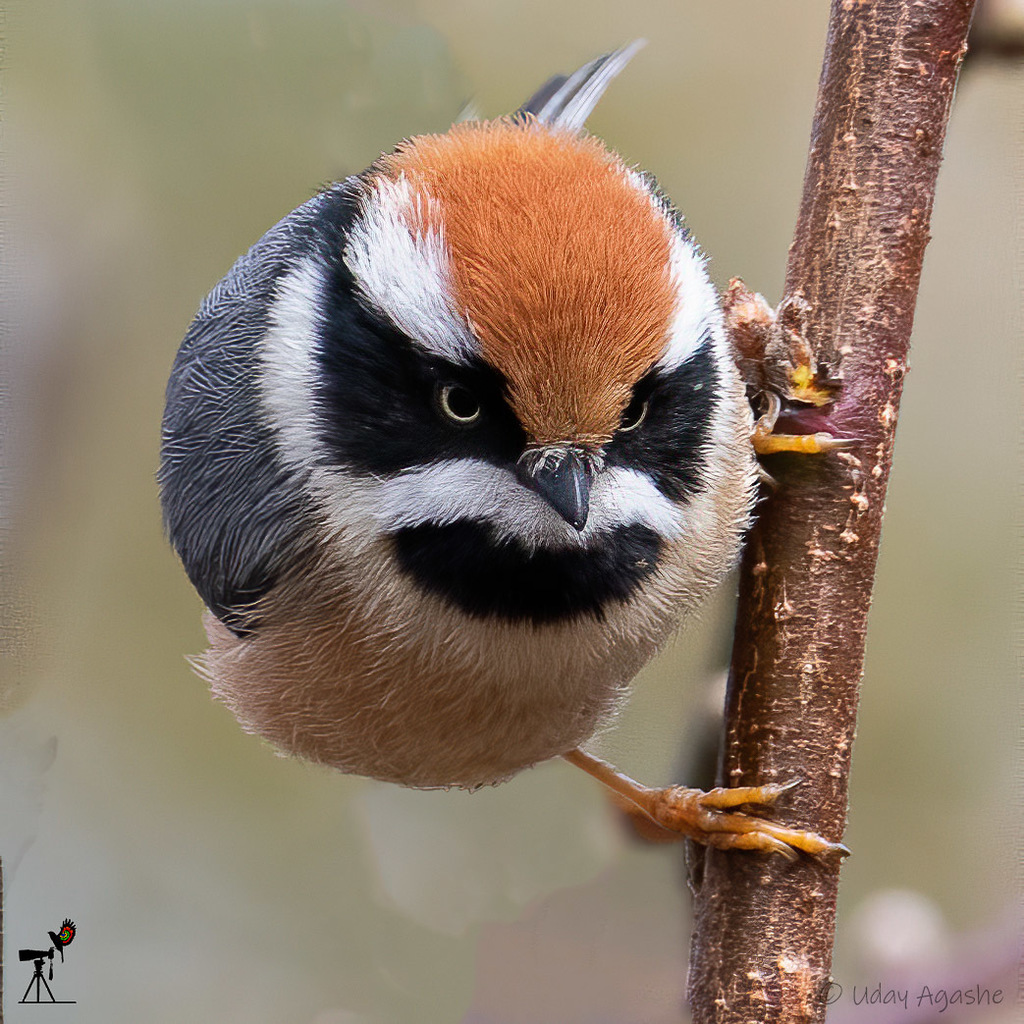
The black-throated bushtit is a small passerine, around 10.5 cm (4.1 in) long and weighing 4–9 g (0.14–0.32 oz). There is considerable racial variation in the plumage, but all subspecies have a medium length tail (as opposed to the long tail of the related long-tailed tit), a black throat and a black 'bandit mask' around the eye. The nominate race has a chestnut cap, breast band and flanks and dark grey back, wings and tail, and a white belly. The other subspecies have generally the same pattern (minus the chest band) but with grey caps or all grey bellies and flanks. Both sexes are alike.
Range & habitat
It ranges from the foothills of the Himalayas, stretching across northern India through north-eastern Bangladesh, Nepal, Bhutan, northern Myanmar, Vietnam, and Taiwan. Disjunct populations also occur in southern Vietnam and eastern Cambodia, on the island of Hainan and further north in China up to the Yellow River. It lives in open broadleaf forest as well as pine forest, generally occurring in middle altitudes.
Wikipedia: “Distribution and habitat”
What it does
The black-throated bushtit is highly social and will travel in large flocks of up to 40 birds.
Breeding. The nest is constructed out of moss and lichen and hangs from the branches of trees.
Feeding. The species feeds on small insects and spiders, as well as small seeds, fruits and berries (particularly raspberries). Group numbers swell during the non-breeding season, but smaller groups exist year round. These groups will often join mixed-species feeding flocks.
Wikipedia: “Behaviour”
Listen
Looking for field recordings…
Where it lives
Recorded sightings
—
geo-referenced records in GBIF, from museums, herbaria and field observers.
Drag the globe to turn it. Dots are where records exist, not a range map; darker means more records.
In the stacks
Searching the stacks…
Every page naming Aegithalos concinnus in the Biodiversity Heritage Library →
This page is assembled live from iNaturalist, GBIF, Wikipedia, the Source Library and the Internet Archive. It is not yet part of the hand-edited codex. iNaturalist taxon 7277.