On eBird ↗
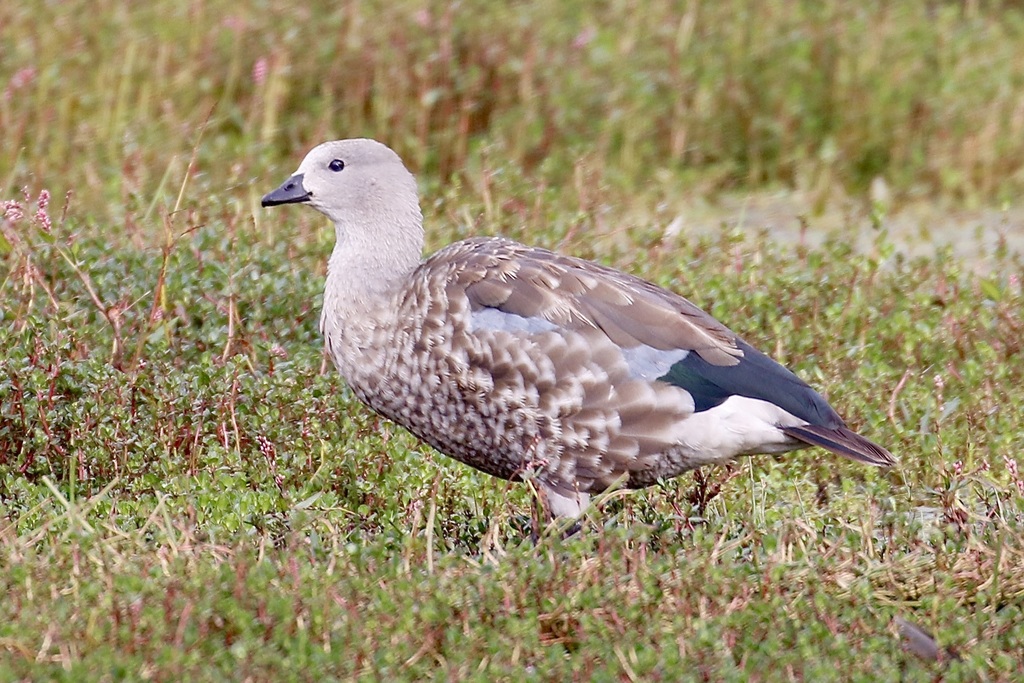
Blue-winged Goose
Live sightings near you, the range map, bar charts of when it is seen, and Macaulay Library photos and recordings.
Blue-winged Goose
Cyanochen cyanoptera
The blue-winged goose (Cyanochen cyanoptera) is a waterfowl species which is endemic to Ethiopia. It is the only member of the genus Cyanochen.
From the article Blue-winged goose on Wikipedia (CC BY-SA), quoted section by section
Description
It is a stocky grey-brown goose-like bird about 60–75 centimetres (24–30 in) long with a slightly paler head and upper neck. It has a small black bill and black legs. Standing birds look fairly dull, grey and dirty white, sometimes showing the blue along the edge of the wing. The sexes are similar, but immature birds are duller. The plumage is thick and loose, an adaptation to the cold of the Ethiopian highlands. In flight, the pale blue upper forewing is conspicuous; the primary feathers are black, and the secondary feathers black glossed green. The underwing has black primaries and secondaris, and a white inner forewing.
Voice. The blue-winged goose is a quiet species, but both sexes may give a high-pitched whistle; it does not honk or cackle like the true geese, but may make a barking alarm call when flushed.
Range & habitat
Its preferred habitat is grasslands close to rivers, freshwater lakes, swamps, freshwater marshes, water storage areas, in high altitude subtropical or tropical shrubland or grassland at 2,500–4,000 m altitude.
Wikipedia: “Habitat”
What it does
It feeds by grazing, and is apparently largely nocturnal, loafing during the day. It can swim and fly well, but this terrestrial bird is reluctant to do either, and is quite approachable. It forms flocks of up to 100 outside the breeding season. It breeds by mountain lakes and streams. The nests of wild birds have not been described; in captivity, it builds a lined nest amongst grass tussocks, and lays 6–7 eggs.
Wikipedia: “Behaviour”
Listen
Looking for field recordings…
Where it lives
Recorded sightings
—
geo-referenced records in GBIF, from museums, herbaria and field observers.
Drag the globe to turn it. Dots are where records exist, not a range map; darker means more records.
In the stacks
Searching the stacks…
Every page naming Cyanochen cyanoptera in the Biodiversity Heritage Library →
This page is assembled live from iNaturalist, GBIF, Wikipedia, the Source Library and the Internet Archive. It is not yet part of the hand-edited codex. iNaturalist taxon 72775.