On eBird ↗
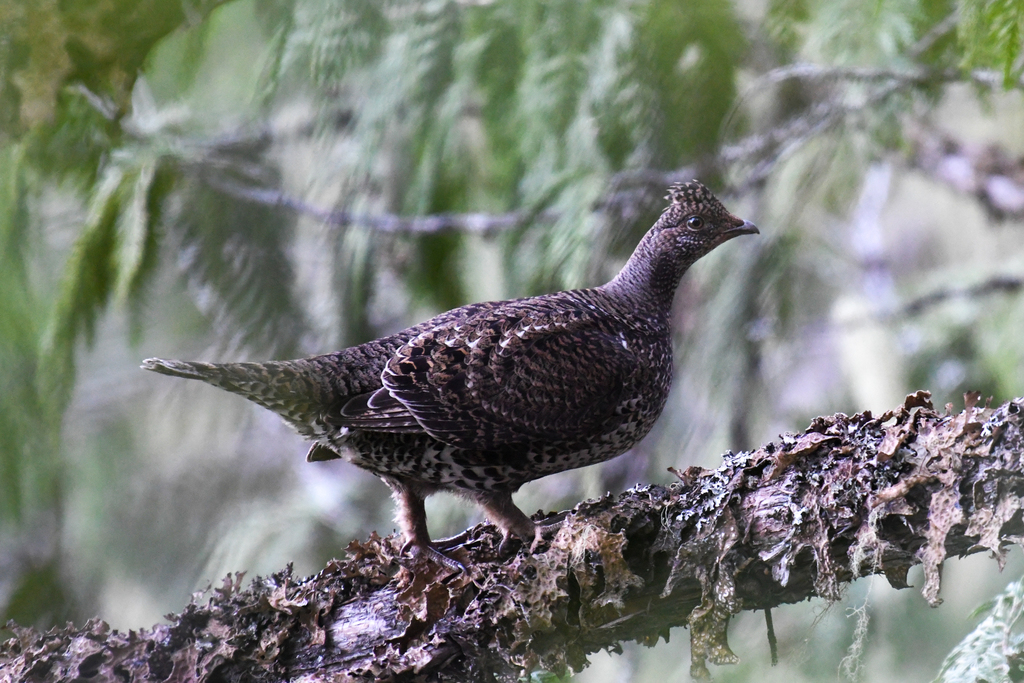
Sooty Grouse
Live sightings near you, the range map, bar charts of when it is seen, and Macaulay Library photos and recordings.
Sooty Grouse
Dendragapus fuliginosus
The sooty grouse (Dendragapus fuliginosus) is a species of forest-dwelling grouse native to North America's Pacific Coast Ranges. It is closely related to the dusky grouse (Dendragapus obscurus), and the two were previously considered a single species, the blue grouse.
From the article Sooty grouse on Wikipedia (CC BY-SA), quoted section by section
Description
Adults have a long square tail, light gray at the end. Adult males are mainly dark with a yellow throat air sac surrounded by white, and a yellow wattle over the eye during display. Adult females are mottled brown with dark brown and white marks on the underparts. Females have longer skinnier necks than males. The males have stouter bodies than the females. The bird averages 40–50 cm (16–20 in) in length and weighs 750–1,300 g (1.65–2.87 lb).
Range & habitat
Their breeding habitat is the edges of conifer and mixed forests in mountainous regions of western North America, from southeastern Alaska and Yukon south to California. Their range is closely associated with that of various conifers. They thrive in old forests because they need diverse plants and trees. Regenerated logged or burned areas also attract the sooty grouse if there are many bushes and shrubs for nesting. The nest is a scrape on the ground concealed under a shrub or log. Grouse mountain, a mountain that acts as the peak of Vancouver, Canada gets its name from the infamous blue grouse that lives on the mountain. The first hikers that reached the top of the mountain hunted the birds so they honored them by naming the mountain after them. This name is also attributed to the large population of the sooty grouse found on the mountain.
Wikipedia: “Distribution and habitat”
What it does
These birds forage on the ground, or in trees in winter. In winter, they mainly eat fir and douglas-fir needles, occasionally also hemlock and pine needles; in summer, other green plants (Pteridium, Salix), berries (Gaultheria, Mahonia, Rubus, Vaccinium), and insects (particularly ants, beetles, grasshoppers) are more important. In winter, they are capable of surviving on fir needles alone. In Spring, they enjoy a diet that consists more of berries, leaves, and flowers. Chicks are almost entirely dependent on insect food for their first ten days. Like many birds, the sooty grouse eat grit and tiny stones. This helps them grind up food in the gizzard.
Wikipedia: “Diet”
Listen
Looking for field recordings…
Where it lives
Recorded sightings
—
geo-referenced records in GBIF, from museums, herbaria and field observers.
Drag the globe to turn it. Dots are where records exist, not a range map; darker means more records.
In the stacks
Searching the stacks…
Every page naming Dendragapus fuliginosus in the Biodiversity Heritage Library →
This page is assembled live from iNaturalist, GBIF, Wikipedia, the Source Library and the Internet Archive. It is not yet part of the hand-edited codex. iNaturalist taxon 72797.